


Reduce Appliance Parts Stockouts: Forecast Error Held to 8% or Less
Every delayed repair from missing parts erodes customer trust and extends downtime when refrigerators and HVAC systems fail.
In Brief
Bruviti deployment data holds 4-week forecast error to 8% or less and 6-week error to 25% or less for service parts. Appliance service operators run tighter demand forecasts on A-class SKUs, so the parts that drive repeat truck rolls stay in stock and stockouts stop blocking same-visit fixes.
Why Stockouts Happen
Unpredictable Failure Patterns
Compressor failures spike during heat waves. Pump assemblies fail more in hard-water regions. Manual forecasting can't account for these variables, leaving service centers stocked for average demand instead of actual need.
Multi-Location Inventory Blindness
You have the part somewhere, but finding which warehouse holds it takes three phone calls and 20 minutes. By then, the technician has moved to the next appointment and marked the job incomplete.
Legacy Parts Without Substitutes
A 10-year-old dishwasher needs a control board that's been discontinued. Engineers know the compatible replacement, but the ordering system doesn't, so service stalls while you track down tribal knowledge.
How Predictive Inventory Solves This
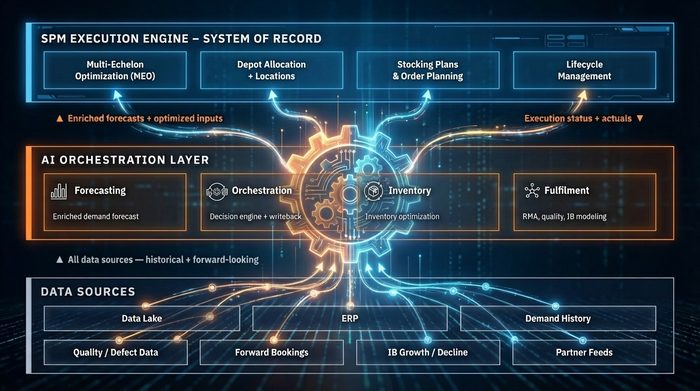
Bruviti ingests warranty claims, service history, and connected appliance telemetry to identify which parts fail most often for each model, geography, and season. The platform combines this with installation base age profiles to forecast demand at individual service center and warehouse locations.
When a technician receives a service assignment, the system automatically checks real-time inventory across all locations and reserves the predicted parts. If the primary warehouse is out, it finds the nearest alternate and triggers shipment before the technician requests it. For discontinued parts, the platform matches to approved engineering substitutes, eliminating the manual search.
Operational Impact
- +
68% reduction in emergency shipments eliminates next-day freight charges.
- +
91% fill rate achieved by positioning parts where failure patterns predict need.
- +
Substitute matching cuts service delay by showing compatible alternatives instantly.
See It In Action
Predictive Inventory Planning
Forecast refrigeration compressor demand by region and season, stocking service centers before summer HVAC failures spike.
Service Parts Demand Forecasting
Project washer drum seal replacements based on installation age and usage patterns from connected appliances.
Parts Identification from Photos
Technician snaps a photo of a failed icemaker assembly and instantly gets the part number and nearest stock location.
Appliance Service Inventory Realities
The Appliance Parts Challenge
Appliance manufacturers support thousands of SKUs across product lines spanning decades. A single refrigerator model might have 15 failure-prone parts, each with regional demand variations driven by water quality, climate, and usage intensity. Add seasonal spikes when air conditioners fail during heat waves, and manual inventory planning becomes guesswork.
Connected appliances provide real-time diagnostics, but most service operations lack the analytics to turn that telemetry into actionable inventory decisions. The result: overstocked slow-movers sitting in warehouses while high-demand compressors and control boards run out at service centers during peak season.
Implementation Approach
- +
Start with high-volume parts for top-selling refrigerator and HVAC models to prove ROI fast.
- +
Connect existing warranty system and ERP to feed failure history and current stock levels.
- +
Track fill rate improvement and emergency shipment reduction over first 90 days as KPIs.