


Stop Stockouts From Delaying Critical Server Repairs: 95-98% Fill Rate
Every hour of downtime costs hyperscale operators millions while the needed memory module sits in the wrong facility.
In Brief
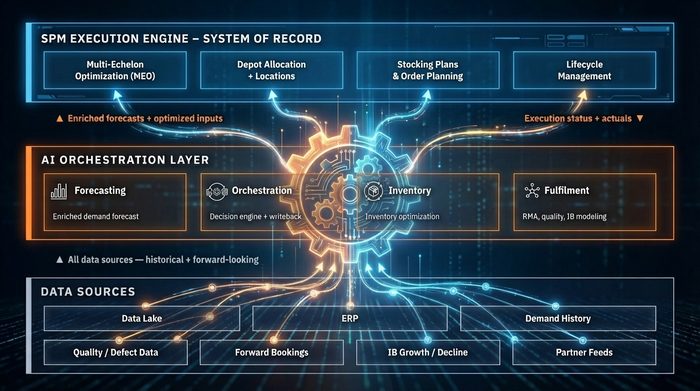
Bruviti deployment data shows a 95-98%+ fill rate with 40% fewer stockouts, so critical server repairs are not held up waiting on parts. The system forecasts demand per location and keeps the right SKUs stocked ahead of failures. Deployment data ties the fill rate to continuous AI demand sensing across the install base.
Why Parts Aren't Where You Need Them
Blind Forecasting
Manual forecasts ignore hardware telemetry and BMC logs that predict failures. You order based on last year's usage while equipment age and workload patterns shift demand.
Wrong-Location Stock
Critical components sit in regional warehouses while urgent repairs wait for overnight shipment. No visibility into which data centers need which parts next week.
Substitute Part Guesswork
When the exact part number is out of stock, finding compatible alternatives requires tribal knowledge and manual lookups that delay resolution.
Predict Failures Before They Create Stockouts
The platform analyzes IPMI telemetry, BMC logs, and hardware age across your data center fleet to forecast which components will fail at which locations. It spots early warning signs like temperature drift in memory modules or increasing disk error rates, then calculates part demand by facility and time window.
You see predicted needs two weeks out with recommended stock positions. When an urgent repair comes in, the system instantly suggests compatible substitute parts if the exact SKU isn't available, checking compatibility against configuration databases and previous successful replacements. No more guessing which memory module fits which server generation.
Instant Impact
See It In Action
Predictive Inventory Planning
Forecast server component demand by analyzing BMC telemetry and failure patterns across hyperscale facilities to position stock strategically.
Service Parts Demand Forecasting
Project cooling system and power supply needs based on equipment age, PUE trends, and seasonal workload patterns.
Parts Identification from Photos
Snap a photo of a failed component and instantly get part number identification with substitute options for immediate ordering.
Data Center Parts Management
Scale-Specific Challenges
Managing parts for hundreds of thousands of servers across geographically distributed facilities creates visibility gaps. A memory module shortage at one data center coexists with excess stock 200 miles away because inventory systems don't communicate and forecasts ignore telemetry showing early failure indicators.
Hardware diversity compounds the problem. Multiple server generations, CPU architectures, and vendor configurations mean substitute parts require precise compatibility matching. BMC and IPMI logs contain predictive signals about impending failures, but manual processes can't analyze this volume of data to forecast demand accurately.
Implementation Path
- +
Start with high-failure components like memory and storage drives to prove ROI within 60 days.
- +
Connect BMC telemetry feeds and inventory systems to enable predictive positioning across facilities.
- +
Track stockout reduction and emergency shipment rate monthly to quantify operational improvements.