


Platform Architecture
Bruviti’s AI Operating Layer is built on a four-tier hierarchical component model with event-driven communication, AI-driven routing, and a self-contained deployment architecture designed for on-premise and air-gapped environments.
System Overview
The platform provides a complete agent framework for building, deploying, and operating AI-driven workflows in enterprise service environments. It is structured around four architectural principles:
- +
Hierarchical composition — business processes decompose into agents, workflows, tasks, and tools, each layer building on the one below.
- +
Event-driven communication — all components communicate through an asynchronous event bus, enabling parallel execution and loose coupling.
- +
AI-driven routing — an intelligent orchestration engine analyzes business context and routes requests to the optimal agent or workflow.
- +
Self-contained deployment — every component, model, and data asset deploys within the enterprise perimeter with no external dependencies.
Component Architecture
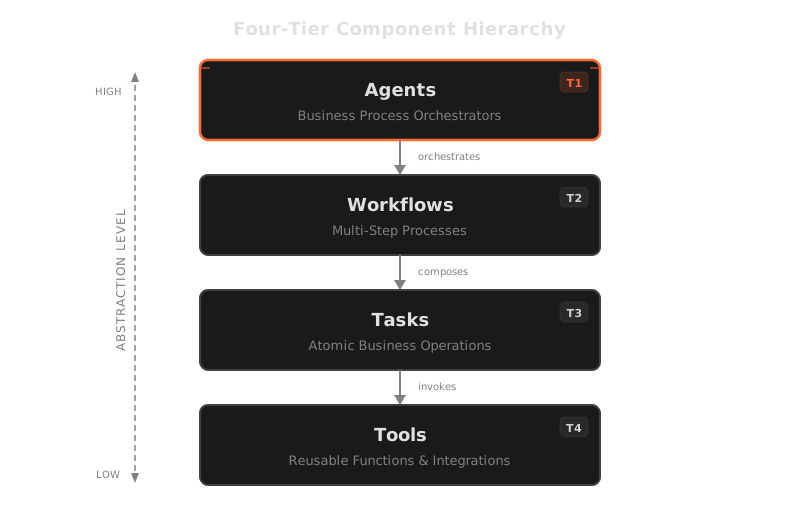
The framework follows a four-tier hierarchy that mirrors how businesses organize their operations. Each tier has a distinct responsibility and well-defined interfaces to the tiers above and below it.
Agents
Agents are the top-level orchestrators. Each agent owns an entire business process — for example, an Order Management Agent or a Customer Service Agent. Agents receive business events, determine which workflows to invoke, coordinate parallel execution paths, and aggregate results into a unified business outcome.
Workflows
Workflows coordinate multi-step procedures within an agent's scope. A single workflow handles a coherent sequence of operations — for example, a Payment Processing Workflow or a Diagnostic Triage Workflow. Workflows manage step sequencing, branching logic, error handling, and state transitions between tasks.
Tasks
Tasks perform specific, atomic operations. Each task does one thing: validate a credit card, classify a support ticket, extract entities from a document. Tasks are stateless and reusable — the same Validate Address task can be used by order processing, shipping, and customer onboarding workflows.
Tools
Tools are the lowest-level building blocks: database connectors, API integrations, file processors, data transformers, and pre-trained ML models. Tools provide reusable functions that tasks invoke. The platform ships with a pre-built component library of common tools, and custom tools can be developed and registered.
Each layer builds upon the one below. Agents compose workflows, workflows compose tasks, tasks invoke tools. This separation means individual components can be developed, tested, versioned, and reused independently. A task written for one workflow can be reused by any other workflow without modification.
Event-Driven Communication
All inter-component communication uses an asynchronous event bus. When a business event occurs — a new service request, an equipment alert, a parts order — the event bus distributes it to all subscribed agents simultaneously.
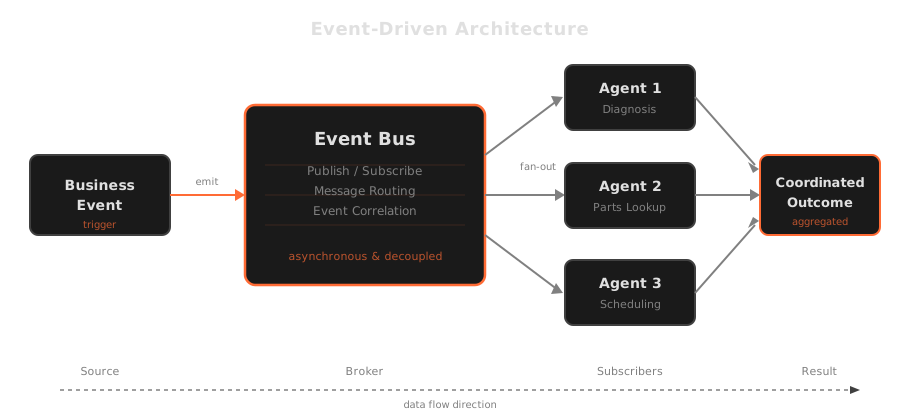
The event-driven model provides four architectural properties:
| Property | Description |
|---|---|
| Real-time processing | Events trigger immediate agent response — no polling, no batch windows |
| Parallel execution | Multiple agents process the same event concurrently (e.g., inventory check, payment, notification run in parallel on a new order) |
| Loose coupling | Agents subscribe to events they care about and ignore the rest. Adding or removing agents does not require changes to other components. |
| Independent scaling | Each agent scales based on its own event load. A high-volume notification agent can scale independently of a low-volume compliance agent. |
The event bus also provides state management and persistence. Event history is retained, enabling replay for debugging, audit trail generation, and recovery from failures.
Intelligent Routing
The platform includes an AI-driven orchestration engine that sits between incoming business context and the agent pool. Rather than relying on static routing rules, the engine uses language models to analyze the current situation and determine the optimal processing path.
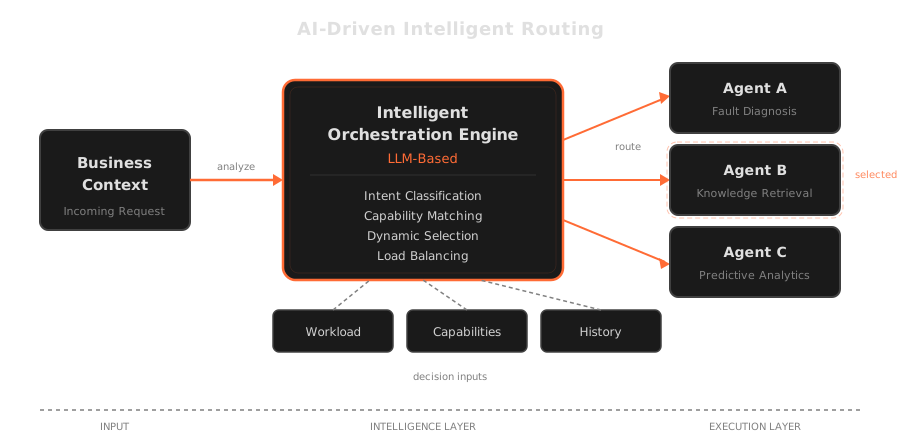
The routing engine provides four capabilities:
- +
Intelligent routing — determines optimal agent(s) for each request based on context analysis, considering workload, agent capabilities, and historical performance.
- +
Natural language understanding — processes unstructured inputs (emails, chat messages, voice transcripts) and extracts actionable intent without requiring structured input formats.
- +
Predictive analytics — anticipates downstream requirements based on the current context. For example, a parts inquiry about a specific equipment model may pre-fetch relevant service history and part availability data.
- +
Continuous learning — routing decisions improve over time through machine learning feedback loops. The system tracks which routing decisions led to successful outcomes and adjusts.
Platform Components
The platform ships four core component groups. All components deploy within the enterprise perimeter — no external service dependencies.
Core Framework
The foundation layer providing event-driven messaging infrastructure, state management and persistence, component lifecycle management, and security and access control. The core framework handles all inter-component communication and ensures reliable message delivery even under load.
Code Generation Engine
An on-premise code generation system that produces agent, workflow, and task implementations from requirements specifications. The engine generates implementation code, test suites, evaluation harnesses, and documentation. It enforces platform conventions and best practices through generated code, reducing the surface area for integration errors.
Pre-Built Component Library
An extensible library of ready-to-deploy components organized by function:
- +
Business agents — customer service, order processing, reporting, and diagnostic agents
- +
Integration tools — database connectors, API integrations, file processors for structured and unstructured data
- +
Utility functions — data transformation, validation, calculations, and formatting
- +
AI/ML models — pre-trained vision models, predictive models, forecasting models, and NLP models deployable on-premise
Development Tools
A toolset for building and operating platform solutions: workflow designer for composing multi-step processes, component discovery and reuse interface, testing and evaluation framework with automated regression, and performance monitoring dashboards for production workloads.
Every component — the core framework, the evaluation engine, the code generation system, the component library, and the development tools — deploys within the enterprise perimeter. No data leaves. No external API calls are required for operation. Models train on your data inside your infrastructure and generate code that stays in your environment.