


Set Up AI Parts Inventory for Industrial Equipment: 85% Auto-Extraction Accuracy
Decades-long equipment lifecycles mean your parts forecasting must integrate with legacy systems without creating new technical debt.
In Brief
Bruviti deployment data shows AI-driven parts inventory hits 85% auto-extraction accuracy and answers any parts search query in under 30 seconds. For industrial equipment OEMs, that means catalog and SKU data builds itself from manuals and drawings, so technicians find the right part instantly instead of digging through PDFs.
Implementation Challenges for Industrial OEMs
Legacy System Integration Complexity
Connecting AI forecasting to decades-old ERP systems requires custom data pipelines for each equipment generation. Engineering teams waste months building one-off connectors instead of delivering value.
Vendor Lock-In Risk
Black-box forecasting platforms trap inventory data and prediction logic in proprietary systems. When the model fails for low-volume parts or seasonal demand, you cannot retrain or customize the algorithm.
Model Maintenance Burden
Training foundation models from scratch demands scarce ML engineering talent and compute resources. Parts prediction accuracy degrades as equipment ages unless models continuously retrain on new failure patterns.
Headless Architecture with Standard Interfaces
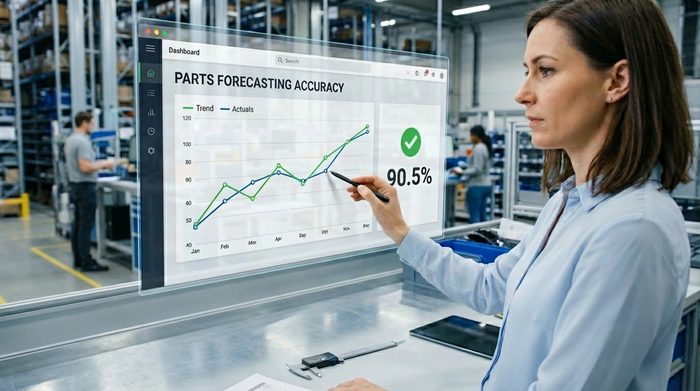
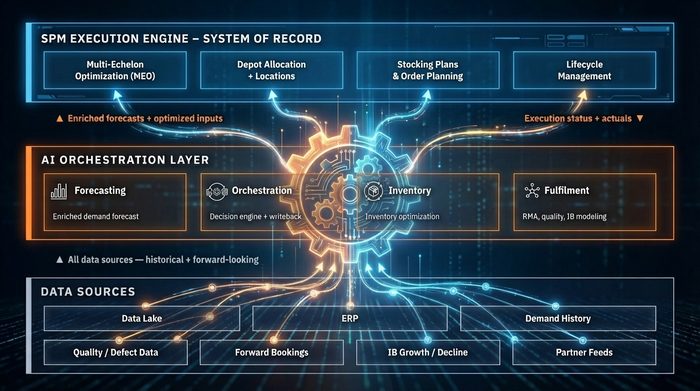
Bruviti provides Python and TypeScript SDKs that expose parts demand forecasting as standard REST APIs. Your engineering team writes integration code once using familiar languages, then deploys prediction endpoints that connect to existing SAP MM, Oracle E-Business Suite, or custom inventory systems. The platform ingests sensor telemetry from PLCs and SCADA systems alongside service history from legacy databases, training forecasting models without requiring you to migrate data warehouses.
The headless design lets you customize prediction logic for specific equipment families while the platform manages model training infrastructure, feature engineering pipelines, and retraining schedules. When forecast accuracy drops for low-volume parts or seasonal demand shifts, your team adjusts hyperparameters or feature sets through version-controlled configuration files. Data stays in your cloud environment with role-based access controls you define, not locked in a vendor's proprietary storage layer.
Technical Implementation Benefits
- +
Deploy production forecasts in 6-8 weeks using pre-built SAP and Oracle connectors, not custom integration projects.
- +
Reduce carrying costs 18-25% by training models on equipment-specific failure patterns and usage telemetry.
- +
Maintain forecast accuracy over 10+ year lifecycles through automated retraining on new service data.
See It In Action
Service Parts Demand Forecasting
Train prediction models on decades of installed base telemetry and service records for CNC machines, pumps, and turbines to forecast consumption by equipment age and run hours.
Predictive Inventory Planning
Use REST APIs to pull location-specific demand forecasts into your warehouse management system, optimizing stock levels across global service networks for heavy machinery.
Parts Identification from Photos
Integrate image recognition APIs that identify worn components from field photos, returning part numbers and availability to speed quoting for industrial equipment repairs.
Industrial Equipment Implementation
Technical Architecture for Long-Lifecycle Equipment
Industrial OEMs support equipment spanning decades, meaning your forecasting system must ingest telemetry from modern IoT sensors on new CNC machines alongside CSV exports from legacy SCADA systems on 20-year-old turbines. The platform's data connectors normalize PLC tags, vibration sensor streams, and historian databases into a unified feature set for model training. When equipment generations use different part numbering schemes, the SDK's mapping layer translates historical service records into consistent training data without requiring master data migration projects.
For high-value capital equipment like power generation systems or industrial robots, forecast models train on equipment-specific usage patterns—run hours, load cycles, environmental conditions—rather than generic failure curves. Python notebooks let your data engineers experiment with custom features like seasonal maintenance windows or geographic deployment patterns, then promote validated models to production through the platform's CI/CD pipeline. As equipment ages and new failure modes emerge, automated retraining keeps forecast accuracy stable across the entire installed base lifecycle.
Implementation Roadmap
- +
Pilot on one high-volume equipment line with existing SAP integration, proving ROI before broader rollout.
- +
Connect PLC telemetry and service history feeds to train models on actual failure patterns and consumption.
- +
Track forecast accuracy versus carrying costs over 6 months to validate model performance before full deployment.