


AI Parts Forecasting for Network Equipment: 85% Auto-Extraction Accuracy at Setup
Network downtime costs millions per hour. Your inventory system needs telemetry-driven forecasting, not spreadsheet guesswork.
In Brief
Bruviti deployment data shows AI parts forecasting for network equipment hits 85% auto extraction accuracy from manuals and BOMs, so builders skip manual catalog tagging. The pipeline ingests existing parts data, structures it automatically, and feeds a demand model that improves planning without a hand-built taxonomy first.
Technical Debt in Legacy Parts Systems
No Real-Time Telemetry Integration
Inventory systems run on monthly sales reports, ignoring SNMP traps, syslog streams, and firmware error patterns that predict component failures weeks before they happen.
Vendor Lock-In Blocks Customization
Closed inventory platforms force you to accept black-box algorithms that can't account for firmware releases, EOL product transitions, or seasonal traffic spikes in your customer base.
Multi-Warehouse Blind Spots
Regional warehouses operate as independent systems with no unified API, forcing you to build separate connectors for each location's Oracle or SAP instance.
Headless Architecture for Parts Forecasting
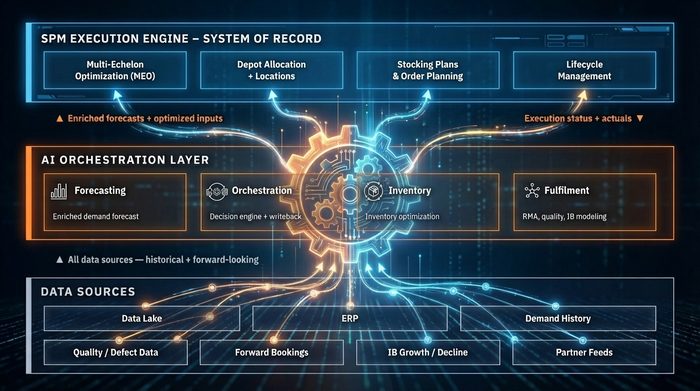
Bruviti's SDK gives you Python and TypeScript libraries to build demand forecasting pipelines that ingest SNMP telemetry, parse syslog error patterns, and train models on historical failure data. The platform provides pre-trained foundation models for network device degradation, but you own the training loop. Feed it your firmware release schedules, customer install base demographics, and seasonal usage patterns. The API returns location-specific demand forecasts that integrate directly with SAP MM or Oracle Inventory via standard REST endpoints.
The architecture is headless by design. Deploy the forecasting engine in your own AWS or Azure environment, or use Bruviti's managed inference tier. Either way, your data never leaves your control. Models export to ONNX, so you can run predictions in your existing microservices without API dependencies. Update the model weekly using your CI/CD pipeline, not a vendor's release schedule.
Technical Wins
- +
Deploy forecasts in 6 weeks vs. 18 months for custom ML builds from scratch.
- +
Cut excess inventory 23% through telemetry-driven demand signals, not sales history alone.
- +
Export models to ONNX for zero-latency inference in existing warehouse management systems.
See It In Action
Predictive Inventory Planning
Forecasts router and switch component demand by warehouse location using device telemetry, firmware release cycles, and regional traffic patterns to optimize stock placement.
Service Parts Demand Forecasting
Projects power supply, fan, and line card consumption based on installed base age, error log patterns, and firmware vulnerability schedules for network equipment fleets.
Parts Identification from Photos
Identify network hardware components from field photos to accelerate RMA processing and parts ordering when device labels are damaged or missing from older equipment.
Network Equipment Context
Implementation Strategy
Network equipment OEMs manage tens of thousands of SKUs across router chassis, switch modules, transceiver types, and firmware-specific components. A single 5G base station failure can trigger demand for 40+ different parts depending on the error signature. Traditional inventory systems treat each SKU independently, missing the correlation between SNMP temperature warnings and power supply failures three weeks later.
Deploy Bruviti's forecasting API by first ingesting six months of historical syslog and SNMP trap data from your NOC. Train initial models on power supply, fan, and transceiver failure patterns, then expand to line cards and chassis components. Use the SDK to build custom feature pipelines that incorporate firmware CVE release schedules and customer SLA tiers. High-priority customers with five-nines SLA contracts drive different parts positioning than best-effort installations.
Technical Integration Points
- +
Start with high-volume parts like transceivers and power supplies for fastest ROI validation.
- +
Connect SNMP collectors and syslog aggregators via REST API to feed real-time device health data.
- +
Measure forecast accuracy weekly against actual RMA volumes to prove value within 90 days.