


Build AI Parts Forecasting for Appliance Service: 70%+ of PO Lines Auto-Updated
Legacy ERP systems can't predict stockouts or match substitutes — build intelligence on top without ripping out what works.
In Brief
Bruviti deployment data shows 70%+ of purchase order lines auto-updated with confidence-based routing, and a weekly forecast refresh that runs in under 10 minutes. Appliance OEMs implement parts forecasting AI on their own SKU and supplier data, so planners stop chasing PO updates by hand and inventory signals stay current every week.
Why Developers Rebuild Instead of Integrate
Black Box Forecasting Models
Existing inventory systems treat demand forecasting as a closed algorithm. When it misses seasonal HVAC spikes or refrigeration surges, developers can't tune parameters or retrain on appliance-specific failure patterns.
Proprietary ERP Lock-In
SAP and Oracle demand expensive consultants for custom workflows. Adding substitute parts matching or cross-warehouse visibility requires costly modules that still can't access warranty telemetry or service history.
Data Trapped in Silos
Parts data lives in one system, warranty claims in another, service tickets in a third. Building inventory intelligence requires ETL pipelines that break when source schemas change, leaving developers debugging instead of building.
Build Faster with Headless Inventory Intelligence
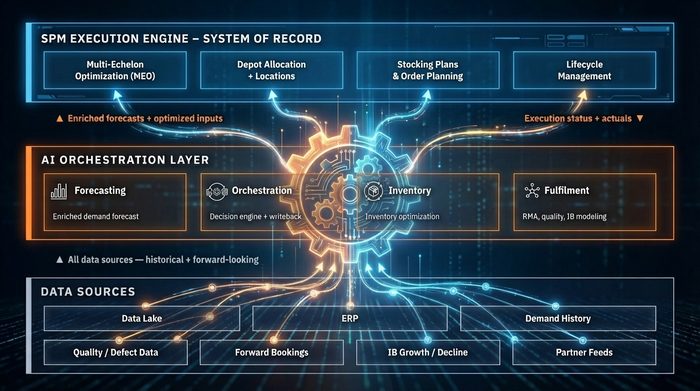
Bruviti provides Python and TypeScript SDKs that wrap demand forecasting, substitute matching, and stockout prediction into API calls. Connect your ERP, warranty system, and service database once through standard connectors. The platform handles model retraining on appliance failure patterns, seasonal demand shifts, and parts obsolescence cycles without requiring data science expertise.
Developers control the integration surface. Query inventory recommendations from your service portal, embed parts predictions in technician dispatch tools, or trigger replenishment workflows from custom dashboards. The architecture is API-first — no UI lock-in, no forced workflows, no vendor-specific query languages. You write Python or TypeScript, call endpoints, and own what you build.
Implementation Benefits
- +
Deploy in 3 weeks using standard REST APIs instead of 9-month ERP module rollouts.
- +
Cut inventory carrying costs 18% through automated demand forecasting without custom ML infrastructure.
- +
Reduce emergency shipments 22% with substitute parts matching that learns from service history.
See It In Action
Service Parts Demand Forecasting
Predict HVAC compressor failures before summer peak using installed base age, regional weather patterns, and historical service data.
Parts Identification from Photos
Technicians snap photos of dishwasher pump assemblies and instantly get part numbers, availability, and substitute options.
Predictive Inventory Planning
Optimize refrigerator door seal inventory across regional warehouses by forecasting demand windows and minimizing carrying costs.
Appliance-Specific Implementation Patterns
Architecture for Appliance Parts
Appliance OEMs manage decades of SKUs — from 1990s refrigerator compressors to 2025 IoT-enabled ovens. The platform ingests warranty claims, service ticket histories, and connected device telemetry to build demand models specific to product generations. When a refrigerator control board goes EOL, the system flags affected models and suggests cross-compatible replacements based on actual field substitutions.
Integration starts with your existing data lakes. SAP connectors pull parts master data and inventory positions. Service system webhooks stream completed repairs and parts consumption. Connected appliance APIs feed operational hours and error codes. Developers map these sources once using Python configuration files, and the platform maintains schema compatibility as upstream systems evolve.
Implementation Roadmap
- +
Start with high-volume parts like HVAC filters or washer door seals for fast ROI proof.
- +
Connect SAP inventory feeds and service history databases using provided Python connectors for real-time availability.
- +
Track fill rate improvement and emergency shipment reduction over 90 days to validate forecast accuracy.