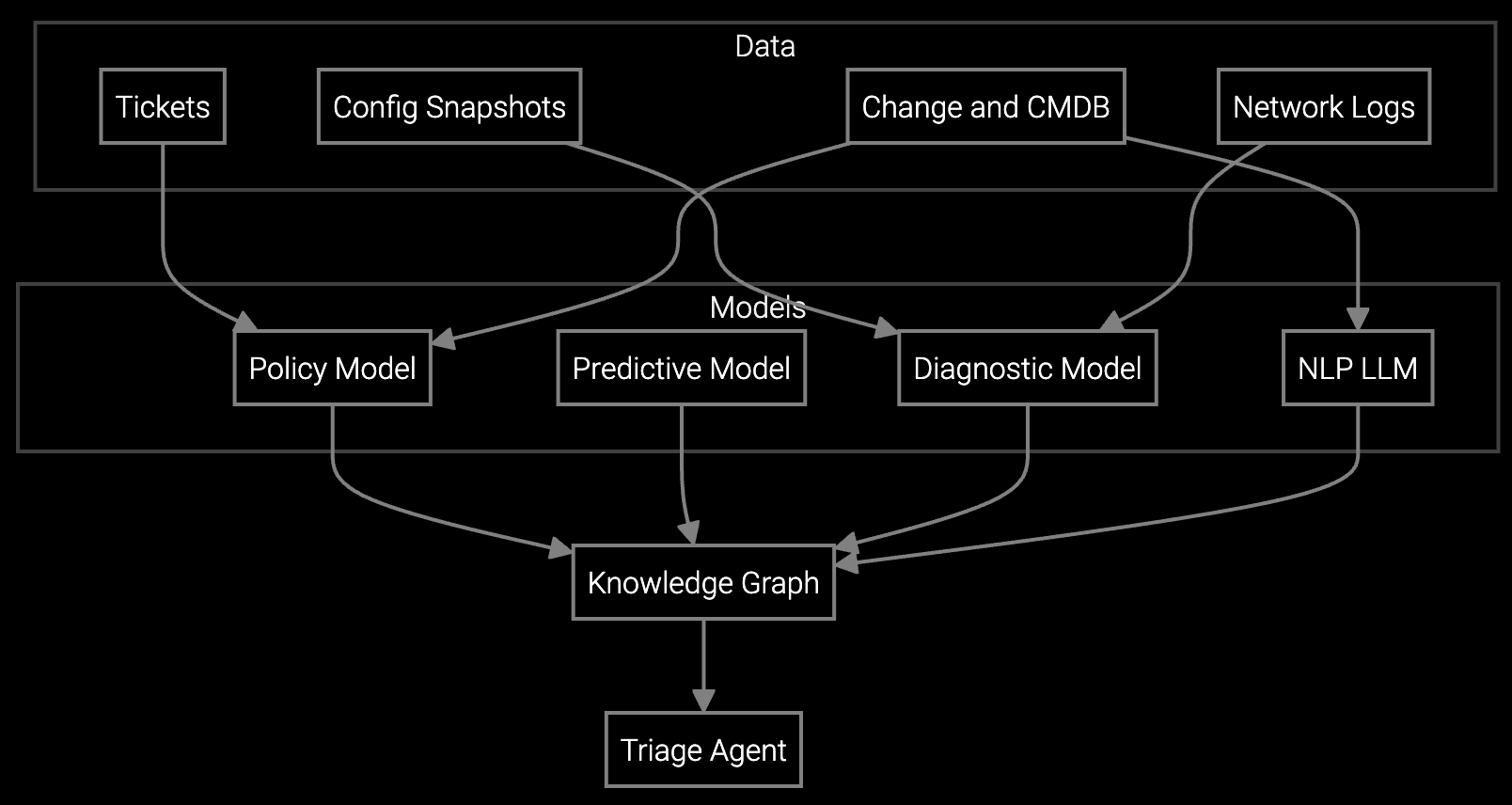
When $1M per hour downtime is at stake, your remote resolution strategy determines whether issues are fixed in minutes or escalate into costly production delays.
A bought remote support platform cuts mean time to resolution 40-60%, per Bruviti deployment data, by reusing proven fixes across the fab. For support teams weighing build versus buy, that is the deciding factor: a self-learning platform delivers MTTR gains in weeks, while in-house builds take far longer to reach the same accuracy.
Building remote support systems from scratch takes 12-18 months. Your support engineers continue manual log analysis while development teams build basic features competitors already have.
Off-the-shelf remote tools lack semiconductor-specific telemetry parsing. Support engineers manually correlate chamber sensor data across multiple screens, missing patterns that trigger unnecessary escalations.
Proprietary platforms force you into long-term contracts with limited integration flexibility. When fab processes change or new equipment is added, you're dependent on vendor timelines for updates.
Bruviti combines the speed of pre-built models with the flexibility of API-first architecture. Support engineers get instant guided troubleshooting for lithography systems, etch tools, and metrology equipment on day one. Meanwhile, your team customizes telemetry parsing for proprietary recipes and chamber configurations without waiting for vendor roadmaps.
The platform analyzes FOUP handling errors, process parameter drift, and contamination patterns using pre-trained models that understand semiconductor equipment behavior. When fab-specific customization is needed, open APIs let you integrate proprietary sensor data, recipe databases, and maintenance schedules without rebuilding core capabilities.
Semiconductor OEMs face unique strategic constraints. Equipment downtime costs exceed $1 million per hour, making remote resolution rate the most critical KPI. Support engineers need instant access to chamber sensor data, recipe parameters, and historical maintenance logs to diagnose issues before production impact.
Generic remote support platforms lack semiconductor-specific knowledge. They cannot parse EUV lithography telemetry, interpret etch chamber plasma measurements, or correlate yield drops with equipment parameter drift. This forces support engineers to manually analyze gigabytes of log data per incident, extending session duration and increasing escalation rates.
Pre-built platforms deploy in 6-8 weeks, including integration with existing equipment telemetry systems. Building in-house takes 12-18 months for basic functionality. Hybrid approaches like Bruviti start with pre-trained models on day one, then add fab-specific customizations incrementally without delaying initial deployment.
Development teams focus on building infrastructure instead of solving support problems. By the time basic log parsing and remote access features are complete, competitors have already deployed AI-driven guided troubleshooting. Your support engineers continue manual workflows for 18+ months while internal teams replicate features available off-the-shelf.
Evaluate platforms based on API openness and data portability. Proprietary systems with closed data models force long-term dependency. API-first platforms let you extract resolution data, integrate proprietary recipe databases, and migrate workflows if business needs change. Check contract terms for data ownership and export capabilities before committing.
Generic platforms cannot. Semiconductor-specific platforms with open APIs can. The platform needs pre-trained understanding of lithography, etch, and metrology equipment behavior, plus the flexibility to ingest custom telemetry from proprietary tools. Look for platforms that balance industry-specific models with customization APIs for fab-unique configurations.
Semiconductor OEMs see measurable impact within 90 days. Each 10-point increase in remote resolution rate reduces escalation volume and shortens mean time to resolution. At $1M+ per hour downtime cost, resolving even one lithography issue remotely per week instead of waiting for escalation delivers six-figure quarterly savings in avoided production impact.
Software stocks lost nearly $1 trillion in value despite strong quarters. AI represents a paradigm shift, not an incremental software improvement.
Function-scoped AI improves local efficiency but workflow-native AI changes cost-to-serve. The P&L impact lives in the workflow itself.

Five key shifts from deploying nearly 100 enterprise AI workflow solutions and the GTM changes required to win in 2026.
See how Bruviti delivers deployment speed with customization flexibility for semiconductor fabs.
Talk to an Expert