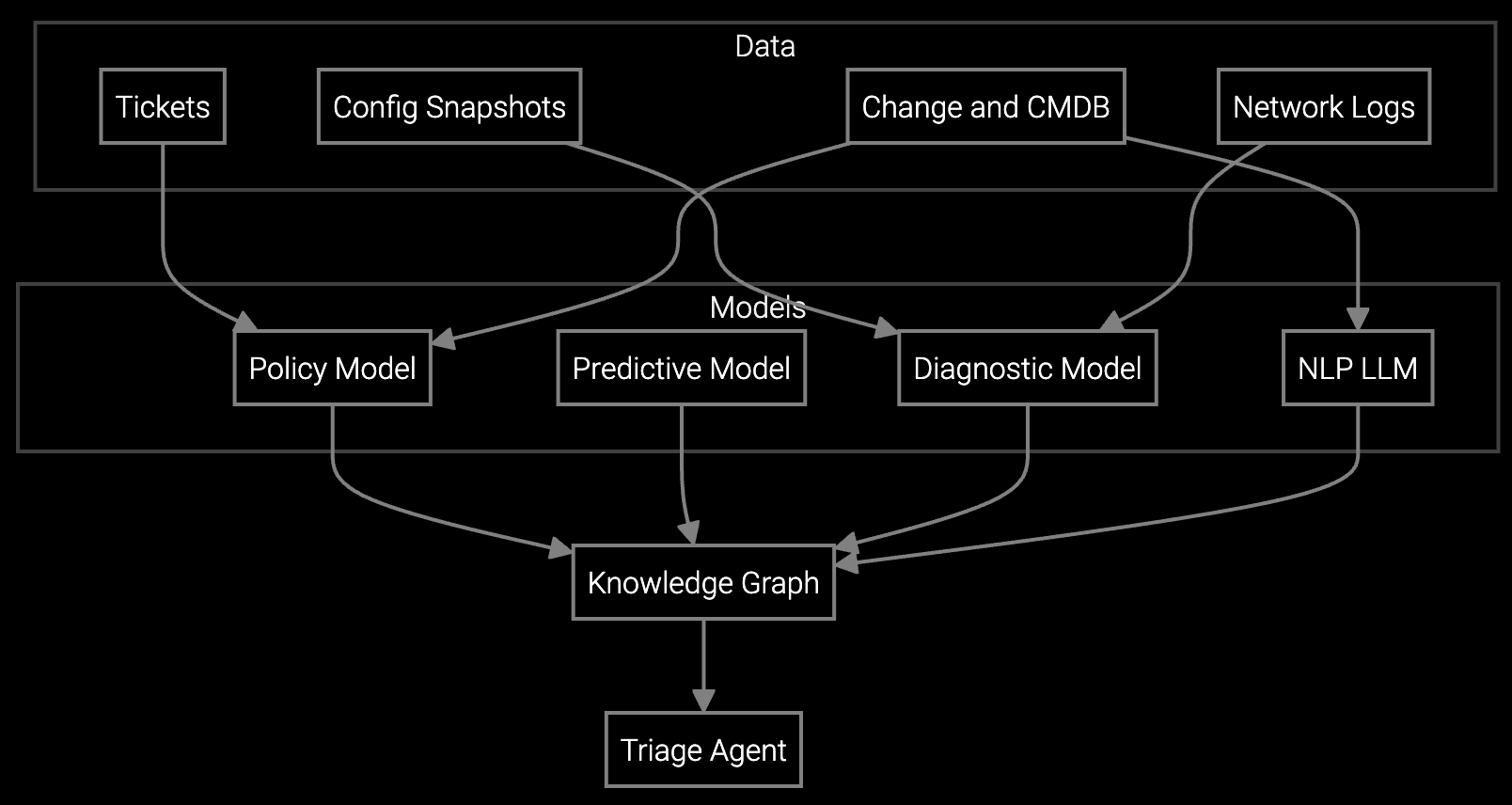
When fab equipment downtime costs $1M per hour, every minute spent diagnosing remotely instead of waiting matters.
Bruviti deployment data shows AI remote support resolves cases 20 to 30% faster and auto-triages 60% of faults. Per case, that means fewer minutes diagnosing, fewer escalations, and 12 to 18% fewer parts returns, so each support engineer closes more work without longer shifts.
Support engineers spend hours parsing lithography tool logs and telemetry manually. Each remote session extends because diagnostic data is scattered across multiple systems, and pattern recognition depends on memory instead of automated analysis.
When support engineers can't diagnose remotely, incidents escalate to senior engineers or become unnecessary dispatches. Each escalation adds delay, increases cost per incident, and extends equipment downtime when chambers or process tools are offline waiting for resolution.
Knowledge gaps force support engineers to schedule follow-up sessions after researching solutions. Repeat sessions double the time to resolution and increase the cumulative cost per incident, especially when fab equipment remains down across multiple remote sessions.
Bruviti's platform analyzes telemetry and log files automatically during remote sessions, presenting support engineers with root cause analysis and guided troubleshooting steps instead of requiring manual investigation. The system correlates process sensor data, chamber parameters, and error patterns across EUV, etch, and deposition tools to identify issues faster than manual log parsing.
Support engineers see a diagnostic summary with suggested resolutions as soon as they connect to the equipment. This eliminates the research phase that extends session duration and reduces escalations by giving support engineers access to pattern-matched historical fixes. Session notes populate automatically, removing administrative time and capturing solutions for future use.
Semiconductor fabs operate with extreme downtime costs where every minute of equipment unavailability directly impacts wafer throughput and yield. Remote support incidents tie up expensive lithography systems, etch chambers, and deposition tools while support engineers diagnose issues. Each extended remote session or escalation delays production when process tools are offline.
The cost per incident includes not just support engineer time but also the downstream impact on fab OEE. When remote resolution fails and issues escalate, equipment remains unavailable longer, affecting multiple wafer lots and cascading through the production schedule. Higher remote resolution rates and shorter session durations directly reduce both support costs and production losses.
Track remote resolution rate (percentage of incidents resolved remotely without escalation), average session duration, escalation rate to senior engineers, and first-session fix rate. These four metrics directly correlate to cost per incident and equipment availability. Measure baseline before implementation and track monthly to demonstrate ROI within the first quarter.
Support engineers see immediate session duration reduction as soon as AI-assisted diagnostics start providing root cause analysis and guided troubleshooting steps. Most fabs report 30-40% shorter sessions within the first month. Remote resolution rate improvements take 60-90 days as the platform learns equipment-specific patterns and support engineers build trust in AI-recommended fixes.
Semiconductor fabs typically reduce cost per incident by 45-60% through a combination of shorter session duration, fewer escalations, and higher first-session fix rates. The exact savings depend on baseline performance, but the largest ROI component comes from reducing equipment downtime by resolving issues faster. When lithography tools cost $1M+ per hour downtime, even 10-minute session reductions deliver substantial value.
The platform matches current symptoms against historical resolution patterns, giving support engineers access to fixes that previously required escalation to senior engineers with specialized knowledge. Automated telemetry analysis identifies root causes that support engineers would otherwise miss, allowing them to resolve complex issues without escalating. This transforms escalation from common to exceptional.
Yes, segment ROI metrics by equipment category such as lithography, etch, deposition, or metrology tools. This reveals where remote support improvements deliver the highest value and helps prioritize expansion. Lithography and critical etch tools typically show the largest ROI due to high downtime costs, while high-volume metrology and inspection systems show ROI through improved support engineer throughput.
Software stocks lost nearly $1 trillion in value despite strong quarters. AI represents a paradigm shift, not an incremental software improvement.
Function-scoped AI improves local efficiency but workflow-native AI changes cost-to-serve. The P&L impact lives in the workflow itself.

Five key shifts from deploying nearly 100 enterprise AI workflow solutions and the GTM changes required to win in 2026.
See how Bruviti measures session duration, remote resolution rate, and cost per incident in your fab environment.
Schedule Demo