Every minute of server downtime costs hyperscale operators thousands—remote resolution speed directly protects your customer SLAs.
Bruviti deployment data shows remote support cuts MTTR 40 to 60% on data center equipment, with cause suggestions on at least 70% of incidents at 85% precision. For operators, faster mean-time-to-resolve means more uptime per technician and fewer escalations. The savings come from resolving remotely, not dispatching.
Support engineers spend hours parsing BMC and IPMI logs across thousands of servers. Every minute delays resolution and increases the risk of escalation to costly on-site service.
When remote sessions fail to identify root cause, issues escalate to field service. Each unnecessary dispatch adds travel time, parts risk, and customer dissatisfaction.
Switching between monitoring tools, ticketing systems, and knowledge bases fragments workflow. Support engineers lose context with every tool switch, extending session duration.
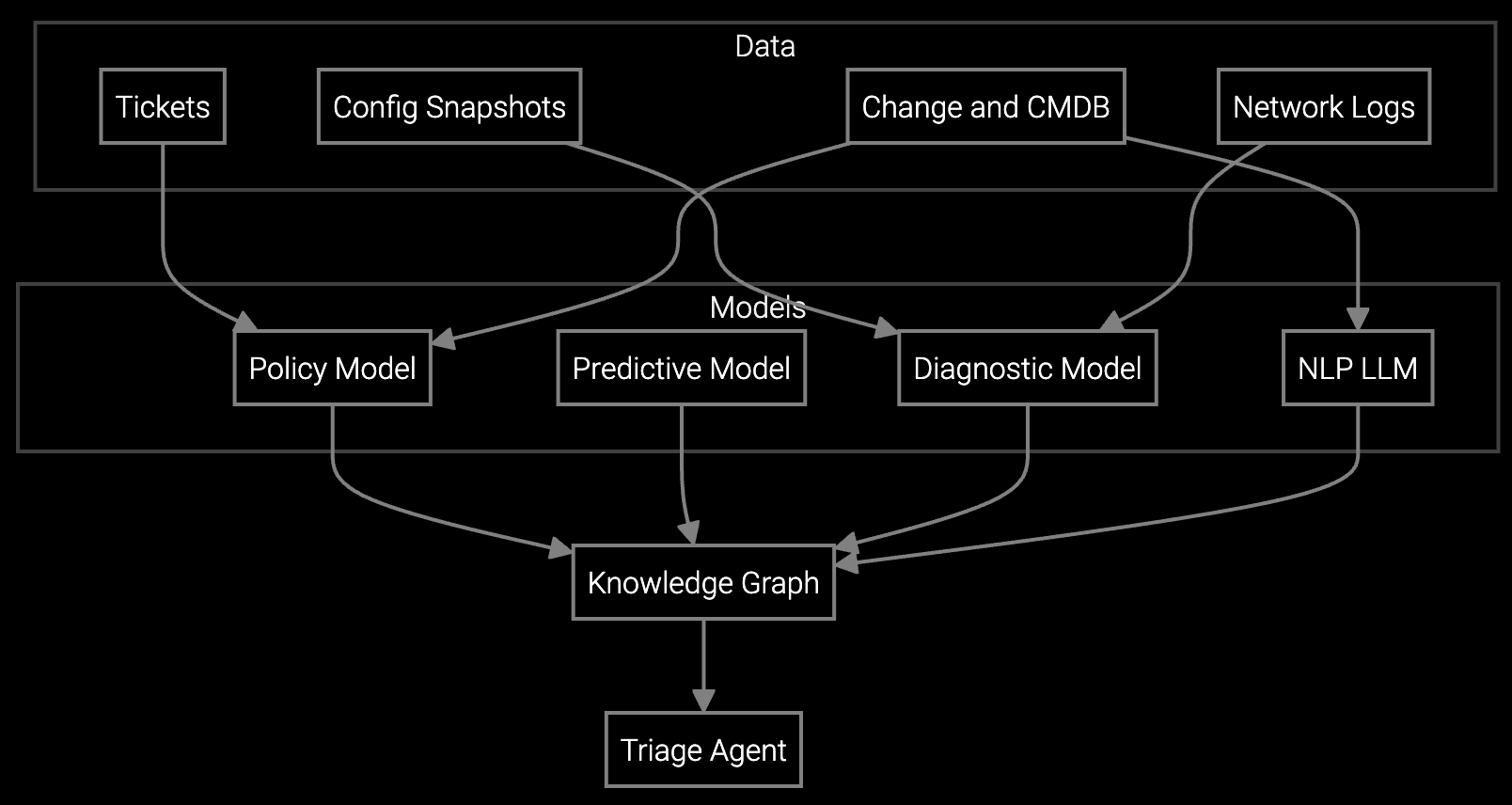
The platform automates root cause analysis by parsing BMC, IPMI, and RAID controller telemetry in real time. Support engineers receive fully formed diagnostic summaries instead of raw log files, eliminating manual investigation time. Guided troubleshooting workflows present next-best-action recommendations based on failure patterns across your entire installed base.
Session context stays unified in a single interface. Hardware state, historical incidents, and resolution steps appear side-by-side, eliminating tool switching. When remote resolution succeeds, the system auto-populates case notes and captures the solution for future use. When escalation is unavoidable, field service receives complete diagnostic context, accelerating on-site repair.
Hyperscale environments amplify ROI because incident volume is massive—thousands of server failures weekly across distributed facilities. Each minute saved per remote session compounds across your support team. Power and thermal incidents benefit most from automated root cause analysis because failure signatures in BMC and PDU telemetry are consistent and pattern-recognizable.
Remote resolution improvements directly protect customer SLAs. When you resolve storage controller failures or RAID degradation remotely, you avoid the 4-8 hour dispatch delay that threatens four-nines availability commitments. Reduced escalation rates also improve parts inventory efficiency—fewer rushed shipments, better stock planning.
Compare your current escalation rate to post-implementation rate, multiply by average field service cost per dispatch. Add session time reduction (hours saved × hourly support cost) and multiply by annual incident volume. Most data center OEMs see $180-$320 savings per avoided escalation depending on geography and travel costs.
Track remote resolution rate, average session duration, escalation rate to field service, and first-contact resolution percentage. Measure baseline for 30 days pre-implementation, then track weekly. Most teams see statistically significant improvements within 60 days on high-volume incident types.
Yes—reduced session duration and fewer escalations directly improve MTTR, protecting customer SLA commitments. Hyperscale operators measure OEM responsiveness in minutes, not hours. Remote resolution improvements also reduce repeat contacts because root cause analysis is more accurate the first time.
Session duration improvements appear within 2-3 weeks on high-volume incident types. Escalation rate reduction takes 60-90 days to measure reliably because field service dispatch patterns have natural variability. Full financial impact becomes clear after one fiscal quarter when you can compare total support costs year-over-year.
Most data center equipment manufacturers achieve payback in 4-7 months based on reduced escalations and session efficiency gains. Larger installed bases and higher incident volumes accelerate payback because savings scale with volume. OEMs supporting hyperscale customers see faster returns due to stricter SLA penalties and higher escalation costs.

Software stocks lost nearly $1 trillion in value despite strong quarters. AI represents a paradigm shift, not an incremental software improvement.
Function-scoped AI improves local efficiency but workflow-native AI changes cost-to-serve. The P&L impact lives in the workflow itself.

Five key shifts from deploying nearly 100 enterprise AI workflow solutions and the GTM changes required to win in 2026.
Get a custom ROI analysis based on your incident volume, escalation rates, and current session metrics.
Schedule ROI Assessment