
When every hour of fab downtime costs $1M+, incomplete asset records and configuration drift directly impact your bottom line.
Bruviti deployment data shows AI-driven installed base tracking cuts unplanned downtime 10 to 20% and reduces lost production minutes 12 to 18%. For operations, fewer surprise stoppages on tracked equipment is the ROI: more uptime per tool with the same maintenance headcount.
When your asset records don't match actual tool configurations, preventive maintenance windows get extended. You're searching for chamber kit part numbers, verifying software versions, and confirming which recipe was last run.
Without accurate lifecycle tracking, you can't predict when consumables will fail. Chamber kits degrade past their limits, causing unexpected tool downtime in the middle of production runs.
When tool issues occur, you're missing critical context. What were the last 10 recipe runs? When was the last chamber clean? Which firmware version is installed? You waste hours reconstructing history from scattered logs.
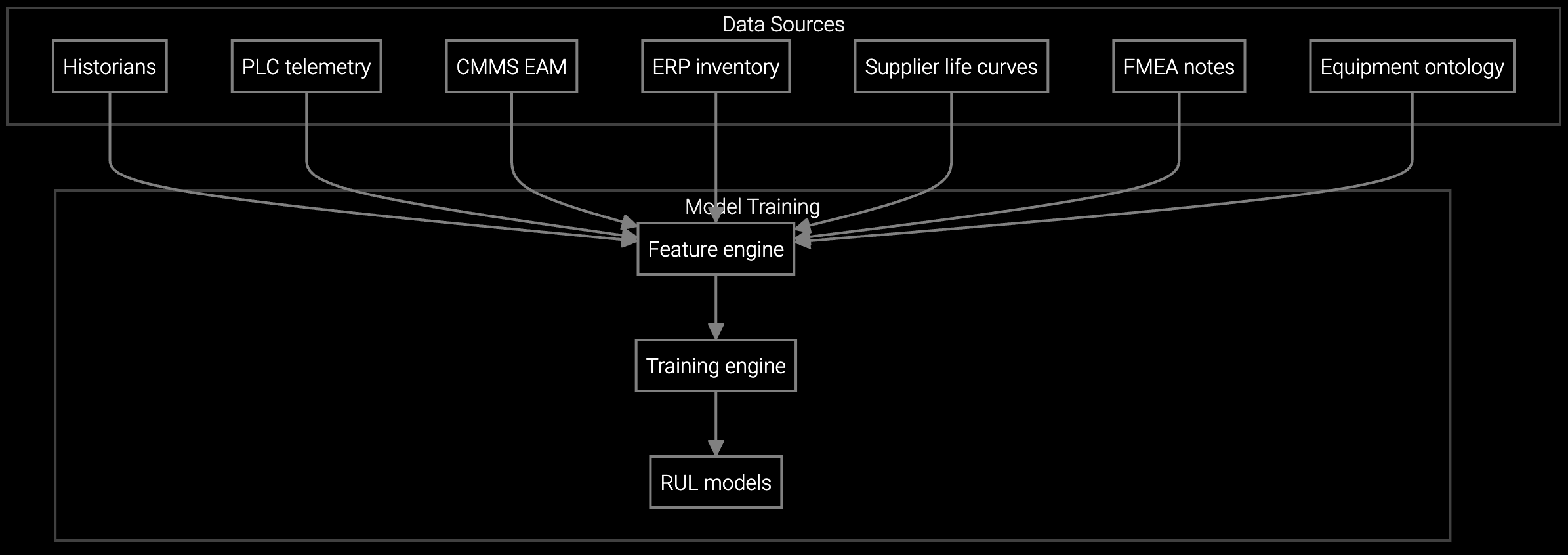
Bruviti's platform continuously ingests telemetry from lithography systems, etch tools, deposition equipment, and metrology instruments to maintain real-time asset records. Every recipe change, software update, chamber kit replacement, and calibration event is automatically logged with timestamps and context.
The system correlates equipment configurations with process outcomes, identifying which tool states produce optimal yield and which patterns precede failures. When a PM window approaches, you see exactly which consumables need replacement based on actual usage cycles. When a tool fault occurs, you get complete equipment history in seconds—not after 45 minutes of log diving.

Analyzes real-time telemetry from etch and deposition tools to detect process drift before it impacts wafer yield.
Forecasts chamber kit and consumable replacement timing based on actual usage patterns, enabling scheduled PM during planned downtime.

Schedules PM windows based on tool condition data rather than fixed intervals, reducing unnecessary downtime while preventing failures.
In a 200-tool fab running 24/7 production, configuration drift adds 30-45 minutes to every PM window. With 8 PM cycles per tool per quarter, that's 400-600 hours of unnecessary downtime annually—equivalent to $400-600M in lost wafer throughput opportunity at $1M per hour.
Automated asset tracking eliminates configuration lookups during PM, provides instant part number validation, and surfaces which tools are due for consumable replacement. The 35% PM time reduction translates to 140-210 reclaimed production hours per quarter. Additionally, predictive scheduling prevents 15-20 unplanned downtime events per year by flagging degrading chamber components before they fail mid-run.
Downtime cost is calculated by multiplying hourly wafer throughput value by hours saved. For a fab producing 10,000 wafer starts per month with $100 average selling price per die and 500 dies per wafer, each hour of production time is worth approximately $1M. AI-powered asset tracking reduces unplanned downtime by identifying degrading components before failure and shortens PM windows by eliminating configuration lookup time.
Most semiconductor OEMs see payback within 6-9 months. The ROI comes primarily from preventing unplanned downtime events (15-20 events avoided per year at $1M+ per hour) and reducing PM duration (35% time savings across hundreds of tools annually). A 200-tool fab typically avoids $2-3M in downtime costs within the first year.
Accurate configuration records eliminate 30-45 minutes of lookup time per PM window. Instead of searching logs for chamber kit part numbers, verifying software versions, or reconstructing recipe histories, maintenance teams see complete tool state automatically. This allows PMs to be executed in planned windows without schedule overruns, protecting production capacity.
Yes. The platform correlates process telemetry with consumable usage cycles to forecast when chamber components, RF generators, and other wear parts will degrade. By tracking actual stress conditions rather than calendar time, it identifies which tools need consumable replacement during the next scheduled PM, preventing mid-run failures that cause wafer scraps and unplanned downtime.
Focus on three core metrics: unplanned downtime events per month (target 15-20% reduction), average PM window duration (target 35% reduction), and configuration lookup time per incident (target 90% reduction). Translate these into wafer throughput equivalents using your fab's cost-per-hour calculation. Additionally, track consumable replacement accuracy to measure predictive maintenance effectiveness.

Software stocks lost nearly $1 trillion in value despite strong quarters. AI represents a paradigm shift, not an incremental software improvement.

Function-scoped AI improves local efficiency but workflow-native AI changes cost-to-serve. The P&L impact lives in the workflow itself.

Five key shifts from deploying nearly 100 enterprise AI workflow solutions and the GTM changes required to win in 2026.
See how automated asset tracking reduces PM duration and prevents unplanned downtime in your semiconductor operations.
Schedule ROI Analysis