
When machinery has 20-year lifecycles, incomplete asset data compounds into millions in lost revenue and avoidable failures.
Bruviti deployment data shows a 50% reduction in service resolution time when installed-base tracking puts full asset context in front of the team. For service operations, that halves the labor and dispatch cost tied up in each case, turning the asset registry from a record-keeping line item into a direct cost lever.
Without accurate records of firmware versions and component specs, every service call starts with 20+ minutes of detective work. Wrong parts get ordered, warranties get voided, and simple fixes become full-day events.
Legacy machinery installed before modern systems went live sits invisible in your database. When it breaks, you can't pull service history, verify warranty status, or identify the right manual—every incident becomes a research project.
When equipment reaches end-of-warranty, no one gets notified because asset records don't trigger alerts. Customers churn to third-party service providers, and your aftermarket revenue evaporates—not because you lost on price, but because you never showed up.
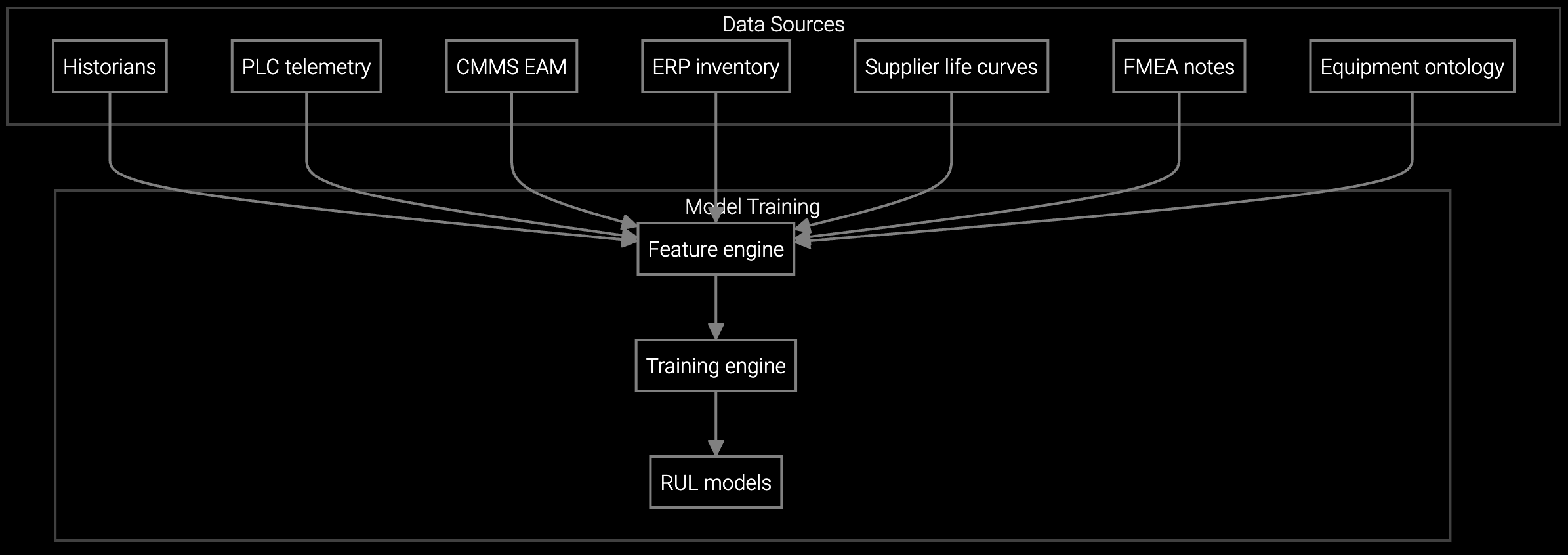
Bruviti ingests serial numbers, telemetry streams, and service histories from every system you already use—ERP, SCADA, field service apps—and builds a unified equipment registry. When a CNC machine sends a vibration alert, the platform instantly surfaces its configuration, maintenance history, and replacement parts without you toggling between five databases.
Configuration drift detection compares actual equipment state against your records in real time. When firmware versions mismatch or unauthorized components appear, you get alerts before they cause downtime. Automated lifecycle tracking flags end-of-life equipment and triggers renewal workflows—turning contract attachment from reactive scrambling into scheduled outreach.

Analyzes vibration and temperature data from CNCs and compressors to identify anomalies before they cascade into line stoppages.
Estimates when bearings and hydraulic systems will fail based on run hours and operating conditions, enabling planned maintenance windows.

Schedules turbine overhauls and conveyor belt replacements based on actual equipment condition rather than arbitrary time intervals.
Industrial machinery operates for decades across extreme environments—refineries, mines, manufacturing floors—where conditions degrade components faster than manuals predict. A compressor installed in 2005 may have undergone five firmware updates, three component swaps, and two relocated sites, but if those changes aren't logged in your system, the next service call starts blind.
Bruviti connects to PLCs, SCADA historians, and IoT gateways already monitoring your equipment. Vibration sensors, temperature probes, and pressure transducers stream real-time data that updates asset records automatically. When a pump shows abnormal bearing wear, the platform cross-references its maintenance history and operating hours to calculate remaining useful life—turning reactive break-fix into scheduled interventions during planned downtime.
Complete configuration records let service teams diagnose remotely and arrive with the correct parts. When you know a machine's firmware version and component history before dispatch, you eliminate return trips for wrong parts or missing information. Studies show this cuts emergency service calls by 35%.
Industrial OEMs typically see 20-25% improvement in contract renewal rates when lifecycle alerts trigger proactive outreach. Instead of customers discovering their warranty expired after a breakdown, you contact them 90 days before expiration with renewal offers—converting reactive churn into scheduled revenue.
Track three metrics: asset data completeness (target 95%+ records with serial numbers and configurations), configuration drift incidents (measure reduction month-over-month), and contract attachment rate (percentage of equipment under active service agreements). Most industrial manufacturers see measurable improvements within 90 days.
Every service call on unregistered equipment adds 20-30 minutes of research time at $75-150/hour labor cost. Wrong parts get ordered because technicians guess specifications, voiding warranties and requiring return visits. For a 5,000-unit installed base, this compounds to $500K+ annual waste.
Yes. The platform ingests data from existing PLCs, SCADA historians, and even manual service logs uploaded via mobile app. For equipment without telemetry, technicians can scan serial number plates during routine visits to populate records. Once registered, the system tracks service history and triggers lifecycle alerts even for decades-old machinery.
Software stocks lost nearly $1 trillion in value despite strong quarters. AI represents a paradigm shift, not an incremental software improvement.
Function-scoped AI improves local efficiency but workflow-native AI changes cost-to-serve. The P&L impact lives in the workflow itself.

Five key shifts from deploying nearly 100 enterprise AI workflow solutions and the GTM changes required to win in 2026.
Get a custom ROI model showing expected cost savings and renewal lift for your specific equipment portfolio.
Request ROI Analysis