Connected appliances generate support volume that overwhelms traditional remote tools—quantifying resolution rate gains directly impacts margin.
AI remote support cuts parts returns by 12 to 18% and repeat truck rolls by 38%, per Bruviti deployment data. For builders modeling ROI, fewer wrongly-swapped parts and avoided return visits are the line items that pay back fastest, on top of a 10 to 15 percentage-point first-time-fix gain that compounds the savings.
Support engineers spend excessive time parsing telemetry logs and navigating fragmented knowledge bases during remote sessions. Manual log analysis and unclear troubleshooting paths extend resolution time and increase cost per incident.
Complex HVAC systems and connected appliances often require escalation when remote diagnostics fail to identify root cause. Each escalation adds $120-180 in incremental cost and delays time to resolution for the end customer.
Multiple remote access tools, telemetry platforms, and knowledge systems create context-switching overhead. Engineers lose 8-12 minutes per session toggling between TeamViewer, proprietary diagnostic software, and internal documentation portals.
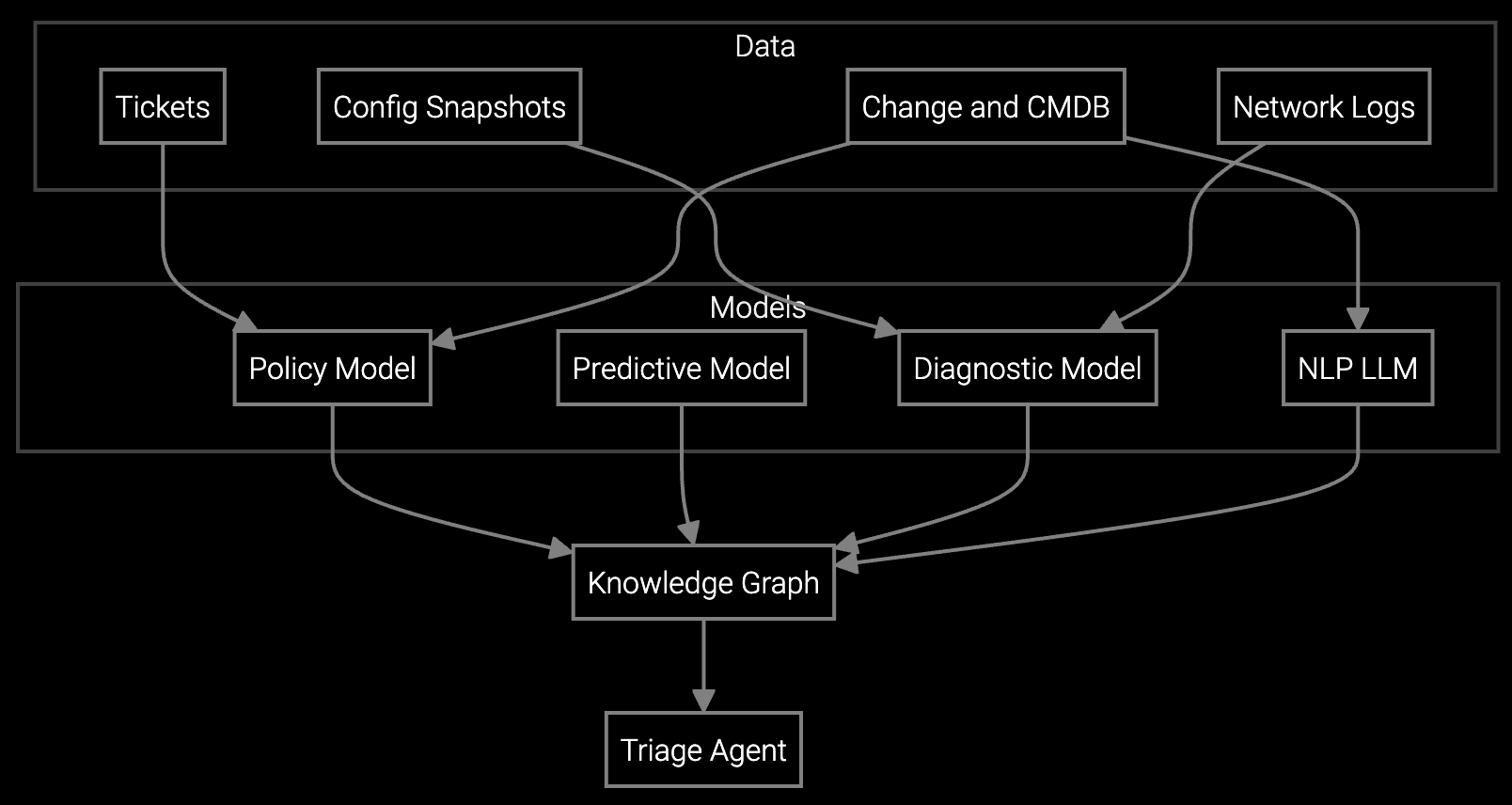
Bruviti's platform integrates with existing remote access infrastructure via REST APIs, ingesting telemetry streams from connected appliances (MQTT, CoAP) and parsing log files in real time. The system applies pattern matching and root cause analysis models trained on historical resolution data, surfacing likely failure modes within the first 90 seconds of a remote session. Support engineers receive step-by-step guided troubleshooting workflows with context-aware documentation pulled from resolved cases.
The architecture uses Python SDKs for custom telemetry parsers and TypeScript APIs for frontend integration with remote access tools like TeamViewer or LogMeIn. Engineers can extend the platform with custom diagnostic scripts specific to proprietary equipment models. Session transcripts are automatically captured and converted to structured knowledge base articles, eliminating manual documentation overhead. Integration points include SAP Service Cloud, Oracle Field Service, and custom ticketing systems via webhooks.
Appliance manufacturers face thin margins (2-4% warranty cost as percentage of revenue) where small efficiency gains translate to meaningful margin protection. The ROI calculation starts with current remote support volume: multiply annual remote sessions by average session duration (38 minutes) and support engineer hourly cost ($45-65 loaded). Compare this baseline to post-AI state with 18-minute sessions and 75% remote resolution rate.
For a manufacturer handling 2.5 million remote support cases annually, the math becomes concrete. Current state: 2.5M sessions × 38 min × $52/hour = $82.3M in session labor. Post-AI: 2.5M sessions × 18 min × $52/hour = $39M. The $43.3M labor savings compounds when you factor in avoided escalations—1.375M escalations eliminated at $150 each = $206M total annual impact. Implementation cost for API integration and model training typically runs $400K-800K, delivering 18-24 month payback.
Implementation costs of $400K-800K deliver payback in 18-24 months when measured against combined labor savings from reduced session duration and avoided escalation costs. High-volume manufacturers handling 2M+ annual remote sessions often see payback in 12-16 months due to scale effects.
Remote resolution rate is calculated as (sessions resolved without escalation / total remote sessions initiated). Baseline measurement requires 60-90 days of pre-implementation data to establish control. Post-implementation tracking should exclude cases where escalation was required due to parts unavailability rather than diagnostic failure.
Prioritize integration with existing remote access platforms (TeamViewer, LogMeIn) and IoT telemetry streams from connected appliances. These two data sources provide 70% of the diagnostic context needed for automated root cause analysis. Knowledge base integration can follow in phase two without delaying initial deployment.
Reducing session duration from 38 to 18 minutes increases theoretical daily capacity from 12.6 to 26.7 sessions per engineer (assuming 8-hour shift). Real-world capacity gains of 40-52% account for breaks and administrative time. This allows OEMs to absorb 15-20% volume growth without adding headcount.
Platform subscription costs typically run $8-15 per support engineer per month. Model retraining and custom integration maintenance add $60K-120K annually. Total cost of ownership remains 15-18% of initial implementation cost per year, well below the ongoing labor savings generated by efficiency gains.
Software stocks lost nearly $1 trillion in value despite strong quarters. AI represents a paradigm shift, not an incremental software improvement.
Function-scoped AI improves local efficiency but workflow-native AI changes cost-to-serve. The P&L impact lives in the workflow itself.
Five key shifts from deploying nearly 100 enterprise AI workflow solutions and the GTM changes required to win in 2026.
Get custom ROI modeling based on your remote session volume, current resolution rates, and engineer costs.
Request ROI Analysis