
Appliance OEMs operate on 3-5% margins where every contact center dollar counts toward profitability.
Bruviti email automation saves 300+ agent hours per week in appliance customer service, per Bruviti deployment data, by auto-resolving routine inquiries with under 2 minute median handling. Builders translate that reclaimed capacity directly into deflected headcount cost, making the integration spend pay back on labor savings alone.
Agents spend minutes searching knowledge bases across refrigeration, HVAC, and laundry systems. Each extra minute multiplied across seasonal volume spikes directly erodes margin.
Inconsistent troubleshooting leads customers to call back, doubling contact costs. Low first-call resolution burns budget and damages NPS scores.
Training costs for appliance troubleshooting across product lines run $3,000-5,000 per agent. High turnover from complexity and stress compounds cost per contact.
Bruviti's platform connects via REST APIs to your existing CRM, knowledge bases, and case management systems without vendor lock-in. Python SDKs let your team train custom models on historical case data, symptom patterns, and resolution outcomes specific to your product lines.
The ROI compounds through three mechanisms. First, retrieval-augmented generation surfaces the right troubleshooting guide in milliseconds instead of minutes, cutting AHT by 30%. Second, consistent symptom-to-solution mapping raises FCR by 25%, eliminating repeat contact costs. Third, agent productivity improvements reduce hiring needs during HVAC seasonal peaks, lowering recruitment and training overhead.
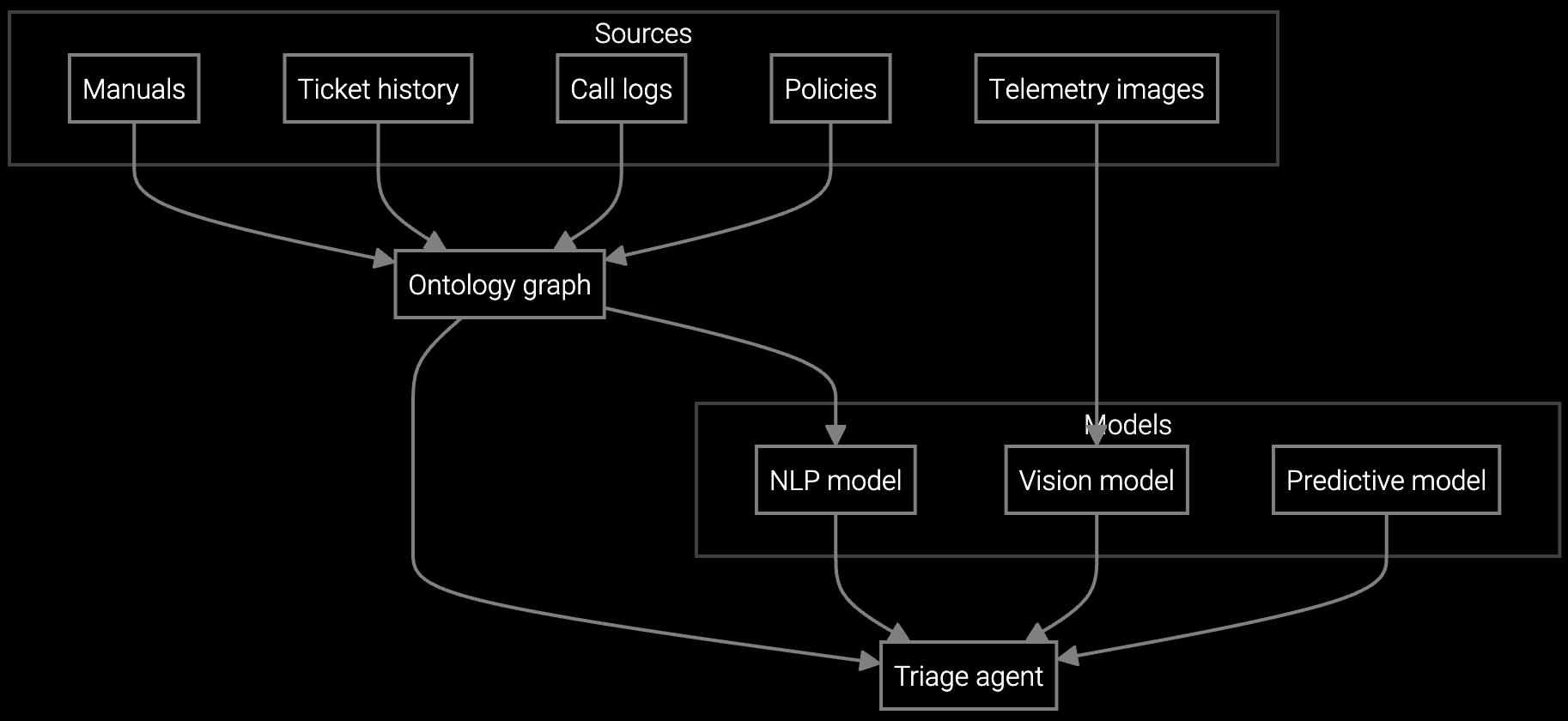
Classifies refrigerator, HVAC, and washer symptoms from customer descriptions, correlates error codes with known failure modes, and routes to agents with the right product expertise.
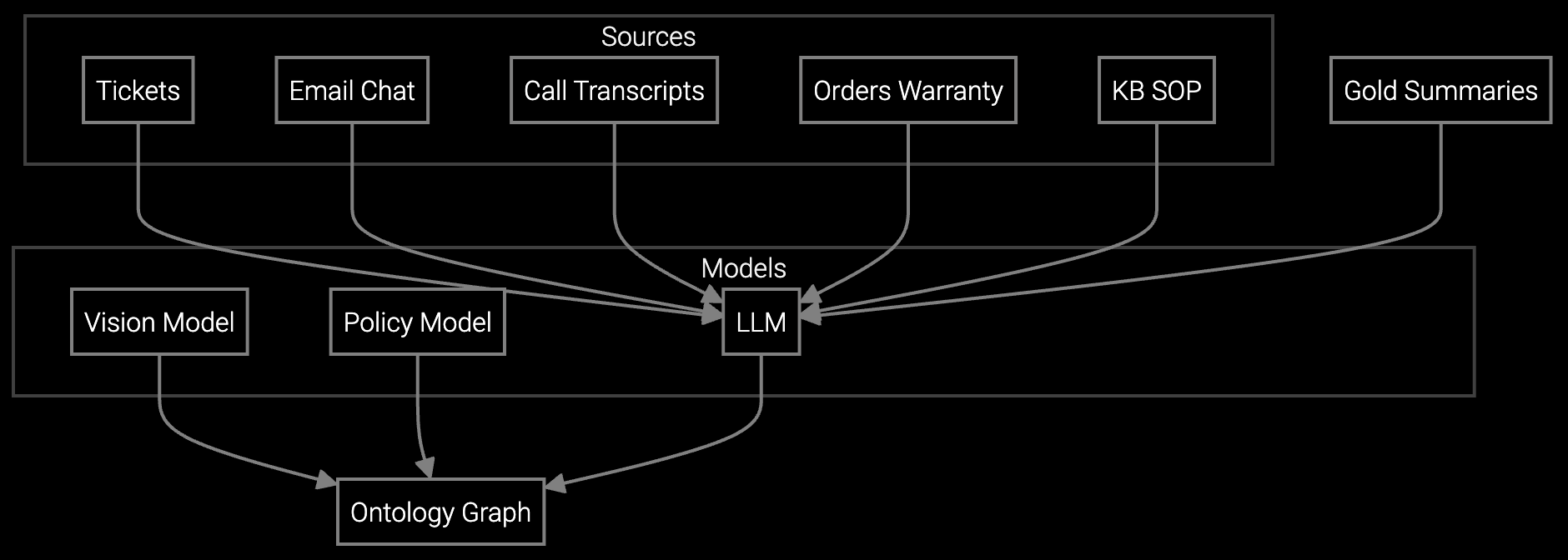
Generates instant summaries from multi-channel histories (chat, email, phone) so agents handling escalations understand full context without reading every interaction.
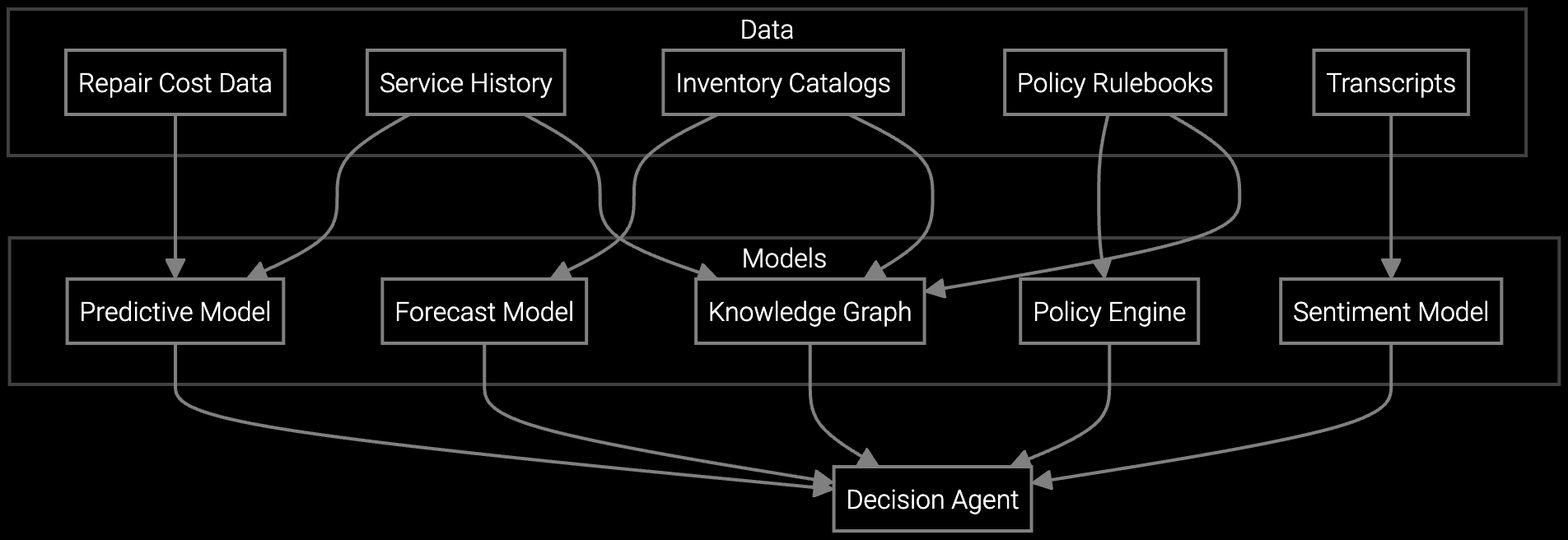
Analyzes appliance age, failure mode, part costs, and warranty status to recommend the most cost-effective resolution, reducing unnecessary replacements.
Appliance manufacturers operate in a high-volume, low-margin environment where contact center costs are a significant percentage of service revenue. Seasonal HVAC demand spikes and connected appliance complexity drive case volumes that strain agent capacity and training budgets.
The fastest ROI comes from applying AI to high-volume, repetitive troubleshooting categories: refrigerator temperature complaints, washer drain issues, HVAC airflow problems. These cases follow predictable symptom-to-solution patterns where retrieval-augmented generation delivers consistent answers faster than any agent can search manually.
Track Average Handle Time (AHT), First Contact Resolution (FCR), cost per contact, agent attrition rate, and CSAT/NPS scores. The primary financial metrics are AHT reduction (aim for 20-30%) and FCR improvement (aim for 15-25%). Compare pre- and post-deployment across the same product lines to isolate AI impact.
Typical appliance OEMs with 100+ agents achieve payback within 9-12 months. Time to value depends on integration speed (REST APIs accelerate deployment), data quality (12+ months of case history improves accuracy), and scale (larger contact centers see faster absolute dollar savings). Pilot deployments on high-volume product lines can show AHT reduction within 30 days.
Bruviti's platform provides Python SDKs and REST APIs that let your team retrain models on your proprietary case data, symptom vocabularies, and resolution workflows. You maintain data sovereignty and can integrate with existing systems (Salesforce, ServiceNow, SAP) without replacing infrastructure. The platform follows open integration standards to avoid lock-in.
A 100-agent contact center costs roughly $3-4M annually in salaries, benefits, and training. AI-powered knowledge retrieval reduces the need for incremental hiring during seasonal peaks and lowers training costs by providing consistent guidance. Platform licensing typically runs 10-15% of comparable agent costs while handling 20-30% more case volume.
Multiply your current repeat contact rate (typically 35-45%) by average cost per contact ($15-25 for appliance OEMs). If AI improves FCR by 25%, the formula is: (Current Repeat Rate × FCR Improvement %) × Annual Case Volume × Cost Per Contact. For 100,000 annual cases at 40% repeat rate and $20 cost, a 25% FCR improvement saves $200,000 annually.

Transforming appliance support with AI-powered resolution.

Understanding and optimizing the issue resolution curve.
Software stocks lost nearly $1 trillion in value despite strong quarters. AI represents a paradigm shift, not an incremental software improvement.
Walk through the integration architecture and cost model with actual appliance case data.
Schedule Technical Demo