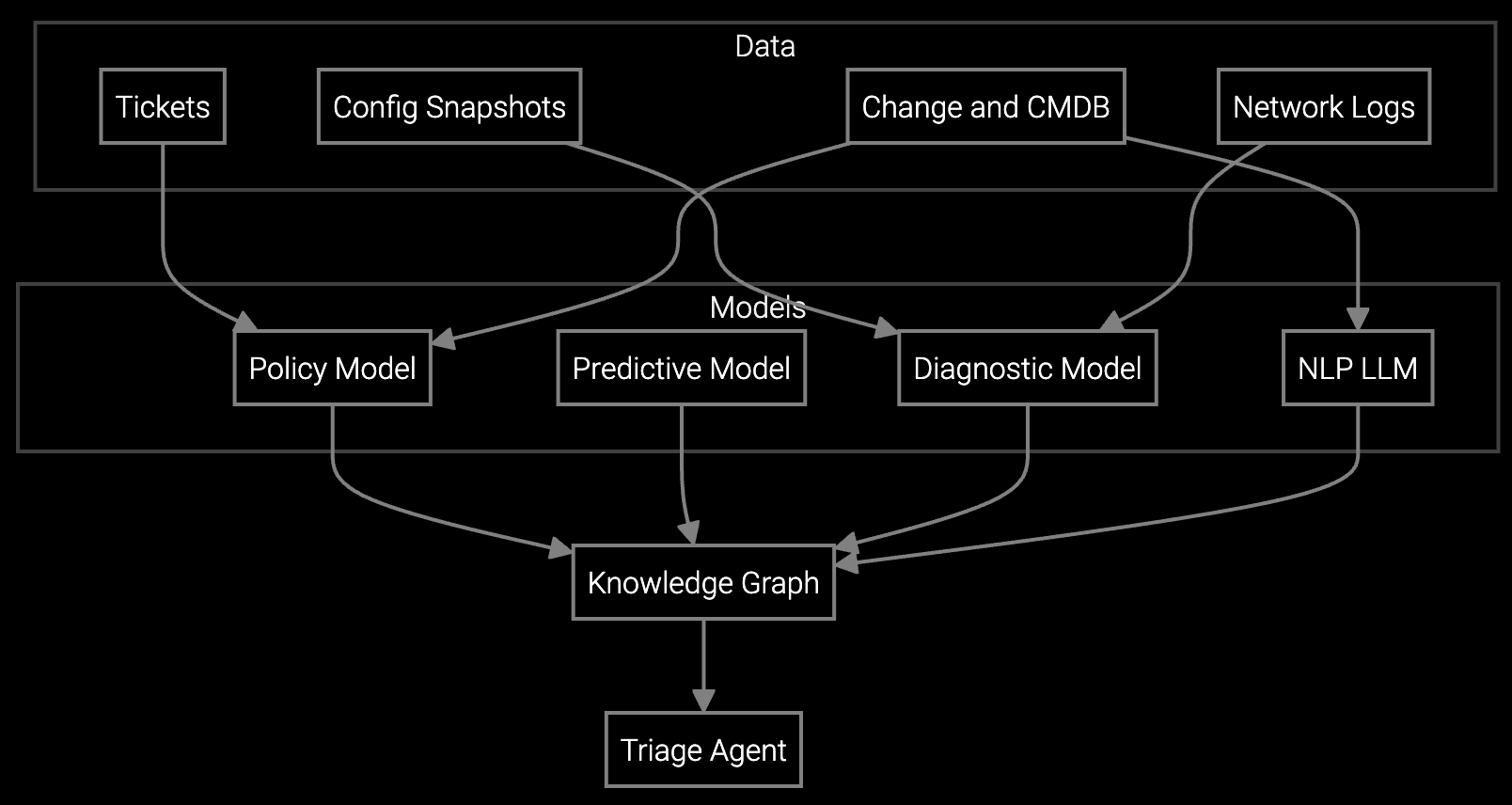
Legacy equipment scattered globally demands a new approach—support engineers can't manually parse PLC logs for every incident.
Industrial equipment OEMs deploying Bruviti AI remote support cut mean time to resolution 40 to 60% by connecting machine telemetry to root-cause analysis. The result is fewer dispatched technicians, faster remote fixes, and a support layer that resolves more incidents on the first contact without sending a truck to the plant floor.
Support engineers spend hours parsing PLC logs, SCADA alarms, and vibration data across decades-old equipment with inconsistent documentation. Each remote session becomes a research project, delaying resolution and escalating to expensive interventions.
Senior engineers hold undocumented expertise on legacy equipment—when they retire, remote support capability declines. New engineers lack the pattern recognition to resolve issues without escalation, pushing more incidents to expensive interventions.
Support engineers switch between remote access platforms, log viewers, equipment manuals, and internal wikis during each session. This context switching extends resolution time and increases the rate of unresolved sessions requiring escalation.
Bruviti's platform ingests PLC, SCADA, and IoT sensor data from your distributed installed base, building an AI layer that executes root cause analysis during remote sessions. The architecture connects to existing remote access tools—support engineers see AI-generated diagnostics in real time as they troubleshoot, not as a separate system requiring context switching.
Deploy by integrating your telemetry pipelines with Bruviti's APIs—sensor data flows automatically, training AI models on resolved incidents. Each support session captures the resolution pattern, building institutional knowledge that survives workforce turnover. Support engineers receive guided troubleshooting steps based on similar historical failures, elevating junior staff to senior-level diagnostic capability and increasing remote resolution rates across your equipment population.
Industrial equipment populations span 10-30 year lifecycles with machines deployed globally—CNC systems in automotive plants, turbines in power generation facilities, and heavy machinery across mining operations. Support engineers face inconsistent documentation for legacy equipment and must diagnose failures using PLC logs, vibration sensors, and temperature telemetry transmitted over unreliable connections.
Your remote support organization becomes the first line of defense for customer uptime commitments. AI deployment transforms this function by automating the diagnostic heavy lifting—analyzing sensor data patterns, correlating alarms across distributed systems, and surfacing resolution guidance based on similar historical failures. This shifts your remote support from reactive troubleshooting to proactive resolution, protecting customer production schedules and your service margins.
The platform ingests data from PLCs, SCADA systems, IoT sensors, and edge devices using standard industrial protocols including Modbus, OPC UA, and MQTT. It also processes equipment logs, alarm histories, and maintenance records. The architecture supports both real-time streaming telemetry and batch historical data imports, allowing AI models to learn from decades of equipment performance data across your installed base.
Bruviti's platform augments existing remote support tools rather than replacing them. Support engineers continue using familiar remote access software while AI-generated diagnostics appear in a unified interface during sessions. The implementation preserves current workflows—engineers follow the same session initiation and troubleshooting processes, but receive real-time root cause analysis and guided resolution steps powered by AI pattern matching across your equipment population.
Industrial OEMs typically see initial remote resolution gains within 60-90 days as AI models train on existing incident data. Improvement accelerates as the platform captures more resolved sessions—remote resolution rates increase 15-20 percentage points within six months for high-volume equipment types. The learning curve depends on telemetry data quality and incident volume, with mature equipment lines showing faster gains than newly deployed products.
The AI leverages whatever telemetry exists—even basic PLC logs and alarm codes—to build diagnostic patterns. For equipment with minimal sensors, the platform focuses on session note analysis and resolution pattern matching from support engineer documentation. This approach still captures tribal knowledge and guides troubleshooting, though remote resolution gains are higher for equipment with richer telemetry streams like vibration data and condition monitoring sensors.
Initial deployment requires integration engineering to connect telemetry pipelines and configure data flows—typically 2-3 engineers for 4-6 weeks depending on system complexity. Ongoing operation is lightweight: support engineers use the platform during normal workflows with minimal additional training. The AI requires periodic model retraining as equipment populations evolve, handled automatically by the platform with oversight from your service engineering team.
Software stocks lost nearly $1 trillion in value despite strong quarters. AI represents a paradigm shift, not an incremental software improvement.
Function-scoped AI improves local efficiency but workflow-native AI changes cost-to-serve. The P&L impact lives in the workflow itself.
Five key shifts from deploying nearly 100 enterprise AI workflow solutions and the GTM changes required to win in 2026.
See how industrial OEMs integrate telemetry and increase remote resolution rates with Bruviti's platform.
Schedule Implementation Review