
Retiring technicians take decades of expertise with them, but failed pilots waste capital and credibility faster.
Bruviti deployment data shows first-time fix rate rising from 75-80% to 88% after AI field service rollout for industrial equipment OEMs. Executives phase deployment around existing dispatch and parts systems, so technicians get fault diagnosis and confirmed parts upfront without disrupting live service operations.
AI systems that don't connect to FSM platforms, ERP, or IoT data sources create manual workarounds and duplicate entry. Technicians ignore tools that add friction instead of eliminating it.
Pilots fail when leadership cannot agree on what constitutes success. Without defined KPIs linked to margins, deployments drift into perpetual testing phases that never reach production scale.
Technicians distrust black-box recommendations they cannot verify. Top performers fear AI will expose proprietary techniques or automate away expertise, leading to quiet sabotage of adoption.
Successful field service AI deployments start narrow and prove value fast. Bruviti's platform integrates directly with existing FSM systems via REST APIs, ingesting work order history, parts consumption logs, and IoT sensor streams without requiring data migration or workflow disruption. The AI begins making predictions on day one by analyzing patterns in completed jobs—which failures required repeat visits, which parts were most frequently missing, which equipment exhibited early warning signs technicians missed.
The platform targets high-frequency failure modes affecting aging equipment with the longest service contracts. Predictive models surface likely root causes and needed parts before dispatch, while mobile tools deliver real-time guidance to less experienced technicians on-site. This approach compresses the expertise gap between retiring veterans and newer hires without requiring formal knowledge transfer programs. Leadership measures impact through first-time fix rate improvements and truck roll cost reductions within the first 90 days, building the business case for broader deployment across additional product lines and geographies.
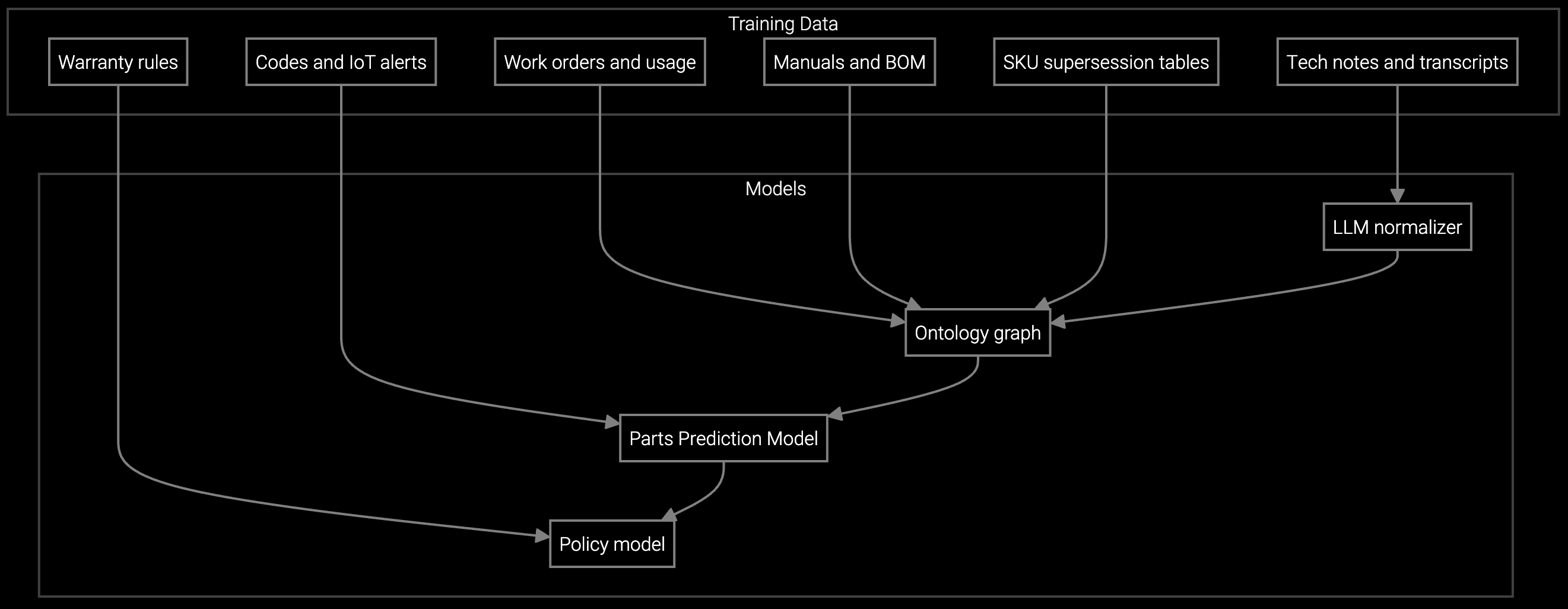
Eliminates missing parts delays for CNC machines and heavy equipment by predicting needed components before dispatch based on failure mode analysis and maintenance history.
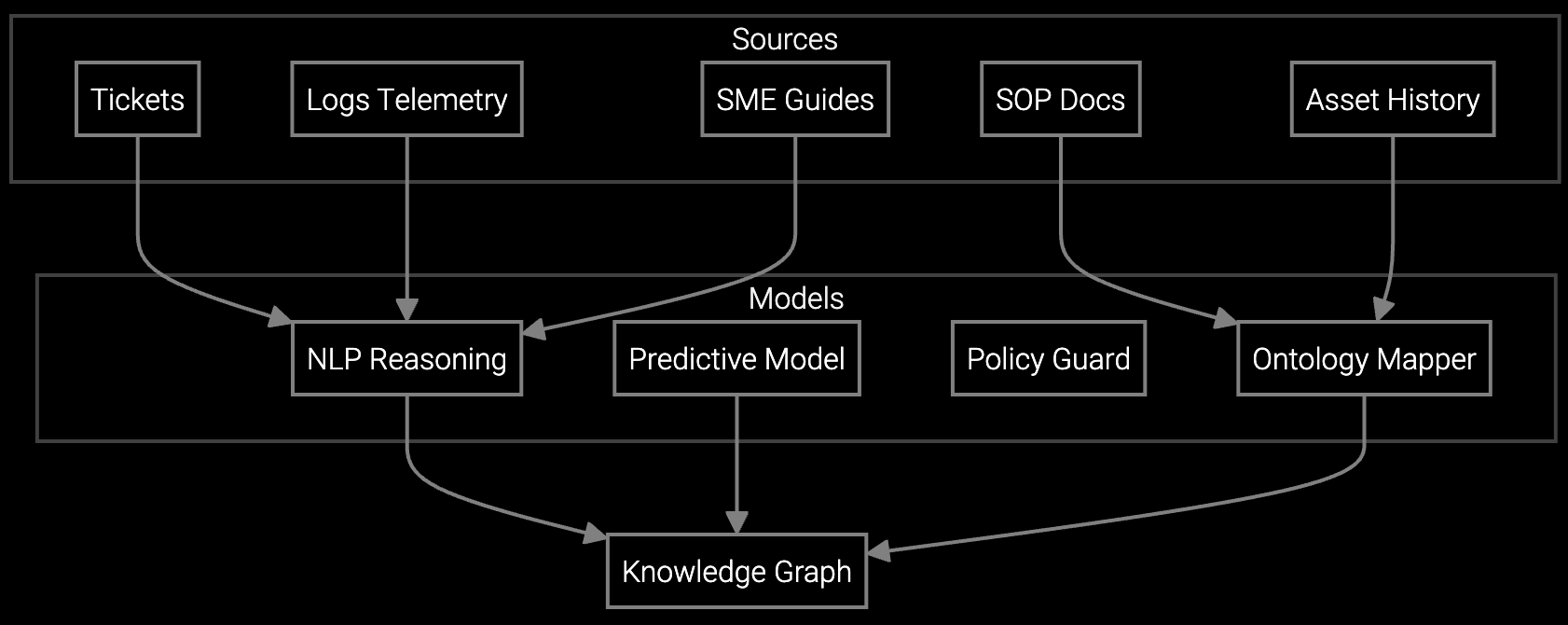
Preserves retiring technician expertise by correlating symptoms with decades of repair patterns across turbines, pumps, and industrial automation systems.
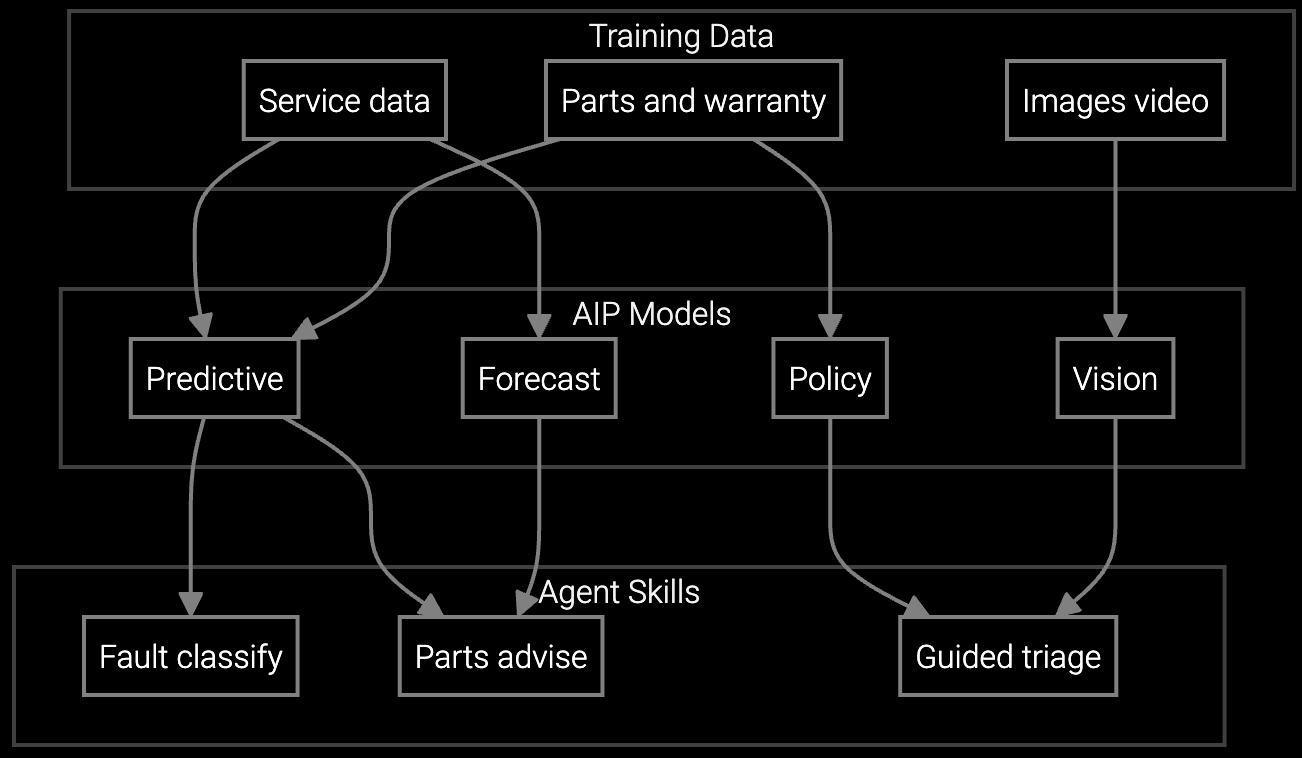
Delivers diagnostic guidance and repair procedures to less experienced technicians servicing legacy machinery with incomplete documentation.
Industrial OEMs face unique deployment challenges: equipment populations spanning 10-30 year lifecycles, geographically dispersed technician teams with varying skill levels, and service contracts written before AI existed. Parts for decades-old CNC machines, turbines, and compressors are often obsolete or have 8-week lead times. Documentation gaps are common—manuals become outdated as equipment receives field modifications over decades of operation.
Successful implementations start with product lines experiencing the highest warranty accruals and lowest first-time fix rates. The platform ingests historical work orders, parts consumption data from these problem assets, and any available PLC or SCADA telemetry. Pilots run parallel to existing workflows for 60-90 days, giving technicians time to validate AI recommendations against real-world outcomes before leadership mandates adoption. This phased approach minimizes disruption while building trust with field teams who understand the equipment better than any algorithm.
Effective deployment requires three foundational elements: a field service management system with accessible APIs, historical work order data spanning at least 12-24 months, and structured parts consumption records. IoT telemetry from installed equipment accelerates predictive accuracy but is not mandatory for initial deployment. The platform can begin generating value from work order history and parts data alone.
Target product lines with the highest combination of repeat visit rates, warranty accruals, and aging technician expertise gaps. Industrial OEMs typically select equipment populations reaching end-of-life but still under service contract, where first-time fix rates are lowest and tribal knowledge is most concentrated. Avoid piloting on new equipment with insufficient failure history or niche assets with too few deployed units to establish patterns.
API integration and initial data ingestion typically complete within 2-4 weeks. A 60-90 day pilot allows sufficient real-world service events to measure first-time fix improvements and parts prediction accuracy. Production rollout to additional product lines or geographies follows immediately if pilot KPIs meet targets. Total timeline from pilot start to scaled deployment averages 4-6 months for industrial equipment OEMs.
Technician adoption succeeds when AI augments rather than overrides human judgment. Bruviti's platform surfaces recommendations with supporting evidence—similar past failures, parts that resolved comparable symptoms, and confidence scores. Technicians can accept, modify, or reject suggestions while the system learns from their corrections. Pilots should include top performers as early adopters whose endorsement signals credibility to skeptical peers.
Track first-time fix rate improvement as the primary success metric—each percentage point gain directly reduces truck roll costs and SLA penalties. Secondary metrics include parts prediction accuracy, mean time to repair reduction, and technician utilization gains. Financial impact flows from reduced repeat visits, lower parts carrying costs, and deferred warranty reserve accruals. Industrial OEMs typically measure payback period in months, not years.

How AI bridges the knowledge gap as experienced technicians retire.

Generative AI solutions for preserving institutional knowledge.

AI-powered parts prediction for higher FTFR.
See how Bruviti delivers first-time fix improvements within 90 days using your existing FSM and parts data.
Schedule Deployment Review