Network downtime costs escalate by the minute while support teams struggle with fragmented tools and siloed knowledge.
Network equipment OEMs deploying AI remote support reach 70% or higher auto-triage, 50% or higher L1/L2 resolution, and a 40% or greater MTTR cut, per Bruviti deployment data. The fastest path skips a custom build: Bruviti ships a pre-trained incident-management layer that routes, diagnoses, and resolves before incidents reach scarce L3 engineers.
Senior support engineers possess critical diagnostic expertise that remains locked in individual experience. When incidents exceed junior engineer capabilities, escalations create bottlenecks that extend resolution times and reduce remote resolution rates.
Support engineers navigate multiple disconnected systems for log analysis, telemetry review, and documentation. Context switching between tools adds overhead to every remote session, increasing mean time to resolution and reducing session efficiency.
Network device logs contain diagnostic signals buried in thousands of lines of output. Support engineers spend significant session time parsing syslog and SNMP data manually, delaying root cause identification and extending customer-impacting downtime.
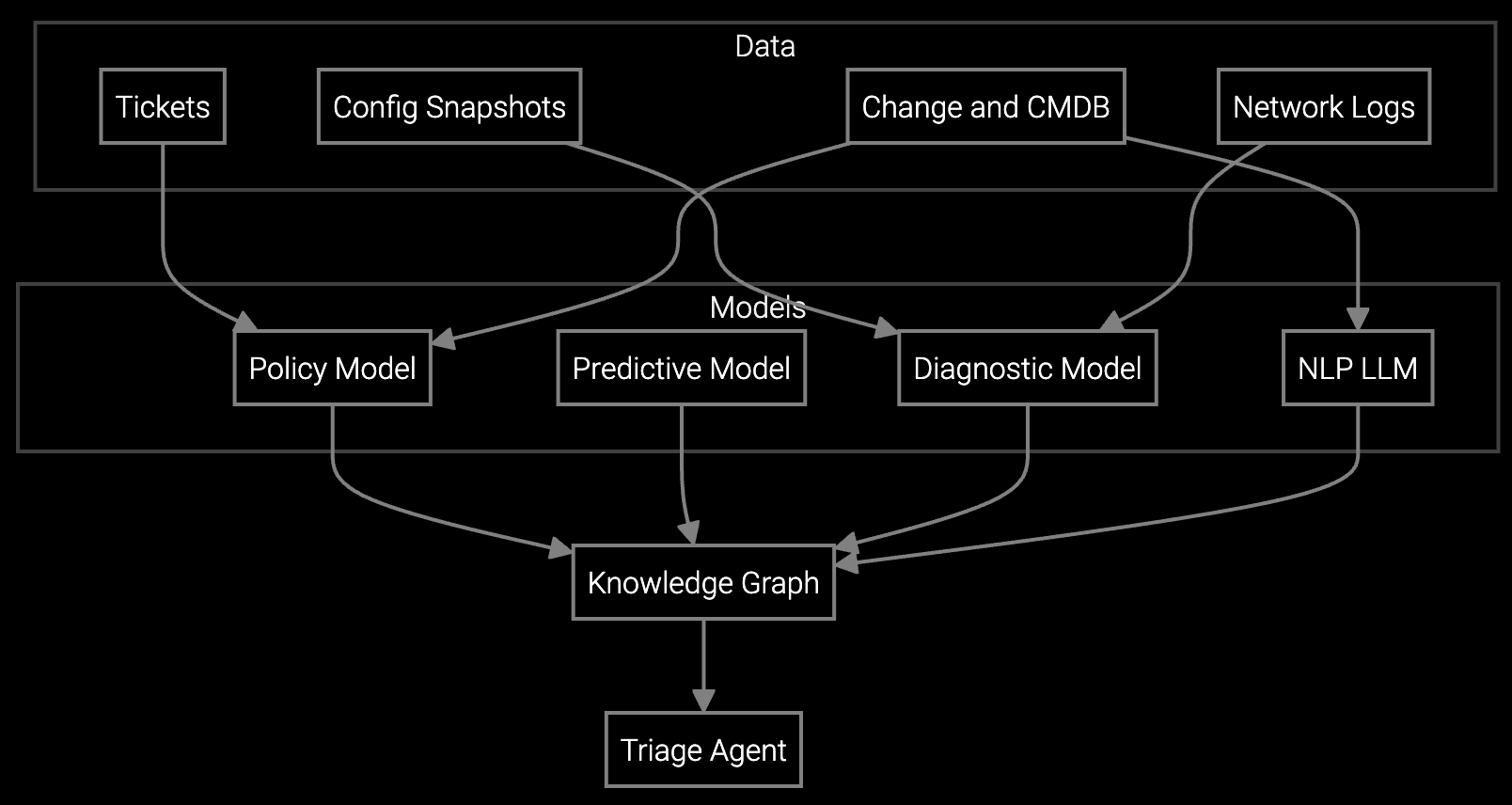
Bruviti's platform integrates with existing NOC systems through REST APIs and telemetry connectors. The implementation begins with log ingestion pipelines that parse SNMP traps, syslog streams, and device telemetry in real time. Support engineers access AI-driven root cause analysis directly within remote session tools, eliminating context switching between diagnostic systems.
The architecture supports phased deployment across product lines. Network OEMs typically start with high-volume router and switch families where remote resolution rates deliver immediate margin impact. The platform learns from historical incident data and documented resolutions, building diagnostic models specific to each equipment type without requiring extensive upfront training datasets.
Network equipment OEMs face unique implementation requirements driven by 24/7 uptime expectations and distributed device populations. Remote support systems must handle high-velocity telemetry streams from thousands of routers, switches, and security appliances while maintaining sub-second query response times for support engineers diagnosing customer-impacting outages.
Implementation success depends on integrating with existing SNMP monitoring, syslog aggregation, and firmware management systems. The platform must parse vendor-specific log formats and correlate events across multi-vendor environments where customers deploy mixed equipment populations. Security requirements demand on-premises deployment options for telemetry containing network topology and configuration data.
Implementation requires API connections to existing telemetry sources including SNMP monitoring systems, syslog aggregators, and remote access platforms. Most network OEMs complete core integrations within 4-6 weeks using standard REST APIs and telemetry connectors. The platform supports both cloud and on-premises deployment to meet security requirements for network topology data.
The system includes pre-built parsers for common network device log formats including Cisco IOS, Juniper JUNOS, and Arista EOS. Custom parsers can be configured for proprietary formats using regex patterns and field mapping templates. The platform automatically learns diagnostic patterns from historical incident resolutions regardless of log format variations.
The platform begins providing root cause suggestions after processing approximately 500 resolved incidents for a given equipment family. Many network OEMs see measurable remote resolution rate improvements within 60 days by starting with high-volume product lines. The system continuously refines diagnostic accuracy as it processes additional incidents and support engineer feedback.
Network equipment OEMs track three primary metrics: remote resolution rate increase, escalation rate reduction, and mean time to resolution improvement. A typical deployment achieving 15-20% remote resolution rate improvement delivers $600K-900K annual savings per 100 support engineers through reduced labor costs and improved SLA performance. Most organizations see positive ROI within 6-9 months.
The platform supports on-premises deployment where all telemetry and diagnostic data remain within OEM-controlled infrastructure. For cloud deployments, data encryption in transit and at rest meets SOC 2 Type II requirements. Role-based access controls restrict diagnostic data visibility to authorized support engineers, and audit logs track all system access for compliance requirements.
Software stocks lost nearly $1 trillion in value despite strong quarters. AI represents a paradigm shift, not an incremental software improvement.
Function-scoped AI improves local efficiency but workflow-native AI changes cost-to-serve. The P&L impact lives in the workflow itself.

Five key shifts from deploying nearly 100 enterprise AI workflow solutions and the GTM changes required to win in 2026.
See how network equipment OEMs reduce escalations and improve remote resolution rates with Bruviti.
Schedule Implementation Review