
Custom integration projects drain budgets while legacy systems hold hostage the data you need to serve customers proactively.
Bruviti deployment data shows a 40% reduction in rush parts orders when asset tracking feeds remaining-useful-life prediction. The return comes from replacing expedite freight and emergency procurement with planned demand, so the integration pays back through avoided premium logistics rather than headcount cuts alone.
Proprietary data formats force engineering teams to build one-off connectors for each legacy system. Every SAP variant, Oracle instance, or custom PLM requires separate development cycles, delaying time to value.
Serial numbers, configuration states, and firmware versions scatter across disconnected systems. Engineers waste hours reconciling records before they can build predictive models or lifecycle analytics.
Closed ecosystems trap your data and force dependency on single vendors. Switching costs escalate as proprietary schemas embed deeper into workflows, limiting architectural flexibility.
Standard REST APIs eliminate custom connector development by exposing asset data through OpenAPI-documented endpoints. Your engineering team writes Python or TypeScript against consistent schemas whether pulling from SAP, Oracle, or proprietary systems. Authentication uses industry-standard OAuth 2.0, and webhook subscriptions push configuration changes in real time without polling overhead.
The platform maintains your data sovereignty through flexible deployment options. Host on your infrastructure or use cloud endpoints that never persist raw telemetry. API responses return JSON structures you control, and GraphQL queries let you specify exactly which fields to retrieve. No black-box transformations, no vendor-specific formats, no data trapped behind proprietary interfaces.

API-driven telemetry ingestion from PLCs and SCADA systems detects anomalies in real time, enabling proactive maintenance before equipment failures disrupt production lines.
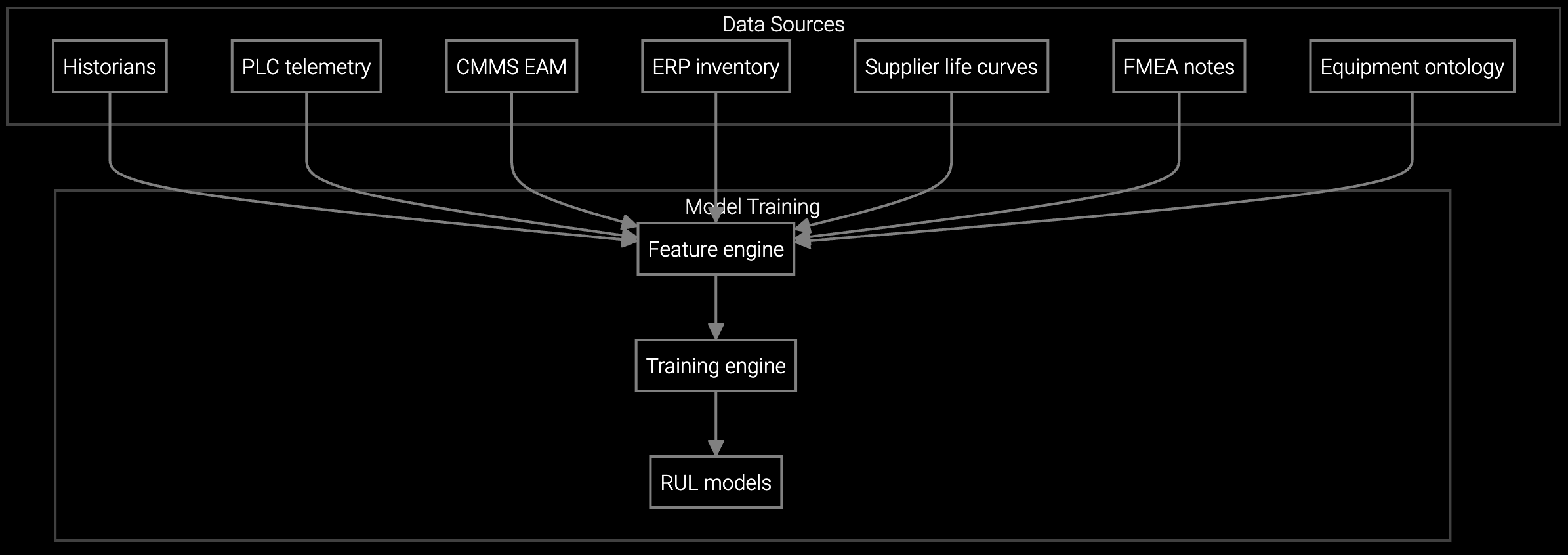
Standard REST endpoints aggregate run hours, vibration data, and maintenance history to estimate component lifespan, informing upgrade cycles and spare parts planning.

GraphQL queries pull configuration states and sensor streams to build virtual equipment models, tracking performance drift across your installed base without vendor-locked data lakes.
Industrial OEMs support machinery with 10-30 year lifecycles, accumulating asset data across multiple PLM upgrades, ERP migrations, and IoT platform generations. A single CNC machine's history might span three different SAP instances, two legacy maintenance databases, and a modern IoT hub collecting vibration sensors and temperature probes.
Custom connectors multiply costs when you serve diverse customer environments. A manufacturer supporting both discrete factories and process plants needs adapters for Siemens PLCs, Allen-Bradley controllers, and proprietary legacy systems. Each connector requires specialized engineering knowledge and breaks when customers upgrade their infrastructure.
Standard REST endpoints eliminate 60% of integration costs by removing custom connector development. Instead of $240K and 6 months building adapters for each legacy system, engineering teams complete API integration in 3 weeks using Python or TypeScript SDKs. Ongoing maintenance costs drop further because standard schemas don't break when you upgrade SAP or Oracle instances.
Track three metrics: deployment time reduction (custom builds vs. API integration), annual maintenance costs (legacy adapter upkeep), and contract attachment rate improvement (asset visibility drives upsell). Industrial OEMs typically see 6-month deployments shrink to 3 weeks, $180K annual maintenance eliminated, and contract attachment rates improve 15-22% within 12 months as complete asset data enables proactive renewal outreach.
Data sovereignty controls and portable schemas prevent lock-in. API-first architectures let you host on your infrastructure or use cloud endpoints that never persist raw telemetry. OpenAPI documentation ensures your engineering team can replicate endpoints if you migrate platforms, and GraphQL queries return only the fields you specify in formats you control. No proprietary data transformations trap your information.
SAP variants and custom PLM systems drive highest costs due to frequent schema changes and customer-specific customizations. Each SAP instance may use different table structures for serial numbers and configuration data, forcing separate connector logic. Oracle ERP migrations similarly require adapter rewrites. Standard APIs eliminate this variability by exposing consistent REST endpoints regardless of backend system architecture.
API integration completes in 3 weeks versus 6 months for custom connector builds. Engineers authenticate via OAuth 2.0, map existing asset fields to API schemas, and subscribe to webhook notifications for configuration changes. The time savings come from eliminating custom adapter code for each legacy system. You write once against standard endpoints rather than maintaining separate logic for SAP, Oracle, and proprietary databases.

Software stocks lost nearly $1 trillion in value despite strong quarters. AI represents a paradigm shift, not an incremental software improvement.

Function-scoped AI improves local efficiency but workflow-native AI changes cost-to-serve. The P&L impact lives in the workflow itself.

Five key shifts from deploying nearly 100 enterprise AI workflow solutions and the GTM changes required to win in 2026.
Explore OpenAPI specs, webhook schemas, and code samples for Python and TypeScript integration.
Access Developer Portal