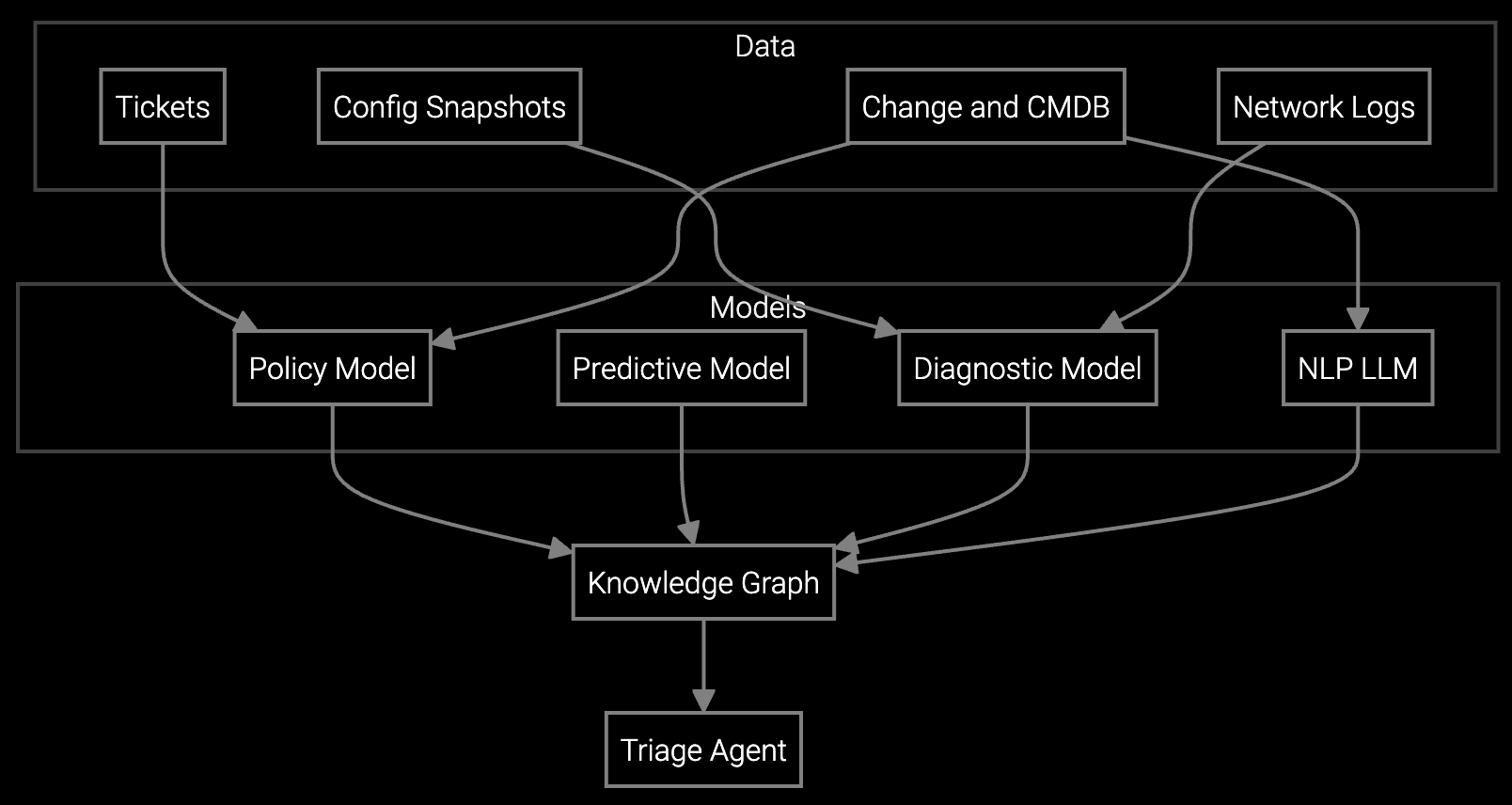
Every unplanned minute of fab downtime costs $1M+, yet manual incident triage still burns hours your support engineers don't have.
Bruviti deployment data shows automated remote support surfaces top-three cause suggestions on 70% or more of incidents at 85% precision. For semiconductor leaders, automating the workflow means the system triages, diagnoses, and routes faults end to end, freeing senior engineers for the high-stakes cases that move yield.
Support engineers spend hours manually parsing equipment logs and telemetry to identify root cause. By the time they reach a diagnosis, production time is already lost and fab managers are demanding answers.
Without real-time guidance, support engineers escalate issues to field service that could have been resolved remotely. Each unnecessary dispatch adds cost and extends downtime while the fab waits for a specialist to arrive.
Resolutions live in scattered email threads, chat logs, and individual engineers' notes. When a similar issue recurs, teams re-diagnose from scratch instead of applying known fixes—wasting time and risking inconsistent outcomes.
Bruviti transforms semiconductor remote support from a reactive scramble into an automated, data-driven workflow. The platform continuously ingests equipment telemetry, process sensor data, and historical incident patterns to build a real-time understanding of fab equipment health across all tool types—from lithography systems to etch chambers.
When an incident occurs, the AI automatically executes root cause analysis by correlating current telemetry against known failure signatures, then routes the case to the appropriate resolution path. Support engineers receive a complete diagnostic package with validated troubleshooting steps, eliminating manual log parsing. For recurring issues, the system presents the exact resolution that worked previously, auto-populates case notes, and flags potential field service needs before the engineer requests escalation.
Semiconductor manufacturing presents unique workflow demands: sub-5nm processes require instant response to recipe drift, chamber contamination triggers cascade effects across tool sets, and OEE targets above 95% leave zero margin for diagnostic delays. Traditional remote support workflows fail because they treat each incident in isolation, missing the systemic patterns that reveal whether a lithography alignment error signals a recipe issue, consumable degradation, or upstream contamination.
Bruviti's platform ingests telemetry from all critical tool types—EUV systems, deposition chambers, metrology equipment, and wafer handling automation—to build a unified incident context. When a support engineer receives an alert, the AI has already analyzed process sensor data, correlated it against maintenance schedules and recent recipe changes, and identified whether this is a new failure mode or matches a known pattern. This fab-wide visibility transforms support from reactive troubleshooting into proactive workflow orchestration.
The platform flags anomalies that fall outside known failure signatures and routes them to senior support engineers with full telemetry context. As engineers resolve these cases, their diagnostic steps and outcomes are captured to train future pattern recognition. This continuous learning loop ensures the AI adapts to evolving equipment behavior without requiring manual retraining.
Bruviti provides APIs that connect to standard remote access platforms, ticketing systems, and equipment telemetry feeds. Initial integration typically focuses on high-volume tool types with the greatest downtime impact. Most semiconductor OEMs complete pilot integration within 4-6 weeks, starting with a single fab line to validate workflow improvements before expanding.
Track three metrics: remote resolution rate increase, field escalation reduction, and mean time to resolution improvement. For semiconductor OEMs, every percentage point improvement in remote resolution rate translates directly to avoided field dispatch costs and reduced equipment downtime. Most organizations see measurable impact within the first 90 days of deployment.
The system operates in two modes: guided resolution and auto-execution. For high-confidence scenarios matching known patterns, the AI can auto-execute safe actions like configuration adjustments or firmware updates. For complex or novel incidents, it presents validated troubleshooting steps for engineer review. OEMs configure the automation threshold based on their risk tolerance and equipment criticality.
The platform analyzes incident telemetry to determine whether remote resolution is feasible before escalation occurs. It provides support engineers with complete diagnostic context, step-by-step troubleshooting guidance, and confidence scores for recommended actions. This eliminates premature escalations driven by uncertainty or incomplete information, reserving field service for issues that genuinely require on-site intervention.
Software stocks lost nearly $1 trillion in value despite strong quarters. AI represents a paradigm shift, not an incremental software improvement.
Function-scoped AI improves local efficiency but workflow-native AI changes cost-to-serve. The P&L impact lives in the workflow itself.

Five key shifts from deploying nearly 100 enterprise AI workflow solutions and the GTM changes required to win in 2026.
See how semiconductor OEMs are reducing escalations and protecting fab uptime with AI-orchestrated incident resolution.
Schedule Demo