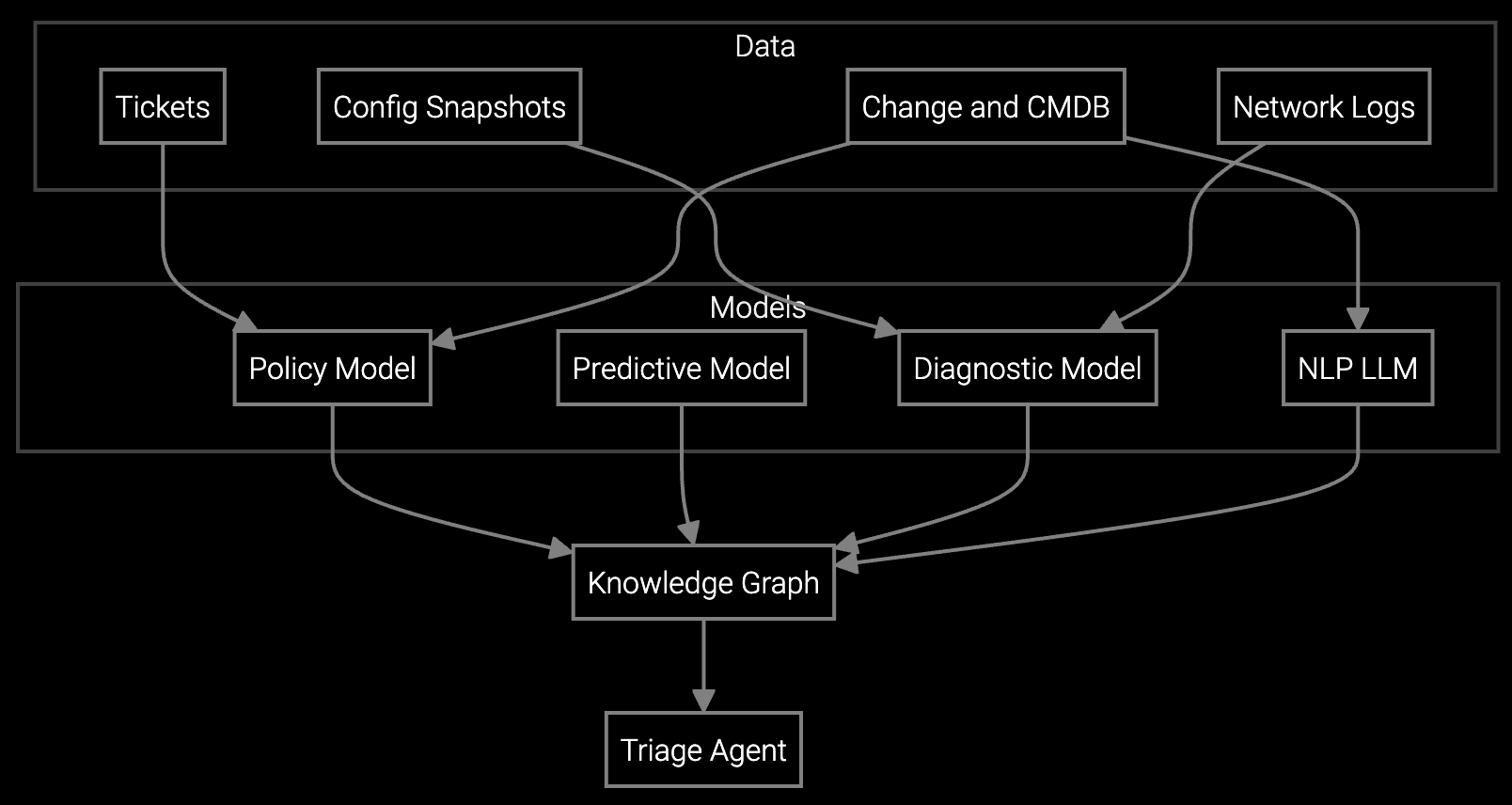
When router failures cascade into network-wide outages, every minute of remote diagnostic time directly impacts your customers' SLA penalties.
Network remote support AI returns 50% fewer duplicate investigations and 3x reuse of proven fixes, per Bruviti deployment data. For builders sizing the payback, the cost driver is wasted engineer hours re-diagnosing solved incidents. Eliminating that duplication, plus a 40% to 60% MTTR reduction, is where the labor savings and ROI concentrate.
Support engineers manually parse SNMP traps, syslog streams, and firmware logs across carrier-grade routers and switches. Pattern matching requires domain expertise and extends session duration.
When remote diagnostics hit dead ends, cases escalate to specialized network engineers or move to RMA processing. Each handoff adds cycle time and increases total resolution cost.
Network infrastructure troubleshooting knowledge lives in senior engineers' heads. Firmware-specific workarounds and configuration fixes don't propagate across the team, creating resolution time variance.
The platform ingests network telemetry (SNMP traps, syslog, firmware error codes) and maps patterns to known resolution paths. When a support engineer opens a remote session, the system auto-parses logs, identifies probable root causes, and surfaces guided troubleshooting workflows. This eliminates hours of manual log review and reduces diagnostic dead ends.
For network equipment OEMs, the ROI calculation centers on remote resolution rate improvement. Each percentage point increase in first-session fixes reduces escalations, shortens mean time to resolution, and lowers cost per incident. Integration via Python SDKs allows your team to ingest custom telemetry feeds and customize diagnostic workflows without vendor lock-in.
Network equipment OEMs serving enterprise and carrier customers operate NOCs with 24/7 support commitments. Each remote session consumes support engineer time analyzing SNMP traps, firmware logs, and configuration files. Reducing session duration directly lowers labor cost per incident. When remote resolution rates climb from 55% to 75%, escalation volumes drop, freeing specialized engineers for complex cases rather than routine troubleshooting.
A typical router or switch RMA costs $1,200-$2,500 in logistics, testing, and no-fault-found processing. Every avoided RMA through improved remote diagnostics flows directly to margin. For OEMs handling 10,000+ support cases monthly, a 20-point improvement in remote resolution rate eliminates 2,000 escalations per month, saving $180K-$300K monthly in escalation and RMA costs.
Most network equipment OEMs see positive ROI within 6-9 months. The calculation hinges on cost per incident reduction (labor + escalation savings) multiplied by monthly case volume. OEMs handling 8,000+ remote support cases monthly typically break even in 5-7 months when remote resolution rates improve 15-20 points.
Track first-session fix rate (percentage of remote sessions that close without escalation or RMA) before and after AI deployment. Baseline this metric for 30 days pre-deployment, then monitor weekly. A 15-20 point improvement within 90 days indicates strong ROI trajectory. Session duration and escalation volume are secondary metrics that validate the primary KPI.
At minimum, ingest SNMP traps, syslog streams, and firmware error codes. Most network equipment OEMs also feed configuration snapshots and interface statistics. The platform's Python SDK allows custom telemetry ingestion from proprietary monitoring systems or NOC tools. More data sources improve diagnostic accuracy but aren't required for initial deployment.
Yes. The platform exposes APIs to define custom troubleshooting workflows based on device model, firmware version, or fault type. Your team retains ownership of workflow logic while the AI handles pattern matching and log analysis. This prevents vendor lock-in and allows you to encode proprietary domain knowledge.
The platform doesn't replace remote access tools—it augments them. When a support engineer initiates a remote session, the AI pulls telemetry, analyzes logs, and presents diagnostic guidance within your existing workflow. Integration happens via API calls that your team controls, so the system fits your current toolchain rather than forcing a replacement.
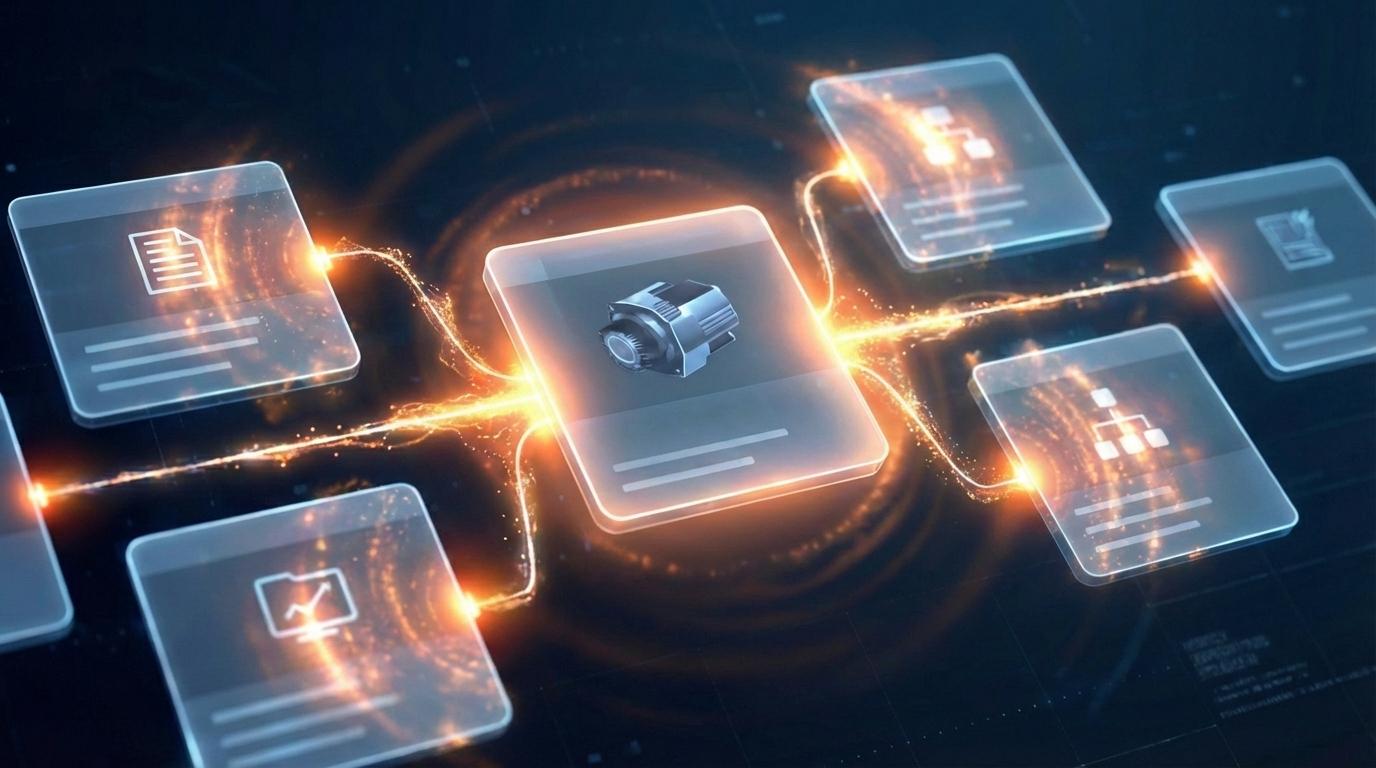
Software stocks lost nearly $1 trillion in value despite strong quarters. AI represents a paradigm shift, not an incremental software improvement.
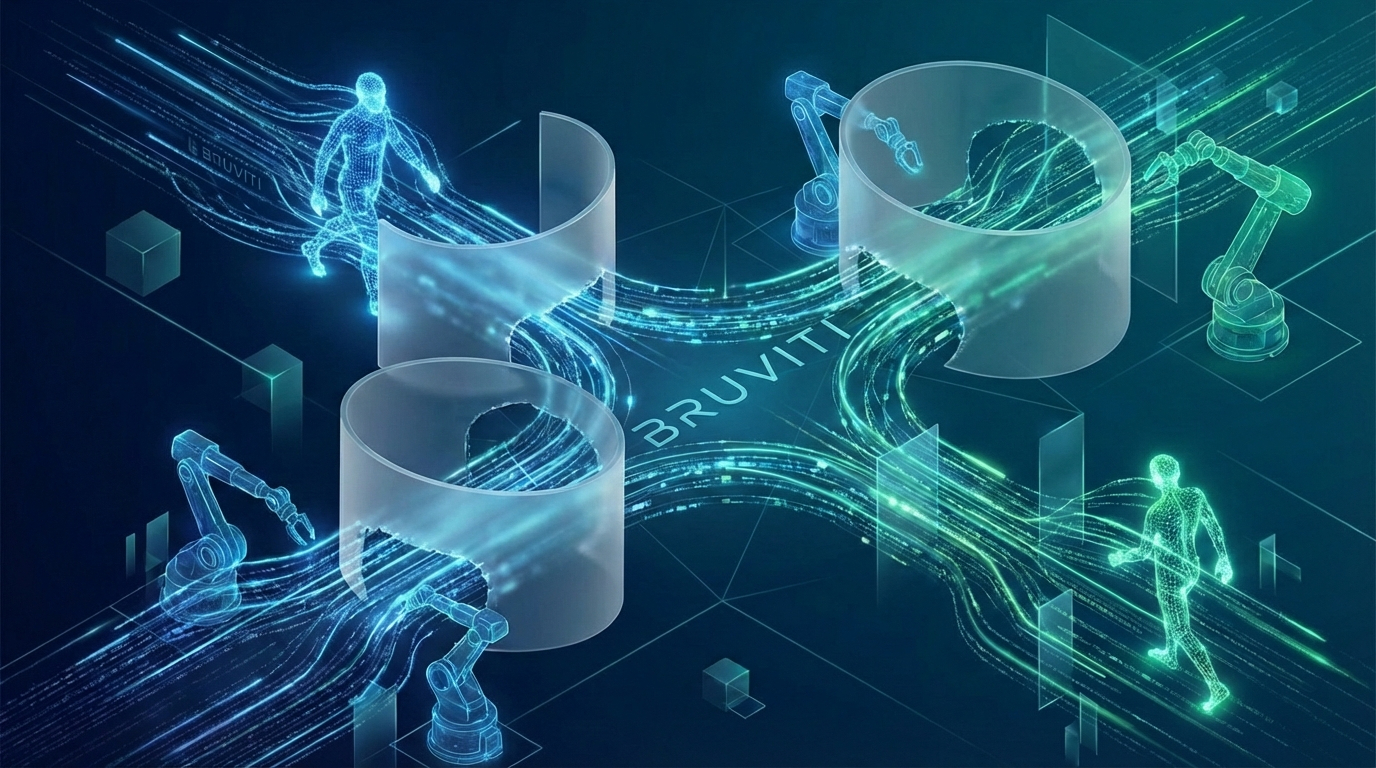
Function-scoped AI improves local efficiency but workflow-native AI changes cost-to-serve. The P&L impact lives in the workflow itself.
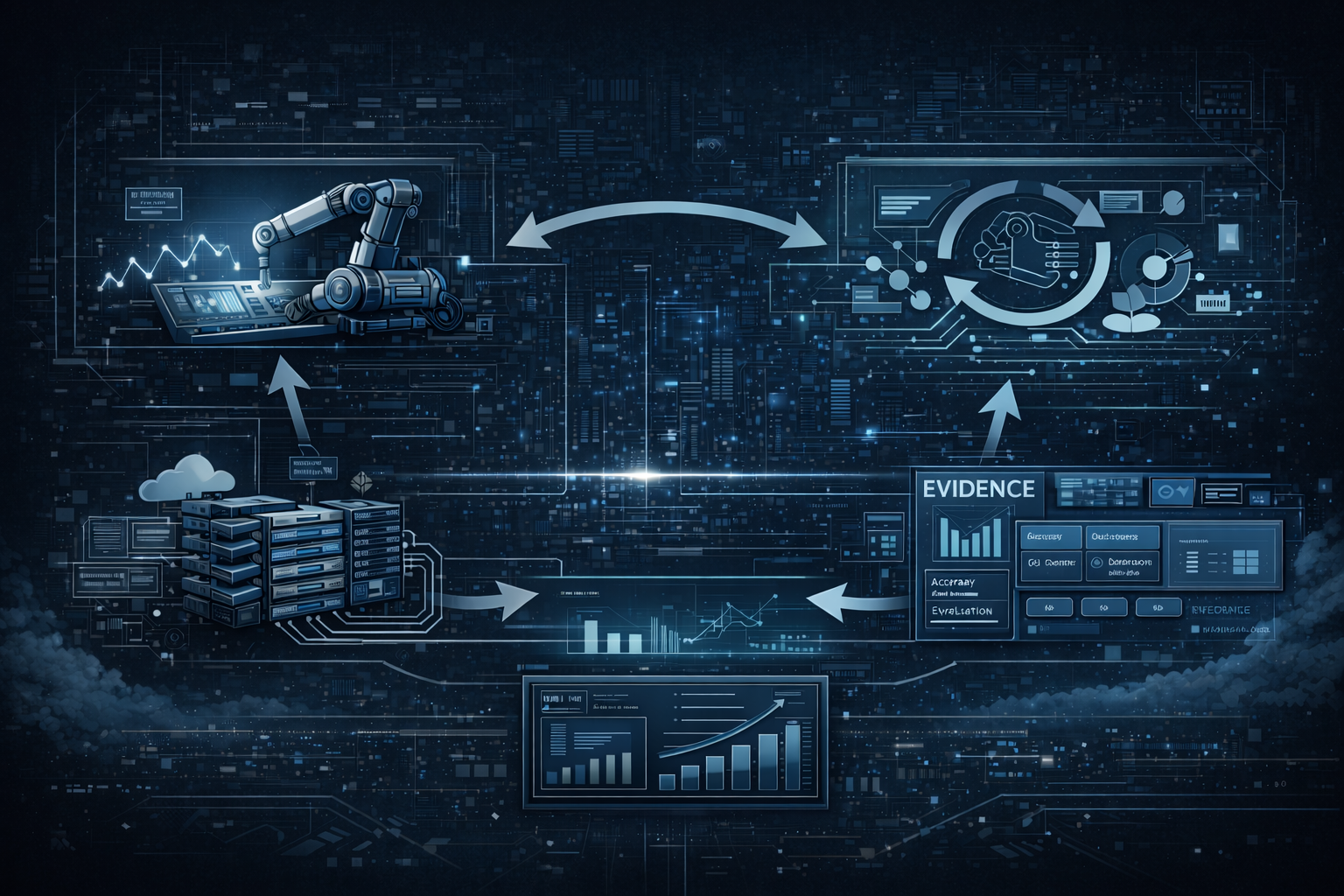
Five key shifts from deploying nearly 100 enterprise AI workflow solutions and the GTM changes required to win in 2026.
See how AI-guided diagnostics reduce cost per incident for your network equipment support operations.
Schedule Technical Demo