
Contact centers handling router, switch, and firewall cases face rising costs as case volumes grow faster than agent headcount.
AI-assisted resolution lowers average handle time 12.5% on network equipment cases, per Bruviti deployment data. Each saved minute compounds across thousands of monthly tickets into measurable cost reduction. Build the ROI model on handle-time savings first, since it is the most directly attributable line and ties to existing agent cost per case.
Agents spend 6-9 minutes per case searching fragmented knowledge bases for firmware compatibility matrices, SNMP trap definitions, and configuration troubleshooting guides across multiple systems. Each additional minute costs the contact center in labor and reduces throughput.
Network equipment cases escalate when agents lack diagnostic context from syslog data or configuration history. Repeat contacts double handling costs and erode customer satisfaction, particularly when NOC teams face SLA penalties for unresolved incidents.
Manual case classification, redundant data entry, and escalation loops drive contact center expenses up while case volumes from multi-vendor network environments continue to grow. Operators cannot hire fast enough to maintain service levels without expanding cost per case.
The platform's API-first architecture integrates with existing CRM and ticketing systems via Python and TypeScript SDKs, preserving current workflows while automating knowledge retrieval and case classification. Agents receive contextual answers from technical documentation, historical case data, and equipment telemetry without switching applications or waiting for escalation.
Custom model training on historical network equipment cases enables the system to recognize failure patterns in syslog data, correlate SNMP traps with known firmware issues, and route configuration-related incidents directly to L2 teams. This reduces time agents spend manually classifying cases and searching for router-specific troubleshooting steps across fragmented knowledge sources.
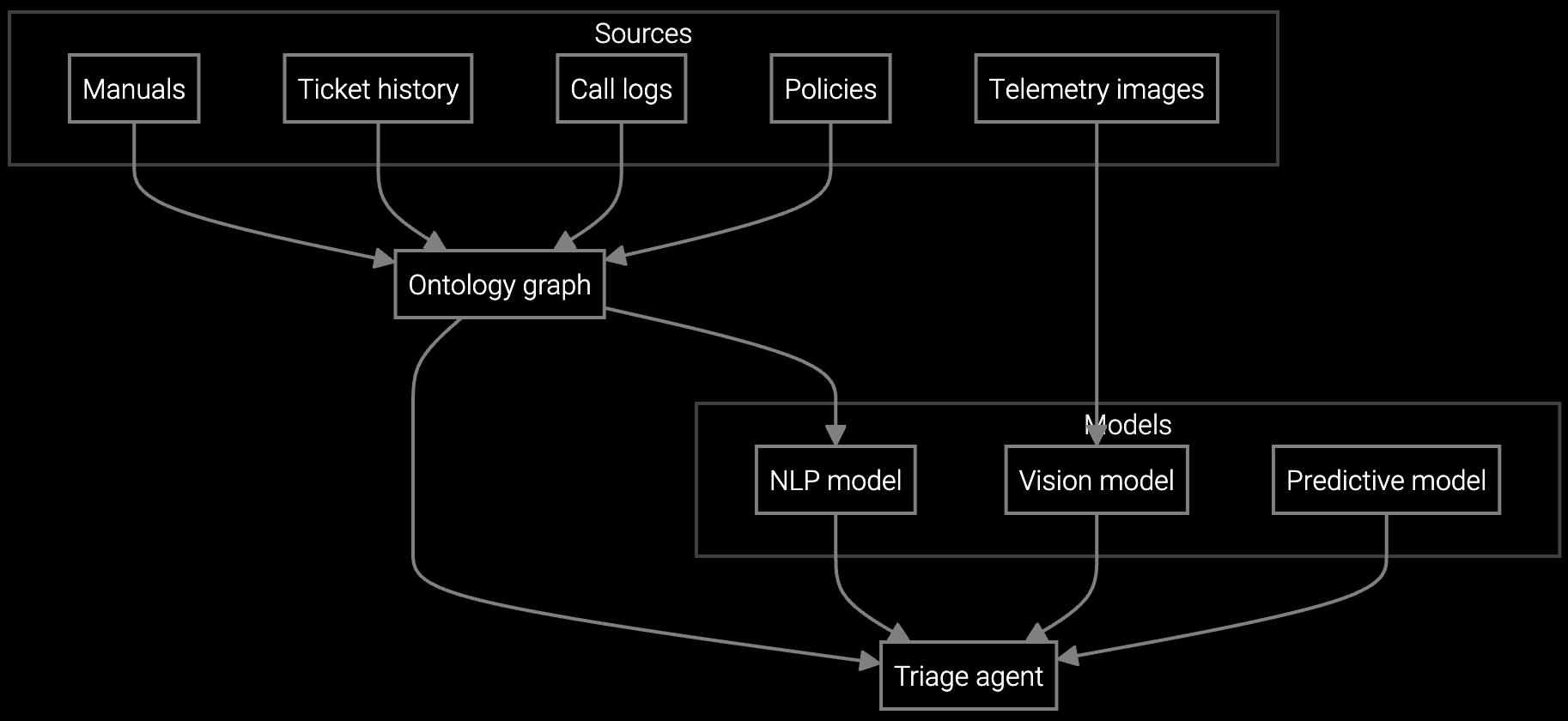
Autonomous case classification for network equipment incidents analyzes syslog patterns, correlates SNMP traps with firmware versions, and routes configuration issues to the correct L2 team with full diagnostic context.
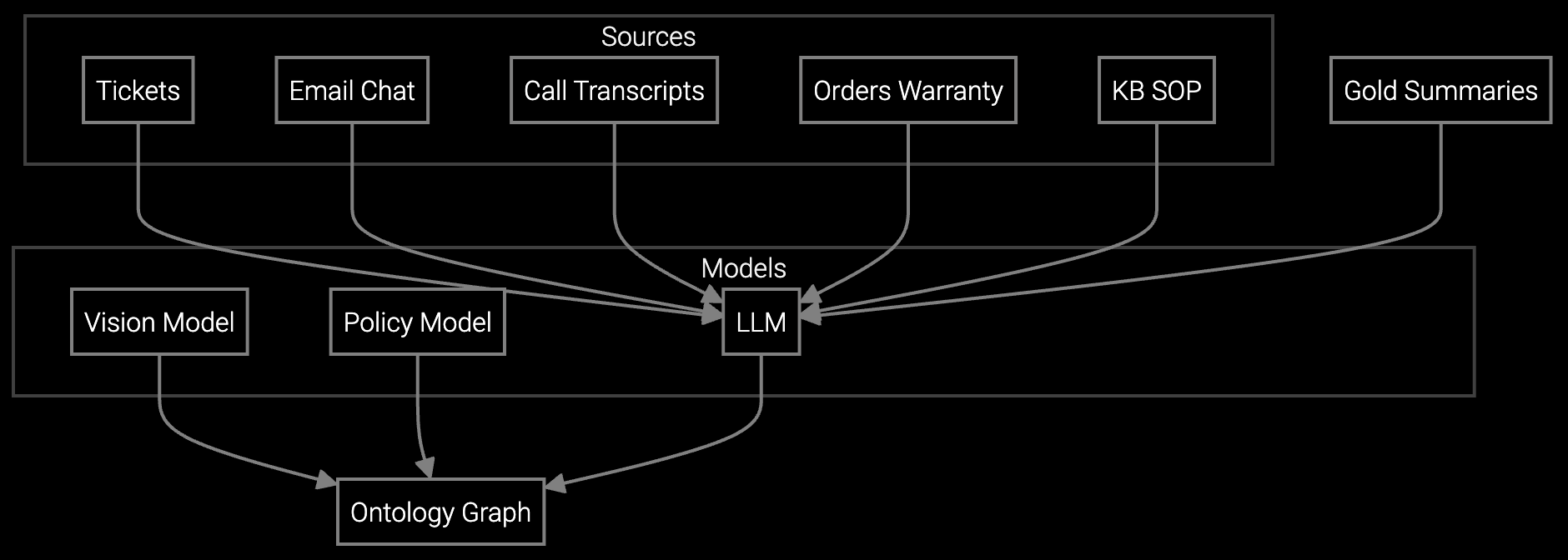
Instant case history summaries from NOC tickets, email threads, and call transcripts give agents full context on router upgrade issues or switch failures without reading multi-page case notes.
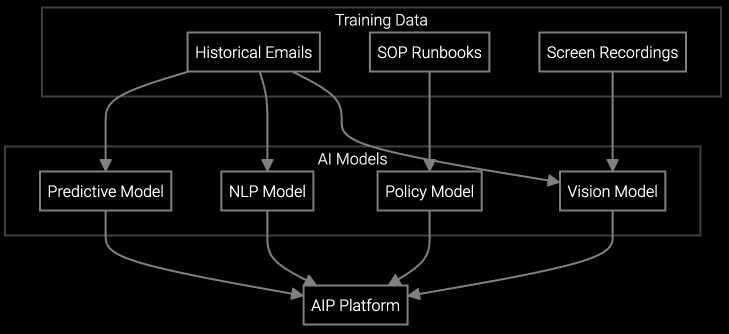
AI reads and classifies incoming network support emails, extracting device serial numbers and error codes, then drafts responses using firmware compatibility matrices and configuration best practices from internal knowledge bases.
Network equipment manufacturers handle 3-5x higher case volumes than other industries because devices connect to NOC monitoring systems that generate automated alerts for every SNMP trap, syslog warning, or configuration drift event. Each router or switch can create dozens of cases annually, multiplying agent workload as installed base grows.
Contact centers also face complexity from multi-vendor environments where customers run Cisco, Juniper, Arista, and proprietary gear side-by-side. Agents must maintain expertise across competing firmware architectures, CLI syntax variations, and vendor-specific RMA processes. AI trained on historical case data provides instant answers to "Which firmware version resolves CVE-2024-XXXX on this switch model?" without manual knowledge base searches.
Track three core metrics: average handle time reduction (target 35-40%), first contact resolution improvement (target 78-82% from baseline 62%), and cost per contact decrease (target $8-12 savings). Multiply these gains by annual case volume to calculate total cost avoidance. Network OEMs typically see payback within 6-9 months as agent productivity increases without headcount expansion.
API integration using Python or TypeScript SDKs typically requires 4-6 weeks of developer time to connect existing CRM, ticketing systems, and knowledge bases. One-time setup costs range from $40K-$80K depending on system complexity, but ongoing maintenance is minimal because the platform uses standard REST APIs. Avoid platforms requiring proprietary connectors or middleware that create vendor lock-in and recurring licensing fees.
Yes. The platform supports custom model training on your historical case data, syslog archives, and firmware documentation. This enables the AI to recognize vendor-specific failure patterns, router configuration issues unique to your product line, and troubleshooting steps your agents have validated over years of network support. Training cycles take 2-4 weeks and can be refreshed quarterly as new firmware versions and case types emerge.
AI analyzes incoming case symptoms against historical data to identify when agents lack sufficient diagnostic context. For network equipment cases, the system auto-retrieves relevant syslog excerpts, SNMP trap histories, and configuration baselines before the agent responds. This prevents escalations caused by incomplete information and reduces repeat contacts from customers saying "the first agent didn't have access to my device logs."
Check for three signals: open API documentation with no rate limits on data export, support for standard Python and TypeScript SDKs without proprietary runtimes, and the ability to self-host model inference endpoints. Request API response time SLAs and uptime guarantees. Verify you can extract all training data, model weights, and case histories in standard formats if you migrate to another platform.

Understanding and optimizing the issue resolution curve.

Part 1: The transformation of IT support with AI.
Part 2: Implementing AI in IT support.
See how Bruviti's API-first platform reduces AHT and improves FCR in your network equipment support operation.
Request ROI Analysis