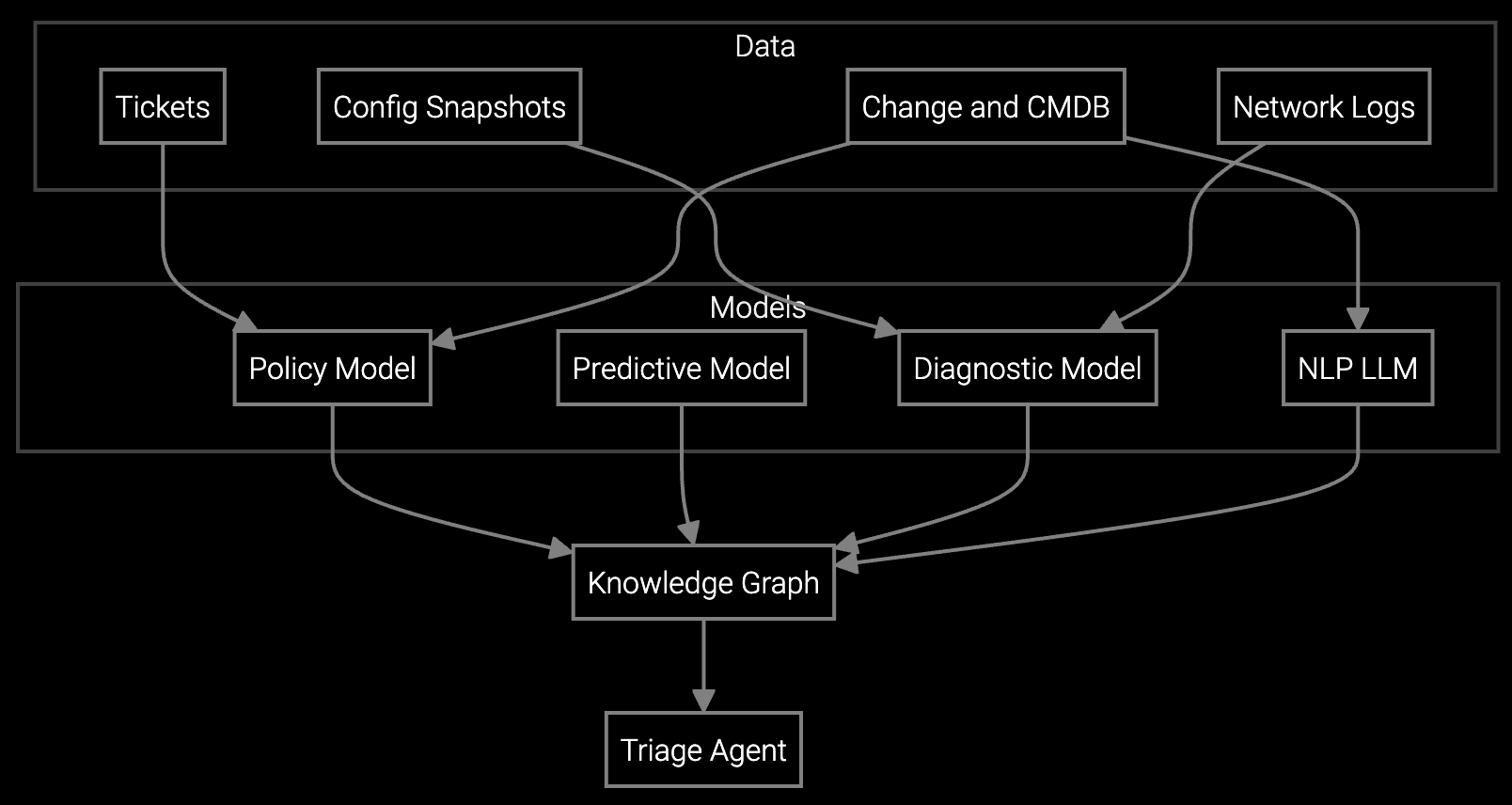
Fragmented tools and undocumented resolutions force support engineers to rediscover the same router firmware bugs and switch configuration errors repeatedly.
Knowledge-driven root cause analysis cuts duplicate investigations by 50% and drives 3x reuse of proven fixes, per Bruviti deployment data. For network remote support, that means siloed runbooks, ticket notes, and engineer tribal knowledge become one searchable layer. Engineers stop re-solving incidents that a peer already cracked, and every resolution feeds the next.
Different remote access platforms for routers, switches, and firewalls prevent support engineers from building consistent workflows. SNMP traps, syslog formats, and CLI syntax vary by vendor, forcing manual context switching and preventing automated pattern recognition across product families.
Support engineers resolve network incidents through trial and error, but session notes capture only final outcomes. Root cause analysis steps, failed attempts, and telemetry correlations disappear when engineers close tickets, forcing new hires to rediscover the same firmware compatibility issues and configuration edge cases.
Syslog files contain thousands of entries per incident, but no standardized parser extracts relevant error sequences. Support engineers spend hours manually correlating timestamps across SNMP traps, firmware logs, and configuration dumps instead of focusing on diagnosis and resolution.
The Bruviti platform provides Python and TypeScript SDKs that ingest syslog, SNMP, and telemetry streams from heterogeneous network equipment. A centralized log parser converts vendor-specific formats into normalized JSON schemas, enabling pattern matching across router models and switch firmware versions without rewriting integration code.
Session context APIs capture each troubleshooting step, failed hypothesis, and successful resolution path. When a support engineer diagnoses a PoE power budget issue on a Catalyst switch, the SDK automatically indexes the telemetry signature, CLI commands used, and resolution workflow. Future incidents matching that telemetry pattern surface the documented solution before engineers begin manual analysis.
Network equipment OEMs support diverse hardware portfolios spanning enterprise routers, carrier-grade switches, wireless controllers, and security appliances. Each product line generates distinct telemetry formats: SNMP traps for hardware faults, syslog for firmware events, and NETCONF streams for configuration changes. A unified remote support platform must normalize these data sources without requiring support engineers to learn vendor-specific parsing logic.
The platform ingests telemetry from existing NOC monitoring tools via standard APIs, eliminating the need to replace operational dashboards. Support engineers access centralized session history showing which firmware bugs triggered previous RMAs, which CLI commands resolved PoE failures, and which configuration templates prevented spanning-tree loops. This institutional knowledge survives staff turnover and reduces mean time to resolution for recurring network incidents.
The platform uses machine learning models trained on millions of syslog entries, SNMP MIBs, and firmware logs to automatically identify error patterns, timestamps, and severity markers regardless of vendor syntax. You define output JSON schemas once, and the system handles format variations across Cisco IOS, Juniper Junos, Arista EOS, and proprietary firmware without manual regex maintenance.
Yes. The platform exposes session history, telemetry patterns, and resolution workflows via RESTful APIs with OpenAPI documentation. All data uses open JSON schemas, allowing you to export resolution knowledge to internal data lakes, build custom Grafana dashboards, or train proprietary ML models on troubleshooting patterns. No proprietary binary formats or closed databases.
The matching algorithm combines telemetry signature similarity, firmware version proximity, and configuration context. It surfaces previous resolutions as suggestions with confidence scores, not as automated fixes. Support engineers review recommended workflows, confirm telemetry alignment, and adapt steps to the current network topology. This human-in-the-loop approach prevents automation from applying outdated solutions to evolved network architectures.
The Python SDK provides webhook listeners that capture session start/end events, screen sharing metadata, and CLI command logs from common remote access platforms. Integration typically requires 2-3 days of developer time to configure webhook endpoints and map session identifiers to your existing ticketing system. The SDK handles authentication, retry logic, and data normalization automatically.
All session data is encrypted at rest using AES-256 and in transit via TLS 1.3. You control data residency and retention policies through configuration files. The platform redacts IP addresses, SNMP community strings, and authentication credentials from stored logs by default. You can deploy the entire system in your private cloud or on-premises environment to meet data sovereignty requirements.
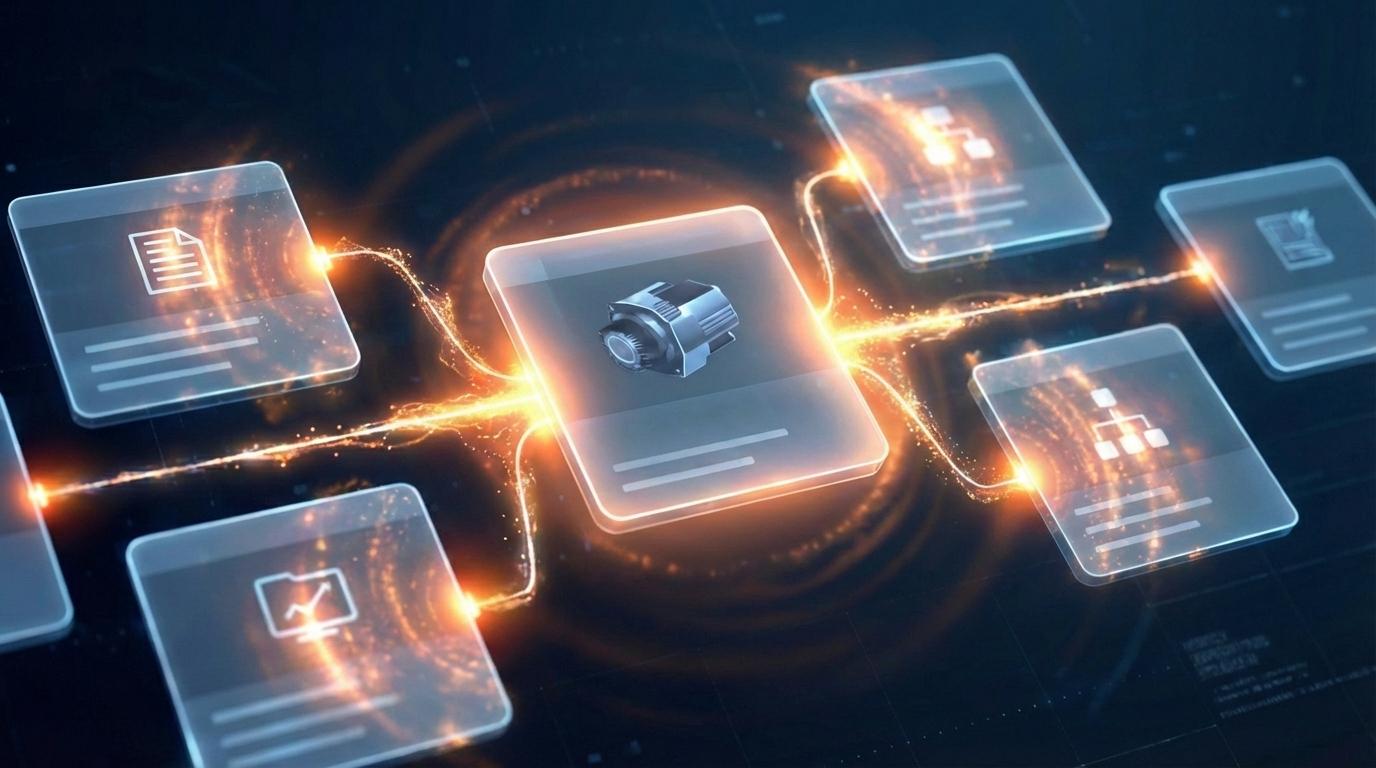
Software stocks lost nearly $1 trillion in value despite strong quarters. AI represents a paradigm shift, not an incremental software improvement.
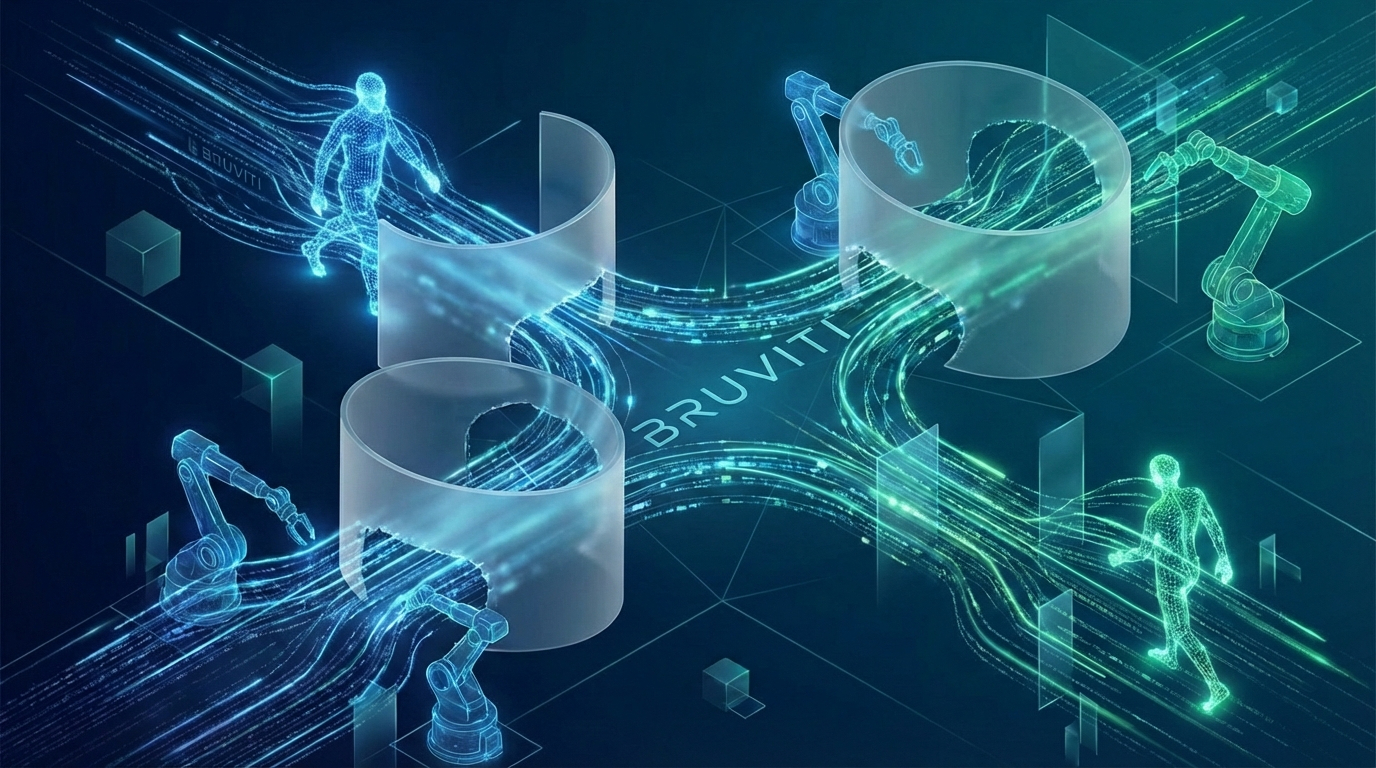
Function-scoped AI improves local efficiency but workflow-native AI changes cost-to-serve. The P&L impact lives in the workflow itself.
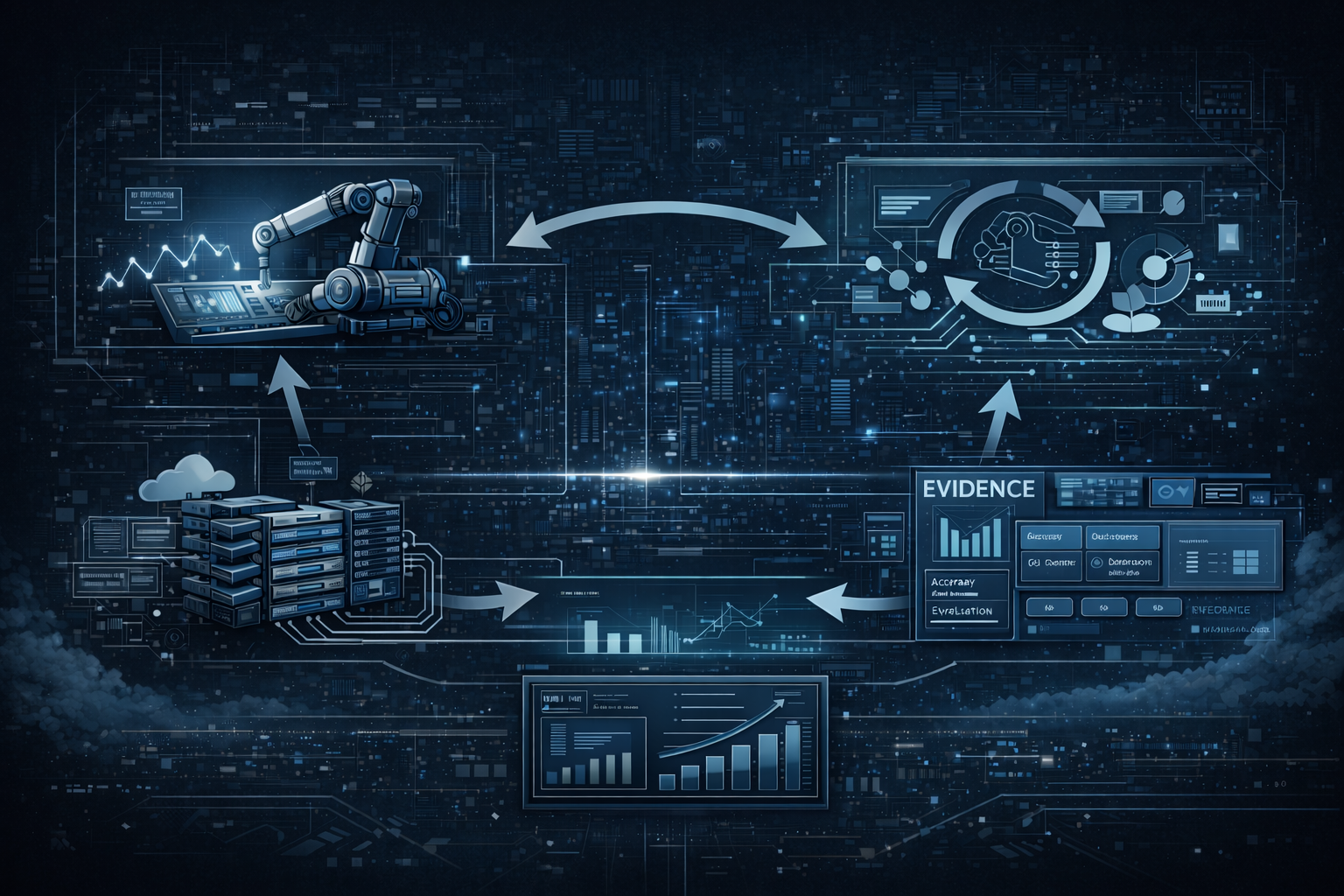
Five key shifts from deploying nearly 100 enterprise AI workflow solutions and the GTM changes required to win in 2026.
Review API documentation, integration examples, and SDK architecture before committing.
Access Technical Documentation