When 40% of remote sessions escalate, your support costs multiply and customer downtime extends—both hitting network availability SLAs.
AI-driven incident management cuts L3 escalations by 35% or more, per Bruviti deployment data. Scarce senior network engineers are the bottleneck, and excessive escalations burn their time on issues L1 and L2 could close. An auto-triage layer resolves more at the front line, protecting expert capacity for the incidents that genuinely need it.
Support engineers spend hours parsing SNMP traps and syslog files from routers and switches, often missing subtle patterns that indicate the actual failure point across distributed network infrastructure.
Firewall restrictions and network segmentation prevent comprehensive device access, forcing support engineers to escalate rather than diagnose remotely, especially in multi-vendor environments with inconsistent telemetry formats.
Firmware-specific quirks and configuration edge cases exist only in senior engineers' experience, creating dependency bottlenecks when complex network issues require escalation to scarce expert resources.
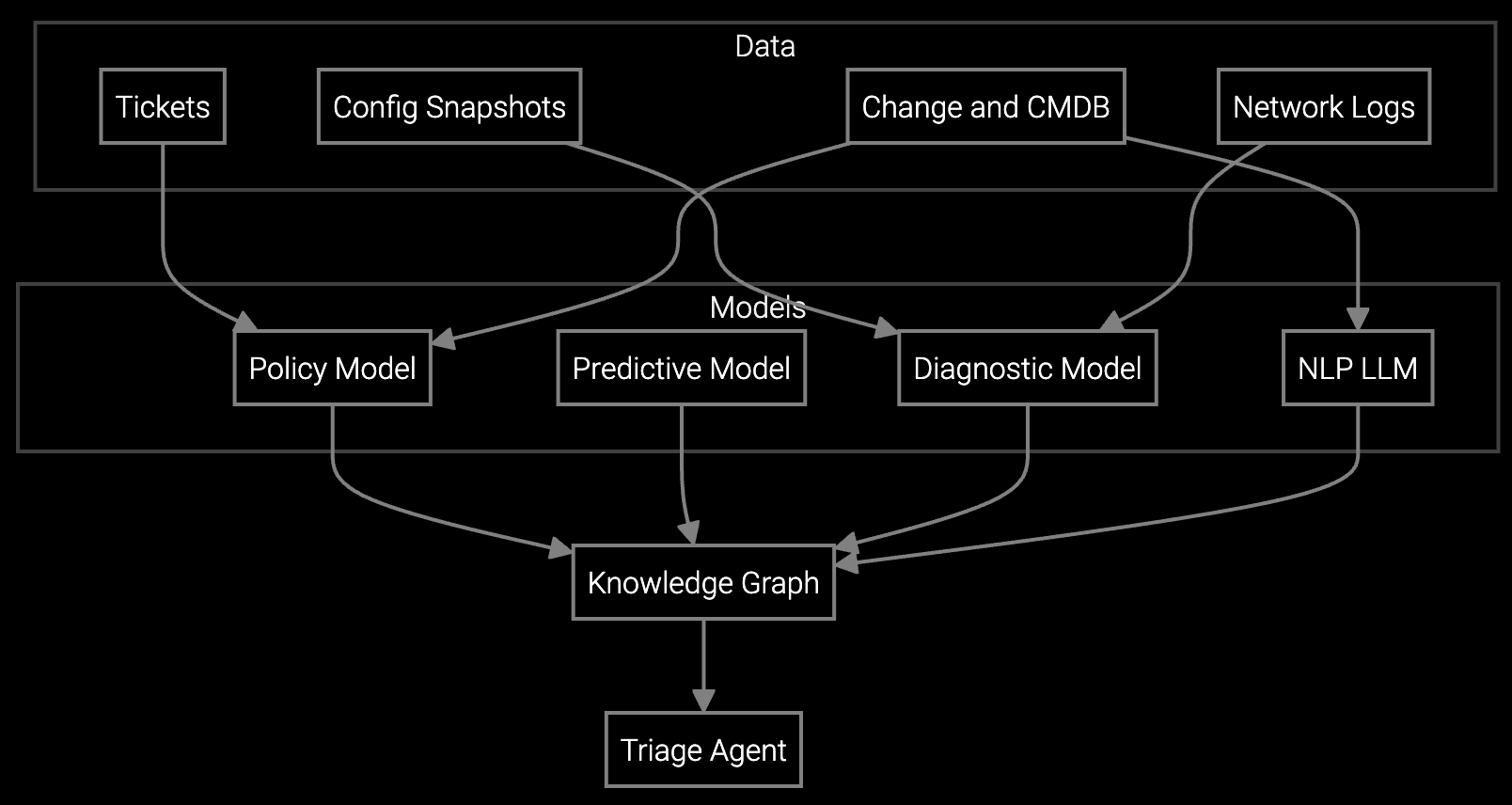
Bruviti's platform ingests real-time network telemetry—SNMP traps, syslog streams, error counters, and firmware logs—to identify root causes during the remote session. The AI correlates patterns across device populations, detecting failure signatures that manual analysis misses: firmware incompatibilities causing intermittent packet loss, configuration drift triggering routing loops, or hardware degradation patterns preceding total failures.
Support engineers receive guided troubleshooting workflows with step-by-step diagnostics tailored to the specific device model and observed symptoms. Session transcripts automatically populate case notes, capturing resolution paths that feed back into the AI's knowledge base. When escalation is unavoidable, the platform provides complete context—parsed logs, attempted resolutions, and predicted root cause—eliminating handoff delays and redundant diagnostics.
Network equipment OEMs support thousands of devices deployed across carrier networks and enterprise data centers, where 24/7 uptime requirements make escalation delays directly visible to customers. Remote support engineers diagnose router firmware bugs, switch configuration conflicts, and firewall policy errors—issues that span multiple device types and software versions, each generating megabytes of syslog data per incident.
AI diagnostics parse this telemetry in real time, identifying patterns like firmware CVE signatures causing packet drops or SNMP trap sequences indicating imminent hardware failure. The platform recognizes when a "configuration issue" is actually a known firmware regression affecting specific software versions, preventing unnecessary escalations by surfacing the documented workaround. For network OEMs serving enterprise and carrier customers with five-nines availability SLAs, reducing escalation rate directly translates to faster incident resolution and protected customer uptime guarantees.
The platform analyzes telemetry patterns across your device population to identify root causes that individual support engineers miss—firmware incompatibilities, configuration drift sequences, or hardware degradation signatures. By surfacing these patterns during the remote session, the AI enables first-contact resolution for issues that previously required escalation to senior engineers with deep product knowledge.
The platform processes SNMP traps, syslog streams, error counters, firmware logs, and configuration snapshots from routers, switches, firewalls, and wireless infrastructure. It correlates this data with historical incident patterns, known CVEs, and resolution outcomes to identify likely root causes specific to your device models and software versions.
Network equipment OEMs typically observe 15-20% escalation rate reduction within the first 90 days as the AI learns your device population's failure patterns and support engineers adopt guided troubleshooting workflows. Full impact—25-30% reduction—emerges at six months when the platform has captured sufficient firmware-specific quirks and configuration edge cases from your resolved incidents.
No. The platform integrates with your existing remote access infrastructure, NOC monitoring systems, and case management tools. It enhances support engineer capabilities by analyzing the telemetry those tools collect, identifying root causes, and suggesting resolution paths—without requiring a rip-and-replace of your remote support stack.
The AI normalizes telemetry formats across vendors, recognizing that a "port error" manifests differently in Cisco IOS syslog versus Juniper Junos event logs. It correlates symptoms across device types to diagnose issues spanning multiple vendors—for example, identifying that intermittent connectivity problems originate from a firmware bug in one vendor's switch affecting traffic to another vendor's router.
Software stocks lost nearly $1 trillion in value despite strong quarters. AI represents a paradigm shift, not an incremental software improvement.
Function-scoped AI improves local efficiency but workflow-native AI changes cost-to-serve. The P&L impact lives in the workflow itself.
Five key shifts from deploying nearly 100 enterprise AI workflow solutions and the GTM changes required to win in 2026.
See how AI diagnostics improve remote resolution rates for network equipment OEMs.
Schedule Demo