
Hyperscale deployments demand asset tracking that keeps pace with hardware sprawl across distributed sites.
Bruviti deployment data shows a connected installed-base approach cutting time to root cause by 65% and repeat failures by 20%. For operators choosing how to manage data center equipment, a unified asset model beats spreadsheets and siloed tools by making every fault traceable to the right asset instantly.
Server firmware versions, memory configurations, and RAID setups drift from documented state as hardware teams make emergency changes without updating systems.
Legacy equipment installed before modern tracking systems remains invisible in asset databases, creating blind spots for lifecycle planning and support coverage.
Without predictive visibility into component health across the installed base, maintenance windows happen on fixed schedules rather than actual equipment condition.
Effective installed base management for data center equipment requires a hybrid strategy combining automated telemetry collection with manual registration processes. The platform continuously ingests BMC and IPMI data streams to track real-time hardware state while providing workflows for registering legacy equipment that predates automated monitoring capabilities.
This approach maintains a complete asset registry spanning multi-generational deployments without forcing infrastructure teams to retrofit telemetry systems onto older equipment. Configuration change detection alerts operators to firmware updates, memory additions, and RAID rebuilds as they occur, eliminating the documentation lag that causes configuration drift. The system builds historical baselines for each server, storage array, and cooling unit, enabling predictive maintenance scheduling based on actual component behavior patterns rather than manufacturer-recommended service intervals.

Virtual models of server and storage configurations track real-time performance metrics, alerting when thermal patterns or RAID rebuild times deviate from baseline behavior.

Analyzes IPMI telemetry streams from distributed data center fleets to identify memory errors, drive SMART warnings, and power anomalies before they escalate to failures.
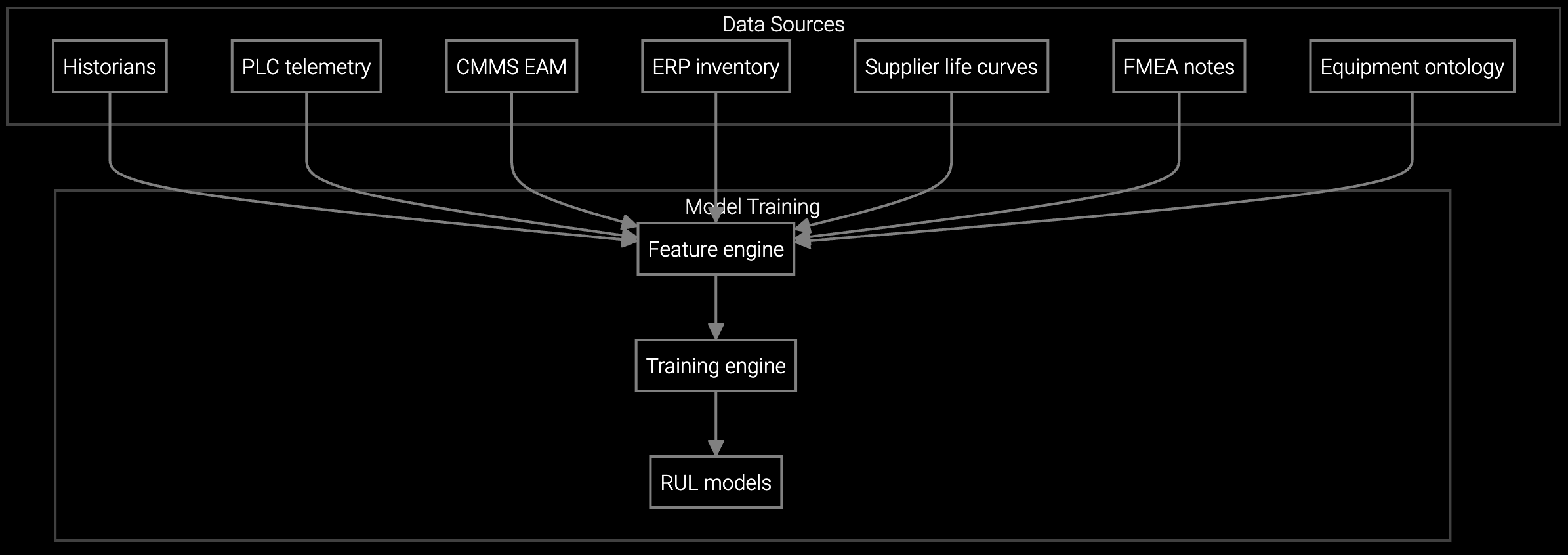
Estimates when cooling systems, power supplies, and storage drives will require replacement based on usage patterns, enabling planned maintenance during scheduled windows.
Data center OEMs face unique tracking challenges as customers deploy thousands of servers across geographically distributed facilities. The platform connects to existing BMC and IPMI infrastructure to automatically register new equipment as it powers on, capturing serial numbers, firmware versions, and hardware configurations without manual data entry. This approach scales to hyperscale deployments where manual asset registration would create weeks of backlog.
For legacy equipment lacking modern telemetry capabilities, the system provides bulk import workflows that accept CSV extracts from existing CMDBs and maintenance logs. Once baseline asset records exist, the platform monitors configuration changes through continuous telemetry analysis, detecting firmware updates, memory additions, and storage expansions as they occur. This real-time visibility prevents the configuration drift that undermines capacity planning and compliance reporting in large-scale deployments.
The platform provides manual registration workflows and bulk CSV import tools for legacy equipment. Once registered, these assets appear in the same unified view as telemetry-connected hardware, enabling complete lifecycle tracking even for mixed-generation deployments. You can attach maintenance logs, warranty records, and service history to manually registered assets.
Start by connecting the platform to your existing BMC/IPMI infrastructure using read-only API credentials. Most deployments achieve 70-80% automatic asset discovery within 48 hours as equipment phones home with telemetry data. Then run a one-time bulk import of legacy equipment records from your CMDB to close remaining gaps.
The system continuously monitors telemetry streams for hardware and firmware changes. When it detects a memory upgrade, RAID rebuild, or firmware update, it automatically updates the asset record and logs the change with timestamp and configuration delta. This eliminates the manual documentation burden that causes configuration drift in fast-moving data center environments.
The platform builds performance baselines for each asset by analyzing historical telemetry patterns. It alerts when drive SMART metrics, thermal readings, or power supply voltages deviate from normal behavior, typically providing 7-14 days of warning before component failure. This enables planned maintenance during scheduled windows rather than emergency repairs during production hours.
For customer-managed deployments, the platform can ingest telemetry through outbound-only connections that don't require VPN access or firewall changes. Customers install a lightweight telemetry forwarder that pushes BMC/IPMI data to your asset registry on a scheduled basis, giving you lifecycle visibility without direct infrastructure access.

Software stocks lost nearly $1 trillion in value despite strong quarters. AI represents a paradigm shift, not an incremental software improvement.
Function-scoped AI improves local efficiency but workflow-native AI changes cost-to-serve. The P&L impact lives in the workflow itself.

Five key shifts from deploying nearly 100 enterprise AI workflow solutions and the GTM changes required to win in 2026.
See how automated telemetry ingestion and real-time configuration monitoring work across distributed data center fleets.
Schedule Demo