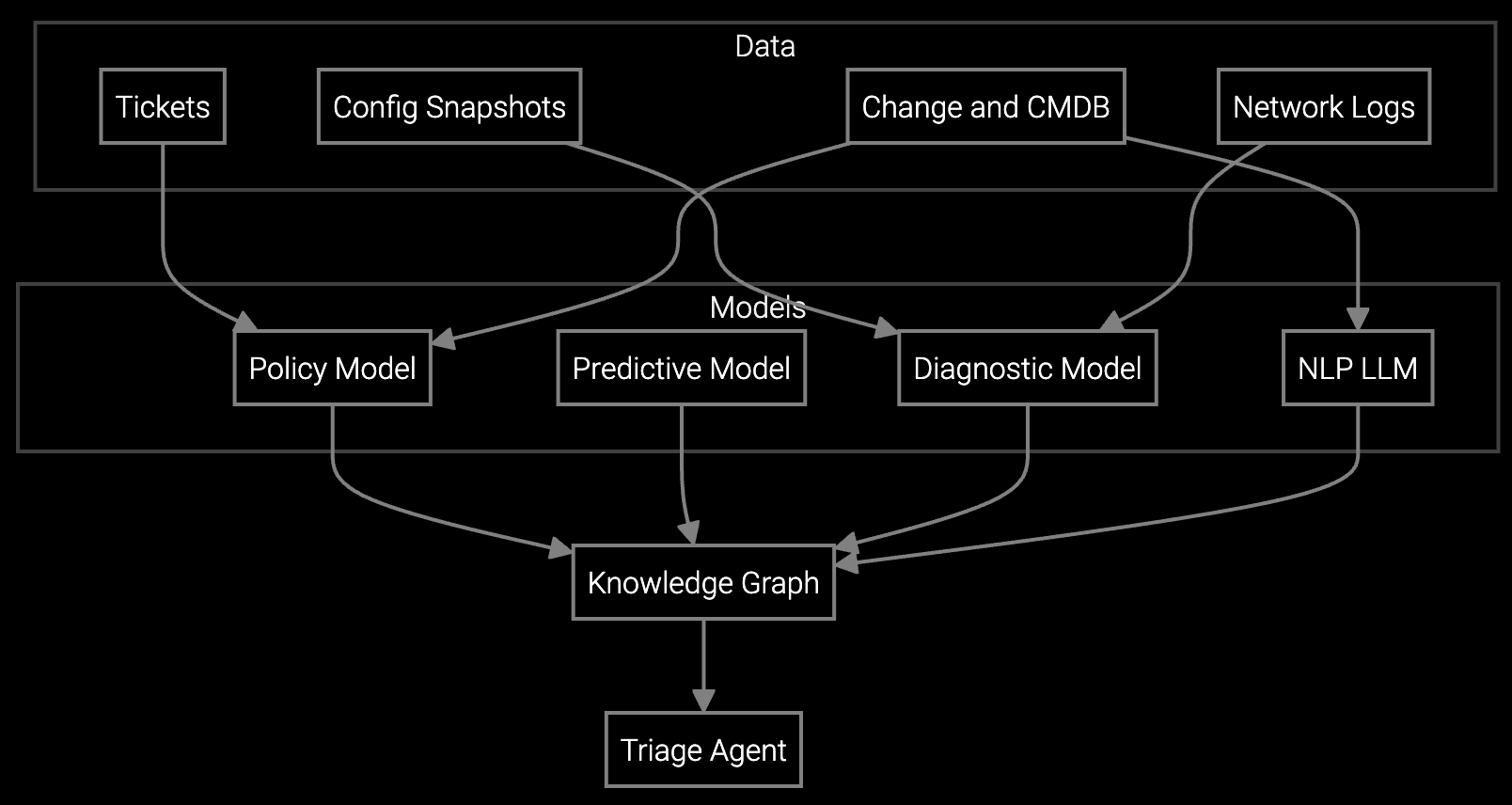
Hyperscale customers demand 99.99% uptime—your remote support strategy determines whether you defend margins or lose them to escalations.
Outcome-based AI agents cut mean time to resolution 40-60%, per Bruviti deployment data, the strategic differentiator in any build-vs-buy decision for data center OEMs. A bought, workflow-first platform reaches that gain in weeks, not the quarters a ground-up build demands.
Remote support engineers escalate issues they could resolve with better tools. Each unnecessary escalation extends MTTR and risks SLA penalties, directly impacting customer renewal rates and margin protection.
BMC telemetry, IPMI logs, and thermal data live in separate systems. Support engineers waste hours correlating data manually, delaying root cause identification and creating inconsistent resolution quality across your support org.
Your competitors are deploying AI-assisted remote support now. Every quarter you spend building in-house is a quarter they gain ground on remote resolution rates, customer satisfaction scores, and support cost per server.
Pure build strategies offer control but demand AI expertise, training data infrastructure, and 18+ months before first value. Pure buy strategies deliver speed but risk vendor lock-in and limited customization for your specific equipment portfolio.
Bruviti's platform eliminates the false choice. API-first architecture lets your engineering teams extend and customize while pre-built models trained on millions of data center service records deliver immediate remote resolution gains. Your support engineers gain AI-assisted log analysis, guided troubleshooting workflows, and automatic session documentation—starting week one, not year two.
Your hyperscale customers deploy thousands of servers per quarter and measure PUE to two decimal places. They expect remote support that resolves RAID controller failures, thermal anomalies, and firmware conflicts without dispatching onsite resources. Your remote resolution rate directly impacts their total cost of ownership calculations—and your renewal rates.
Competitors offering AI-assisted remote diagnostics gain share by demonstrating faster MTTR and lower support costs per server. The strategic question isn't whether to deploy AI in remote support—it's whether you can afford the 18-month build cycle while competitors deploy now and iterate based on real customer feedback.
Most data center OEMs see measurable improvements in remote resolution rate within 60-90 days of deployment. Full ROI—including reduced escalation costs and improved SLA compliance—typically appears within 6-9 months, compared to 24+ months for build-from-scratch approaches that require data collection, model training, and iterative refinement before delivering value.
API-first architecture is the primary lock-in defense. Platforms that expose core functionality through open APIs—session management, telemetry ingestion, guided workflow execution—allow you to integrate with existing tools, export data, and gradually migrate if needed. Avoid platforms that require proprietary data formats or closed integration patterns that make switching costs prohibitive.
Hybrid platforms solve this by providing pre-built models for common data center equipment while exposing training APIs for your proprietary hardware. You gain immediate value from generic server, storage, and cooling diagnostics while your engineering team trains custom models for differentiated equipment—achieving both speed and specificity without choosing one over the other.
Platform approaches require significantly fewer resources than building in-house. Expect 1-2 FTEs for integration management, workflow customization, and performance monitoring—versus 8-12 FTEs for a build strategy that includes data engineers, ML engineers, and infrastructure specialists. The platform vendor handles model updates, infrastructure scaling, and feature development.
Evaluate platforms on three scaling dimensions: session concurrency (can it handle 500+ simultaneous remote sessions), telemetry ingestion rates (millions of BMC events per day), and inference latency (sub-second guided troubleshooting responses). Build strategies often underestimate infrastructure costs at hyperscale, where data center OEMs need enterprise-grade performance without enterprise-sized infrastructure teams.
Software stocks lost nearly $1 trillion in value despite strong quarters. AI represents a paradigm shift, not an incremental software improvement.
Function-scoped AI improves local efficiency but workflow-native AI changes cost-to-serve. The P&L impact lives in the workflow itself.

Five key shifts from deploying nearly 100 enterprise AI workflow solutions and the GTM changes required to win in 2026.
See how Bruviti's platform delivers build-level customization with buy-level speed for data center OEMs.
Schedule Strategic Consultation