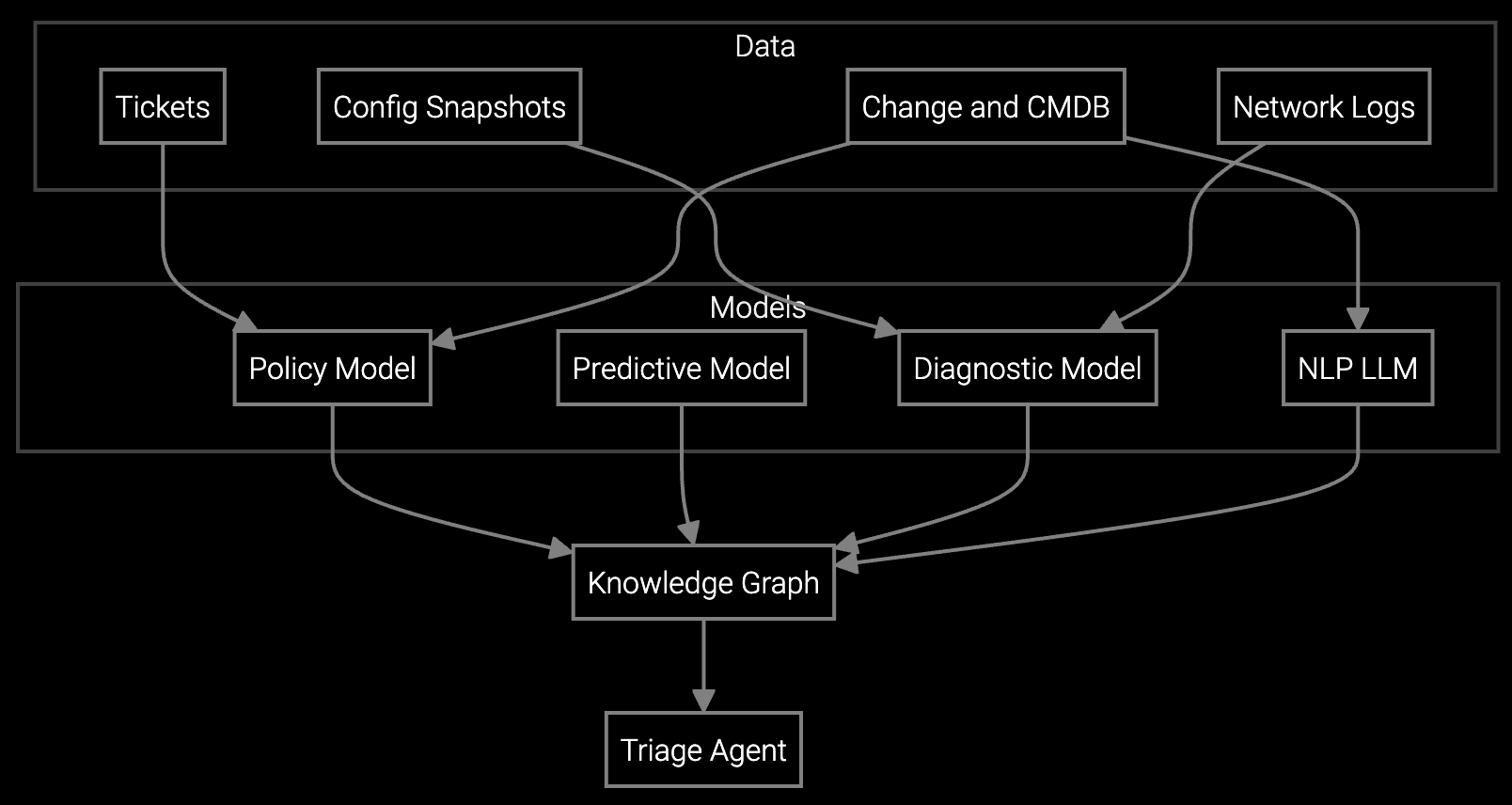
Connected appliances generate terabytes of diagnostic data, but legacy remote tools can't parse IoT telemetry or automate root cause analysis.
A bought remote support model lands top-three cause suggestions on at least 70% of incidents at 85% precision out of the box, per Bruviti deployment data. Builders weighing build vs buy trade a multi-year model-training effort for a system already tuned on appliance service data, then extend it through APIs.
Building diagnostic AI from scratch requires sourcing training data, labeling failure modes, and iterating on model accuracy. Appliance manufacturers without dedicated ML teams face multi-year delays before remote resolution improves.
Proprietary platforms require migrating all telemetry ingestion and remote session workflows into vendor-controlled environments. Data gravity and custom integration costs make switching prohibitively expensive after initial deployment.
Appliance IoT platforms use proprietary protocols for error code transmission. Off-the-shelf diagnostic tools cannot parse manufacturer-specific telemetry formats without extensive custom middleware development.
Bruviti's API-first platform resolves the build-versus-buy tradeoff by separating telemetry ingestion from diagnostic intelligence. Support engineers connect existing IoT data streams via Python SDKs, mapping manufacturer-specific error codes to standardized schemas. Pre-trained models handle common failure modes for refrigerators, HVAC compressors, and washing machine control boards, while custom model endpoints allow fine-tuning on proprietary component data.
The architecture integrates with existing remote access tools rather than replacing them. Session telemetry feeds into real-time root cause analysis without forcing migration to a new remote desktop environment. Support engineers retain their current workflows while gaining AI-assisted diagnostics, eliminating the retraining overhead of closed platform adoption.
Connected appliances transmit error codes, sensor readings, and usage patterns through manufacturer-specific IoT platforms. Refrigerators report compressor temperature anomalies, washing machines stream vibration sensor data, and HVAC systems log refrigerant pressure changes. This telemetry volume overwhelms manual analysis during seasonal demand spikes when air conditioner failures triple support volume.
A phased rollout starts with the highest-volume failure modes. Refrigerator compressor diagnostics and HVAC capacitor failures represent 40% of remote support escalations. Training models on these product lines first demonstrates ROI within one cooling season, then expands to dishwasher control boards and dryer heating elements in subsequent quarters.
API-first platforms expose all diagnostic logic and model endpoints through standard REST or gRPC interfaces. You control data ingestion pipelines, model training workflows, and inference infrastructure. If you choose to migrate, your custom parsers and training data remain portable because they are written in Python or TypeScript rather than proprietary configuration languages.
Pre-built models provide baseline diagnostics for common appliance subsystems. You access model weights and training pipelines via SDK, then fine-tune using your component-specific failure data. Transfer learning accelerates custom model development from 18 months to 8-12 weeks by starting with validated architectures.
Telemetry integration requires mapping your IoT platform's data schema to standardized diagnostic formats. Most appliance manufacturers complete this mapping in 3-4 weeks using Python SDKs. The platform provides schema templates for common protocols like MQTT and CoAP, reducing custom parser development.
Track remote resolution rate for pilot product lines before and after AI-assisted diagnostics deployment. Compare escalation rates and session duration between control groups using legacy tools and test groups with AI assistance. Most appliance manufacturers observe 15-25% escalation reduction within the first quarter of deployment on high-volume failure modes.
Maintenance requires Python or TypeScript developers familiar with REST APIs and basic ML concepts like model retraining. Your team owns telemetry parsers and custom model endpoints, which integrate with existing CI/CD pipelines. No specialized AI expertise is required for day-to-day operations once initial integration completes.
Software stocks lost nearly $1 trillion in value despite strong quarters. AI represents a paradigm shift, not an incremental software improvement.
Function-scoped AI improves local efficiency but workflow-native AI changes cost-to-serve. The P&L impact lives in the workflow itself.
Five key shifts from deploying nearly 100 enterprise AI workflow solutions and the GTM changes required to win in 2026.
See how API-first architecture accelerates deployment without sacrificing flexibility.
Schedule Technical Demo