
No Fault Found returns drain warranty reserves while wasting engineering time on valid parts that passed initial inspection.
AI pattern recognition delivers 50% fewer false alerts than rules-only baselines and detects real failures 65% faster, in under 10 minutes, per Bruviti deployment data. For builders fighting No Fault Found returns, that means fewer parts pulled on phantom faults and warranty claims grounded in actual machine signals, not guesswork.
Manual review of returned pump housings, compressor components, and CNC parts creates multi-week backlogs. Engineers lack standardized criteria for evaluating microscopic wear patterns across equipment deployed 10-30 years ago.
Legacy warranty systems lack APIs for real-time validation. Claims processors manually cross-reference serial numbers against fragmented databases spanning decades of acquisitions and product lines.
No systematic detection of repeat claimants or pattern recognition across facilities. Operators exploit regional warranty policy variations and submit cosmetically damaged parts as functional failures.
Train custom image classification models on your historical NFF determinations. Bruviti's Python SDK lets you fine-tune foundation models using your labeled dataset of SEM/AFM images, visual inspection photos, and failure mode annotations. The platform handles the heavy lifting of data preprocessing, model training, and deployment while you retain full control over training parameters and validation logic.
Build rules-based validation layers using TypeScript APIs that integrate with your existing warranty management system. Query entitlement databases in real-time, cross-reference claim histories by serial number and facility, and flag anomalies based on your custom fraud detection criteria. Deploy models as RESTful endpoints or embed them directly in your RMA workflow without vendor lock-in.
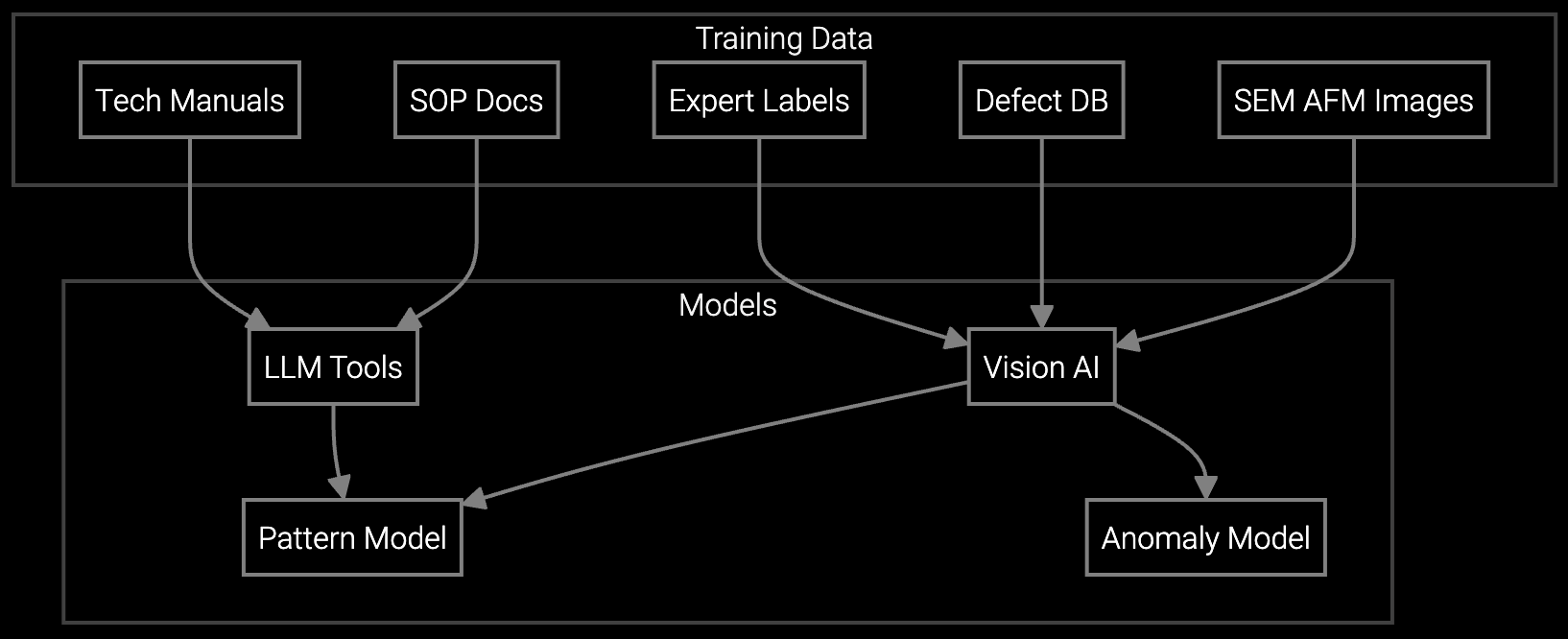
Train AI on microscopic failure modes specific to industrial pump seals, turbine blades, and CNC tooling to automate visual inspection workflows.
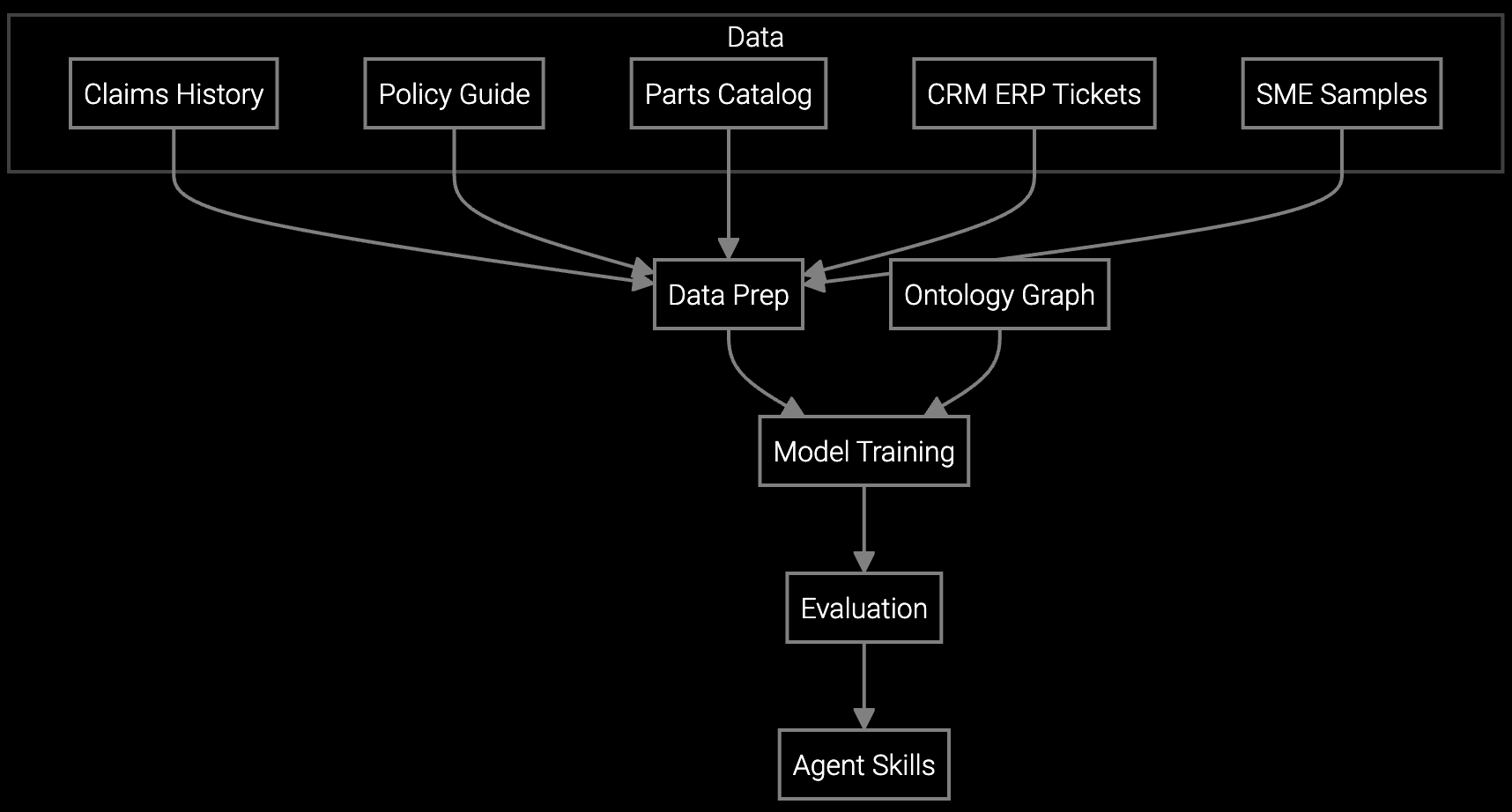
Automatically classify and code claims using custom validation rules that match your entitlement policies and failure mode taxonomies.
Industrial OEMs face unique challenges validating warranty claims for equipment deployed 10-30 years ago. Original design documentation may be incomplete, failure mode libraries span multiple product generations, and entitlement systems evolved through acquisitions. Your AI models must handle this heterogeneity without requiring full database normalization.
Bruviti's headless architecture connects to fragmented warranty systems via API without forcing migration. Train separate models per product family, then ensemble them at inference time. Use your existing serial number schema as the primary key for entitlement lookup, and federate queries across Oracle, SAP, and custom databases simultaneously.
Foundation models require 2,000-5,000 labeled images per failure mode for industrial equipment. If your historical NFF determinations are well-documented with visual inspection photos and engineer notes, you can achieve 85%+ accuracy with transfer learning. Poorly labeled datasets require manual annotation before training.
Yes. The TypeScript validation API lets you define region-specific entitlement rules, claimant history thresholds, and anomaly detection logic. You control the business rules while the platform handles data orchestration and model inference at scale.
Build a human-in-the-loop workflow using confidence score thresholds. Claims below 90% confidence route to engineer review. Log all overrides to retrain models monthly. The Python SDK includes active learning utilities to prioritize labeling of edge cases.
Bruviti's platform supports batch processing via CSV upload, database connectors for Oracle/SQL Server, and webhook-based integration. For truly legacy systems, deploy a lightweight middleware layer that translates SOAP calls to RESTful endpoints without modifying your core warranty application.
Absolutely. All models trained on your data remain your intellectual property. Export models in ONNX or TensorFlow SavedModel format for self-hosting. The platform charges only for training compute and inference API calls, not model ownership or portability.
Software stocks lost nearly $1 trillion in value despite strong quarters. AI represents a paradigm shift, not an incremental software improvement.
Function-scoped AI improves local efficiency but workflow-native AI changes cost-to-serve. The P&L impact lives in the workflow itself.
Five key shifts from deploying nearly 100 enterprise AI workflow solutions and the GTM changes required to win in 2026.
See how Bruviti's Python SDK and validation APIs integrate with your warranty infrastructure in a 30-minute technical demo.
Schedule Technical Demo