
Your 10-30 year equipment lifecycles demand asset visibility that matches service obligations—incomplete data costs margins now.
Bruviti deployment data reports a 30 to 50% reduction in unplanned downtime once installed-base management runs on connected asset data. Implementing AI against a unified equipment registry turns static asset lists into a live reliability layer, so OEMs intervene before failures instead of reacting to them in the field.
Legacy industrial equipment deployed over decades lacks serial numbers, configuration details, or software versions in modern systems. This prevents proactive service, accurate contract attachment, and predictive maintenance scheduling.
Deployed equipment configurations diverge from recorded states through field modifications, firmware updates, and component replacements. Drift creates service errors, incorrect parts shipments, and missed upsell opportunities.
Without automated contract lifecycle tracking, service agreements lapse before renewal conversations begin. Low visibility into installed base health means upsell opportunities go unidentified until customers call with failures.
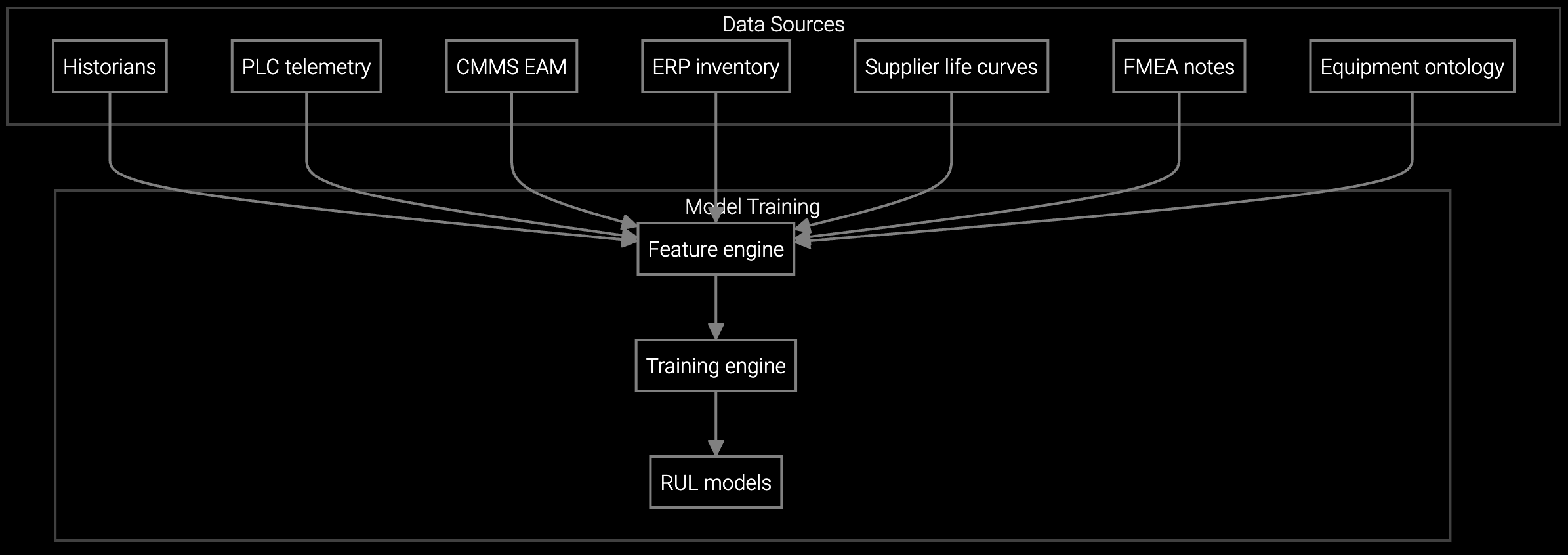
Bruviti's platform ingests telemetry from deployed industrial equipment—PLC logs, SCADA feeds, IoT sensors—to construct real-time digital twins of your installed base. These models track configuration state, software versions, usage patterns, and component health without requiring manual audits or field visits.
The system detects configuration drift automatically by comparing recorded baselines against live telemetry streams. When firmware versions mismatch or components deviate from specifications, the platform alerts service teams and updates asset records. This eliminates the margin erosion caused by incorrect parts shipments and failed service interventions targeting wrong configurations.

Virtual models of CNC machines and industrial robots track real-time performance, enabling proactive maintenance before costly production line failures occur.
Estimates when pumps, compressors, and turbines will fail based on vibration patterns and run hours, enabling planned maintenance windows that protect customer uptime.

Schedules condition-based maintenance for material handling equipment based on actual component wear rather than fixed time intervals, reducing unnecessary service costs.
Industrial manufacturing OEMs support equipment deployed 10-30 years ago across global installations—heavy machinery, CNC tools, industrial robots, and power generation assets with sparse documentation and aging component inventories. Legacy systems lack integration points for modern asset registries, creating visibility gaps that prevent proactive service delivery.
Bruviti connects directly to existing PLC controllers and SCADA infrastructure without requiring equipment retrofits or production downtime. The platform ingests vibration data, temperature readings, run hours, and pressure logs to construct comprehensive asset profiles that update continuously. This approach captures configuration state from deployed equipment without relying on incomplete manual records or costly field audits.
The platform connects to existing PLC controllers, SCADA systems, and IoT sensor networks through standard OPC-UA, MQTT, and REST API protocols. No equipment retrofits or production downtime required—integration typically completes within 2-3 weeks per equipment line.
Asset coverage accuracy reaches 85-90% within 60 days by auto-populating serial numbers and configurations from telemetry streams. The remaining 10-15% of older equipment without telemetry connectivity requires manual data entry or field verification, typically completed within 90 days.
Implementation requires one service operations lead, one IT integration resource for SCADA/PLC connectivity, and access to existing telemetry infrastructure. Total time commitment averages 15-20 hours per week for 8-10 weeks during initial deployment phase.
For equipment lacking PLC or sensor connectivity, the platform accepts manual CSV uploads of serial numbers, install dates, and configurations. These static records integrate with telemetry-rich assets to provide unified installed base visibility across all equipment generations.
Focus on contract attachment rate improvement, asset coverage accuracy, configuration drift detection speed, and reduction in incorrect parts shipments. These metrics directly link installed base visibility to service margin protection and can be measured within first 90 days post-deployment.
Software stocks lost nearly $1 trillion in value despite strong quarters. AI represents a paradigm shift, not an incremental software improvement.
Function-scoped AI improves local efficiency but workflow-native AI changes cost-to-serve. The P&L impact lives in the workflow itself.

Five key shifts from deploying nearly 100 enterprise AI workflow solutions and the GTM changes required to win in 2026.
See how Bruviti's platform turns incomplete installed base data into proactive service revenue opportunities.
Schedule Implementation Review