
When every hour of fab downtime costs $1M+, repeat technician visits aren't just inefficient—they're margin killers.
Bruviti deployment data shows AI scheduling cutting lost production minutes 12-18% and scheduling conflicts 20%. For semiconductor OEMs, that recovered fab uptime is the core ROI of AI-assisted field service, compounding across every tool because production minutes on advanced-node equipment carry the highest cost per hour.
When a technician arrives at a fab without the correct chamber kit or diagnostic insight, the second truck roll doubles your service cost while extending customer downtime into the next shift. Each repeat visit compounds SLA penalty exposure.
Senior technicians who understand chamber recipe interactions and contamination patterns are retiring. Their replacements lack the pattern recognition to diagnose etch tool failures without multiple visits, driving up mean time to repair and eroding customer confidence.
Semiconductor fabs impose steep penalties for unmet response and resolution SLAs. A single delayed first-time fix on critical lithography equipment can trigger warranty claims that exceed quarterly service margins, especially when downtime crosses into high-volume production windows.
The financial impact centers on two cost levers: reducing unnecessary truck rolls through better dispatch decisions, and improving first-time fix rates through predictive parts staging and on-site knowledge augmentation. Bruviti's platform analyzes telemetry from etch chambers, deposition tools, and lithography systems to predict component failures before they trigger emergency service calls, then pre-stages the correct parts based on equipment history and failure signatures.
For technicians already dispatched, the platform acts as a real-time copilot—surfacing tribal knowledge from retired experts, correlating current symptoms with historical failure patterns, and recommending diagnostic sequences that compress resolution time. This dual approach attacks both sides of the cost equation: fewer dispatches overall, and higher success rates on unavoidable site visits.
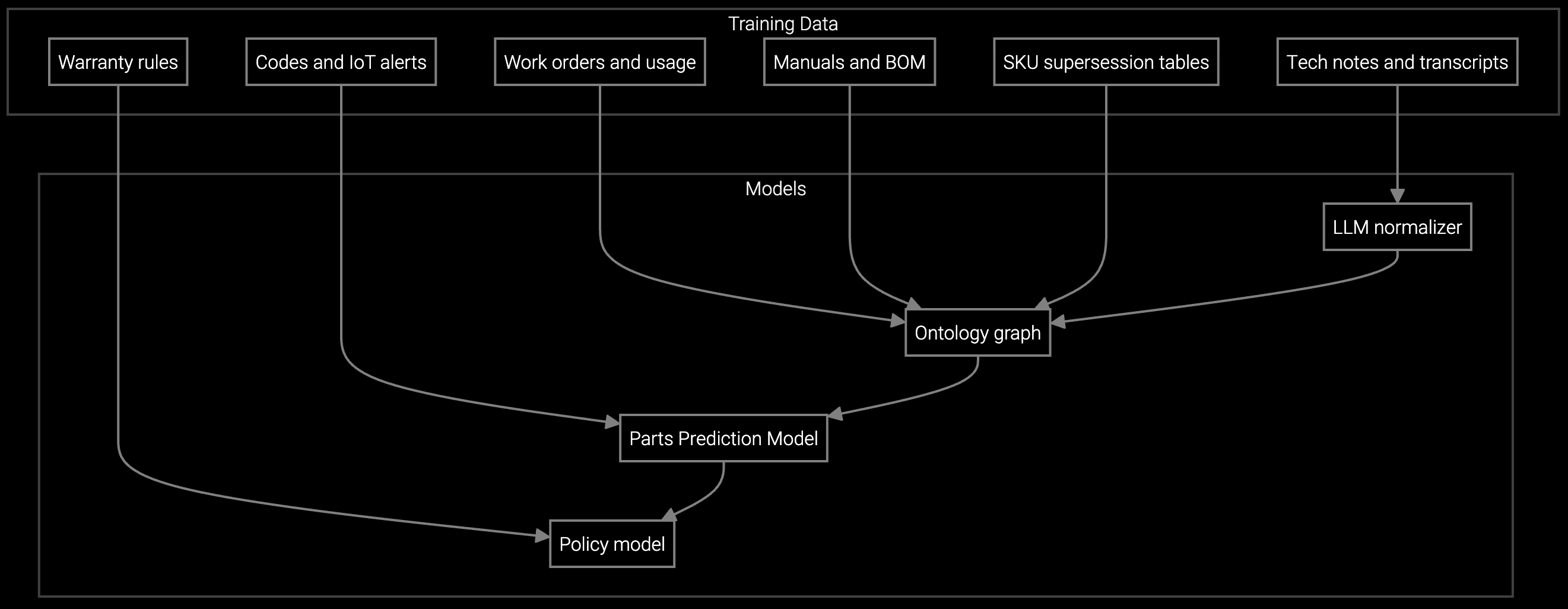
Predict which chamber kits, RF generators, and vacuum components technicians will need before dispatch, eliminating the parts-related repeat visits that double truck roll costs for critical lithography and etch tool repairs.
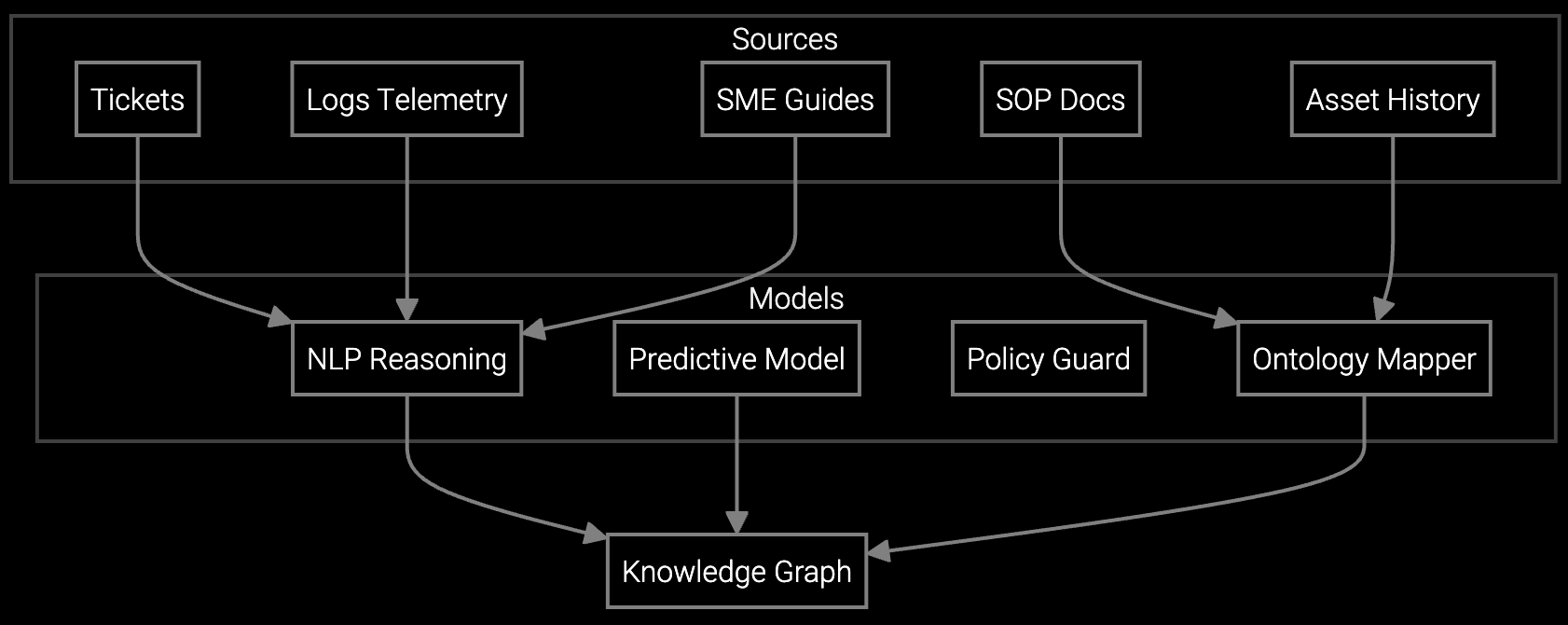
Correlate current tool symptoms with decades of fab maintenance history and tribal knowledge from retired process engineers to identify contamination sources, recipe drift, and component degradation patterns faster than manual diagnostics.
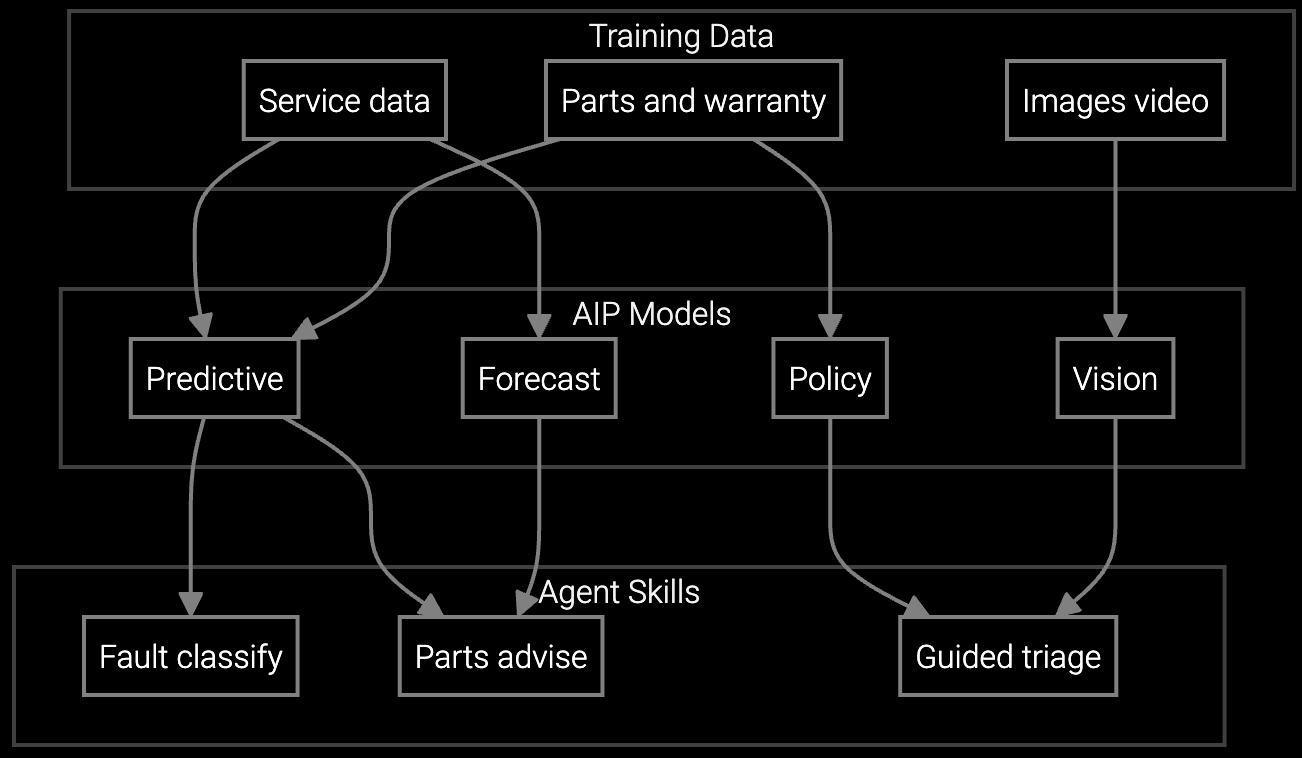
Provide mobile-based real-time guidance during on-site repairs, surfacing step-by-step procedures, safety protocols, and diagnostic recommendations specific to each tool model and failure mode—critical for less experienced technicians working on complex EUV and plasma etch systems.
Semiconductor OEMs face unique field service economics driven by tool complexity and fab downtime costs. A single emergency dispatch to service a halted ASML lithography scanner or Applied Materials etch chamber costs $8,500 in direct labor, parts staging, and travel. When that visit fails to resolve the issue, the repeat truck roll doubles the cost while extending fab downtime—often into the next production shift where penalties multiply.
The ROI model begins with baseline truck roll volume and first-time fix rates. OEMs with 500 installed tools typically execute 6,000 service visits annually. At 72% FTF, that's 1,680 repeat visits costing $14.3M. AI-driven parts prediction and knowledge augmentation push FTF to 93%, cutting repeats to 420 and saving $10.7M—a 75% reduction in repeat visit costs alone. Add 35% fewer unnecessary dispatches from predictive maintenance alerts, and total truck roll savings reach $3-4M annually.
Most semiconductor OEMs observe measurable first-time fix improvement within 60-90 days of deployment, once the platform ingests sufficient tool telemetry and historical service records. Truck roll reduction follows 90-120 days later as predictive maintenance alerts shift service from reactive to proactive. Full financial impact—including SLA penalty avoidance—typically materializes within two quarters as the AI learns equipment-specific failure patterns across your installed base.
Start with your field service management system: total truck rolls per quarter, first-time fix rate by tool type, average cost per service visit, and SLA compliance percentage. Layer in warranty reserve data to quantify penalty exposure. If you track technician utilization and travel time separately, those metrics refine the model. Most OEMs find that 12 months of historical service data provides sufficient baseline to project AI-driven improvements.
The platform analyzes tool telemetry—plasma density fluctuations, chamber pressure variances, RF power drift—to predict which components are degrading. Before dispatch, it pre-stages the correct chamber kit, RF generator, or vacuum pump based on failure signatures. On-site, it guides technicians through diagnostic sequences informed by decades of tribal knowledge, reducing guesswork that leads to incomplete repairs. This combination eliminates the two primary causes of repeat visits: wrong parts and misdiagnosed root cause.
Semiconductor OEMs starting from a 70-75% baseline typically reach 90-95% first-time fix within six months. The improvement magnitude depends on current technician experience levels and parts inventory accuracy. Organizations with significant expertise drain—where 40%+ of field staff have under three years tenure—see the largest gains because AI augmentation compensates for missing tribal knowledge. Well-staffed teams still gain 15-20 percentage points from predictive parts staging alone.
Pull your contract terms for resolution time commitments on critical tool categories—lithography, etch, deposition. Calculate the penalty per hour of SLA breach, then multiply by the number of breaches last year. A semiconductor OEM with 15 SLA violations averaging $150K each faces $2.25M annual exposure. AI-assisted field service typically reduces breaches by 60-70% through faster first-time resolution, translating to $1.35-1.58M in avoided penalties. Include this figure in your board-level ROI presentation as margin protection rather than cost savings.

How AI bridges the knowledge gap as experienced technicians retire.
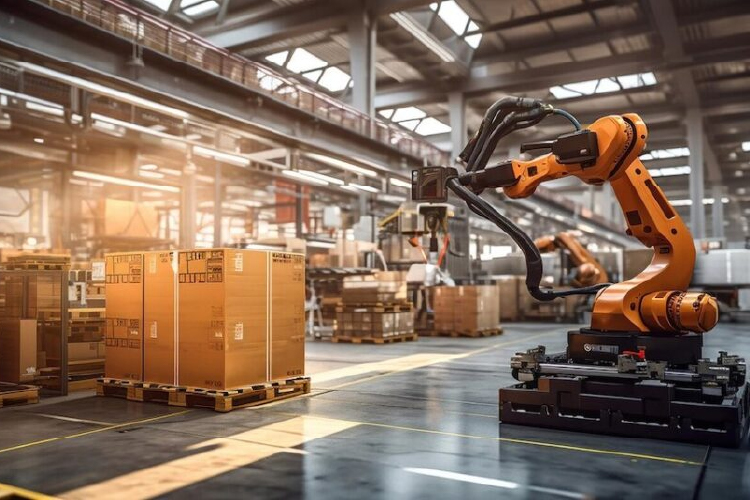
Generative AI solutions for preserving institutional knowledge.

AI-powered parts prediction for higher FTFR.
See how Bruviti's platform delivers board-ready ROI calculations and predictive field service intelligence for semiconductor equipment portfolios.
Schedule Executive Briefing