
Network downtime drives customer churn—choosing the wrong AI architecture locks you into rigid systems that can't adapt to firmware complexity or NOC integration requirements.
Bought AI case-summary tooling delivers 22% lower average handling time on network support, per Bruviti deployment data, without a multi-quarter build. The strategic call is whether your team can match that result faster than buying. For most network OEMs, buying a proven case layer beats building summarization and routing from scratch.
Monolithic CRM systems like Salesforce require migrating case history, knowledge bases, and agent workflows into their walled garden. Your existing SNMP integrations, syslog parsers, and custom telemetry dashboards become stranded assets.
Building from scratch means maintaining Python environments, managing GPU clusters, and retraining models every time firmware versions change or new CVE patterns emerge. Network equipment logs evolve faster than most AI teams can retrain.
When an AI agent misroutes a critical network outage case, you need to see the decision logic. Vendor platforms that hide model internals leave you unable to debug, explain failures to customers, or adjust classification rules.
Bruviti's API-first platform provides foundation models pre-trained on service domain patterns—case classification, log parsing, knowledge retrieval—so builders can focus on network-specific customization instead of infrastructure. Python and TypeScript SDKs let you build custom agents that query telemetry from your existing NOC tools, apply domain logic for firmware-specific error patterns, and route cases to the right team based on SLA rules you control.
The platform exposes REST APIs for every function—case ingestion, knowledge retrieval, model inference—so you integrate with existing ticketing systems without replatforming. Your data stays in your environment. Models run in your VPC or on-premises. When a new router family ships with different log formats, you retrain the classification layer using your historical data, not waiting for a vendor to update their monolithic model.
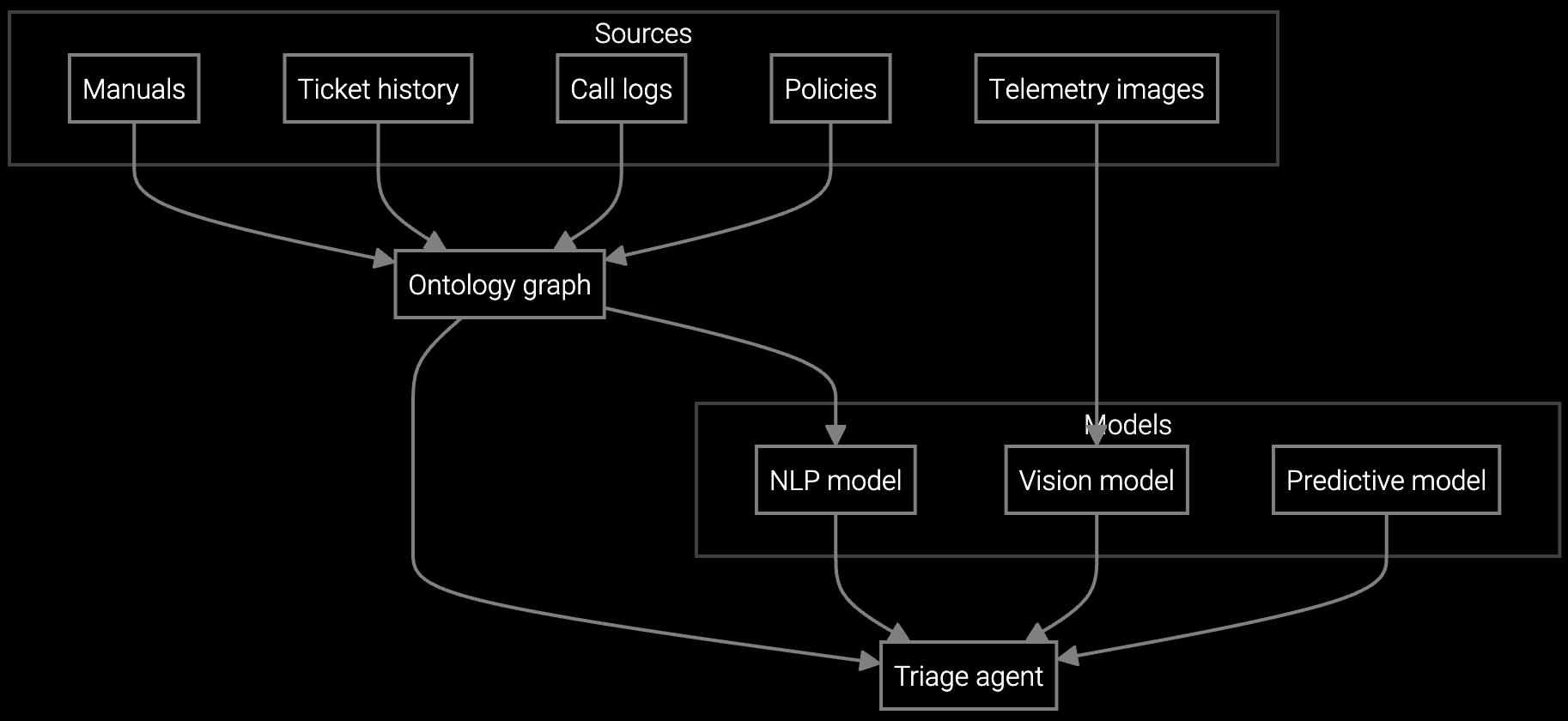
Autonomous agent parses SNMP traps and syslog entries to classify network incidents—differentiating firmware bugs from configuration drift—and routes to hardware, software, or NOC teams with diagnostic context.
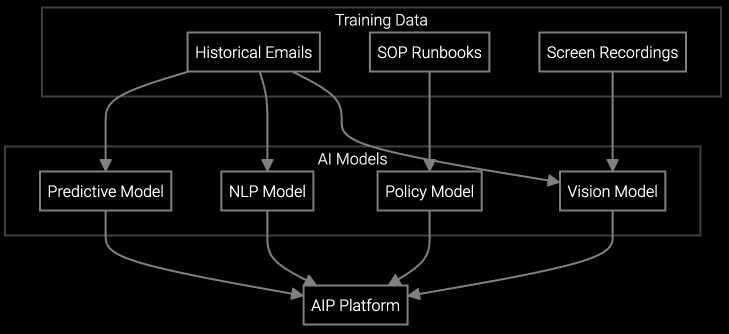
AI reads customer emails describing network downtime, correlates device IDs with telemetry history, and drafts responses with firmware update links or RMA instructions based on failure patterns.
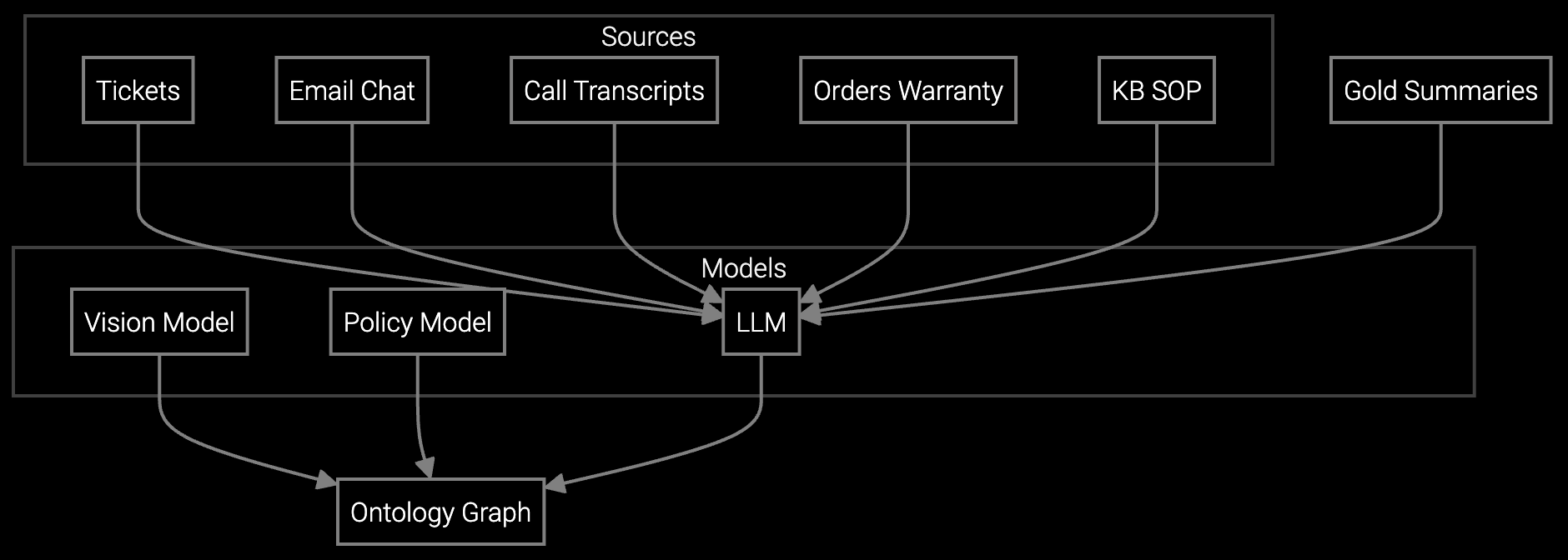
Generates case summaries from multi-channel history—chat logs, email threads, call transcripts—so agents handling escalated router failures see complete context without reading 15 messages.
Network equipment OEMs face unique support complexity: firmware updates change log formats monthly, security CVEs require instant triage, and customers expect 99.999% uptime. Closed platforms can't adapt fast enough when a new router family ships or a zero-day vulnerability hits. Building from scratch means your team spends cycles on infrastructure instead of domain logic.
Hybrid architecture lets you pilot with high-volume, low-risk case types—email triage for routine firmware questions—while keeping critical outage response in human hands. As confidence builds, extend custom agents to parse SNMP traps for specific device families, integrate with your NOC's existing telemetry dashboards, and apply classification rules tuned to your installed base's failure patterns.
API-first means every function—case ingestion, log parsing, knowledge retrieval, model inference—exposes REST endpoints you call from your existing systems. Your agents send SNMP trap data to the platform's classification API, receive structured routing decisions, and write results back to your ticketing system. No replatforming required.
Bruviti provides Python SDKs that let you retrain classification layers using your historical case data. When a new router family ships with different syslog formats, you run a training job on your labeled data, test the updated model in staging, and deploy to production. The foundation model handles language understanding; you tune the domain layer.
Data sovereignty and portability. Your case history, logs, and knowledge bases stay in your environment—Bruviti's platform queries them via APIs you control. Models run in your VPC or on-premises. If you switch vendors, your data and integrations remain intact. No proprietary data lake you can't export.
Typical pilots deploy in 4-8 weeks: two weeks for API integration with your ticketing system, two weeks for model training on historical email data, and 2-4 weeks for agent validation before production rollout. Start with low-risk firmware update queries before expanding to outage cases.
Yes. Bruviti's platform accepts telemetry data via REST APIs or webhook integrations. Your NOC continues using existing SNMP collectors, syslog servers, and dashboards. When an incident occurs, your systems push relevant logs to the AI agent for classification and routing, then receive structured recommendations back.

Understanding and optimizing the issue resolution curve.

Part 1: The transformation of IT support with AI.
Part 2: Implementing AI in IT support.
See how API-first architecture lets your team deploy network-specific support AI in weeks, not years.
Schedule Technical Demo