
Hyperscale operations expose the hidden cost of asset record inaccuracy when configuration drift triggers unplanned downtime.
Bruviti deployment data delivers 7-14 days of early failure warning at 95% or higher precision and 10% or fewer false positives. For data center leaders, connecting installed-base and configuration data turns drift from a silent reliability risk into a problem flagged weeks ahead, protecting uptime across the fleet.
Missing serial numbers, outdated firmware versions, and untracked configuration changes create blind spots across distributed facilities. When emergency replacements require exact component matching, incomplete records delay resolution and extend customer downtime.
Actual server configurations diverge from documented state as firmware updates, memory upgrades, and drive replacements accumulate without centralized tracking. This drift surfaces when predictive maintenance models receive mismatched telemetry, generating false positives that erode trust.
Without proactive visibility into EOL components and contract expiration dates, service opportunities slip through. Customers face unexpected hardware failures instead of receiving upgrade recommendations before critical components reach end-of-support.
Bruviti's platform continuously ingests BMC and IPMI telemetry streams from deployed infrastructure, reconciling real-time hardware state against asset records. The system detects configuration changes as they occur—firmware updates, memory expansions, drive replacements—and automatically updates the asset registry without manual intervention.
Machine learning models identify patterns in asset data completeness, flagging records with missing serial numbers or outdated configurations. The platform prioritizes remediation based on business impact, directing operations teams to high-value assets first. For executives managing margin pressure, this creates a single source of truth that eliminates costly surprises during contract renewals, parts ordering, and predictive maintenance planning.

Analyze BMC telemetry streams to identify thermal anomalies and power supply degradation before server failures impact customer SLAs.
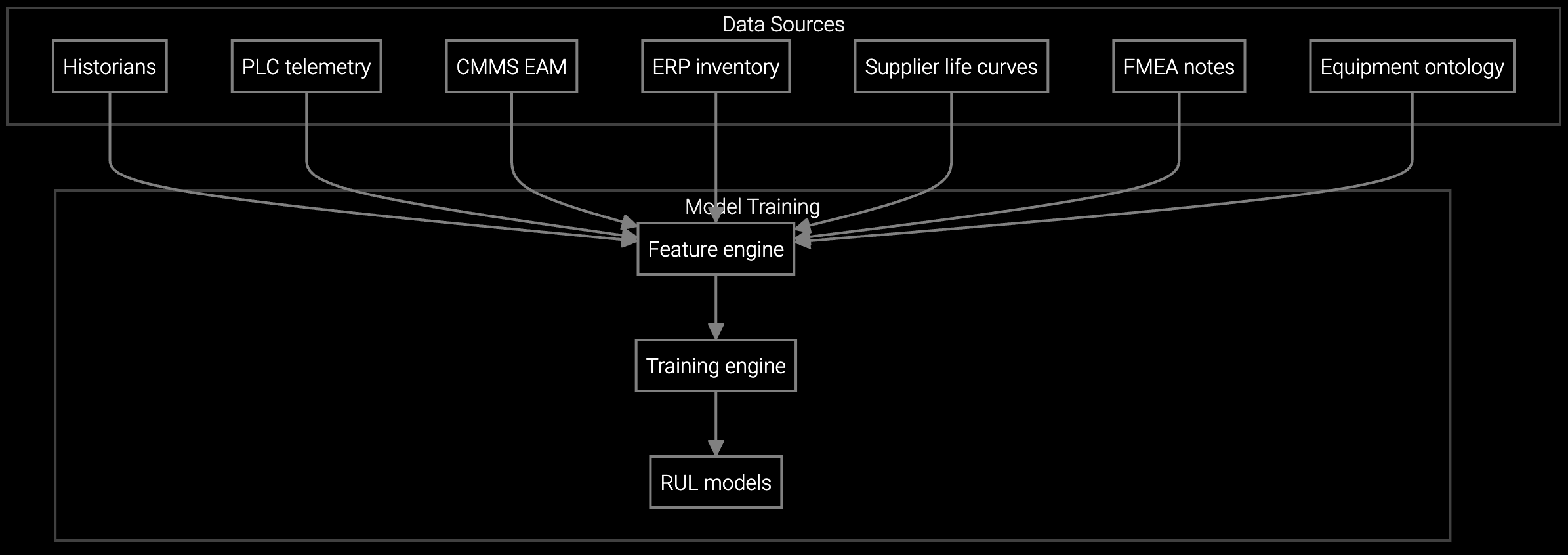
Estimate drive and memory module lifespan based on usage patterns, enabling maintenance windows aligned with customer peak demand cycles.

Schedule proactive component replacements based on actual equipment condition rather than fixed intervals, optimizing parts inventory across facilities.
Data center OEMs face configuration drift at scale when managing hundreds of thousands of servers across geographically distributed facilities. BMC and IPMI telemetry provides real-time visibility into memory configurations, RAID controller firmware versions, and power supply health—but only if asset records accurately reflect deployed hardware.
When configuration drift reaches 42%, predictive maintenance models receive mismatched inputs. A memory upgrade completed six months ago but missing from records generates false thermal alerts. Drive replacements tracked manually in spreadsheets never sync with the central asset registry. The result: operations teams waste time investigating phantom issues while real problems go undetected.
Configuration drift occurs when physical changes—firmware updates, memory expansions, drive replacements—happen without updating the central asset registry. Manual tracking via spreadsheets or ticketing systems fails at scale, especially across distributed facilities. Over time, documented configurations diverge from actual hardware state, creating blind spots for predictive maintenance and parts planning.
AI continuously reconciles BMC and IPMI telemetry against asset records, detecting discrepancies in real-time. When a server's memory configuration changes, the system automatically updates the asset registry without human intervention. Machine learning models identify patterns in incomplete records, prioritizing remediation based on business impact rather than requiring exhaustive manual audits.
Incomplete asset records delay emergency component replacements when exact matching is required, extending customer downtime and triggering SLA penalties. Missing EOL dates cause reactive failures instead of proactive upgrade opportunities, losing predictable service revenue. Configuration drift generates false maintenance alerts that waste engineering time, reducing operational efficiency and increasing service delivery costs.
Organizations typically see asset data accuracy rise to 96% within 90 days of deployment. The platform automatically reconciles existing records against current telemetry in the first 30 days, then maintains accuracy through continuous monitoring. Speed depends on BMC data quality and the percentage of infrastructure with active telemetry connections.
Bruviti ingests BMC, IPMI, and SNMP telemetry from servers, storage systems, and network equipment. The platform connects to existing asset management and ERP systems to reconcile physical hardware state against business records. APIs enable bidirectional sync with ticketing systems, parts inventory databases, and contract management platforms for end-to-end lifecycle visibility.

Software stocks lost nearly $1 trillion in value despite strong quarters. AI represents a paradigm shift, not an incremental software improvement.

Function-scoped AI improves local efficiency but workflow-native AI changes cost-to-serve. The P&L impact lives in the workflow itself.

Five key shifts from deploying nearly 100 enterprise AI workflow solutions and the GTM changes required to win in 2026.
Discover how AI-powered asset intelligence eliminates blind spots and protects service margins at scale.
Schedule Demo