
Thin margins and high contact volumes make implementation choices critical—wrong system selection or phasing can erode ROI before value arrives.
Appliance manufacturers using Bruviti cut call-center volume 35% and raised first-call resolution 16%, per Bruviti deployment data, by deploying AI triage and agent-assist on existing contact-center tooling. The rollout starts with the highest-volume call types, deflecting routine contacts and routing the rest with full context, so service capacity scales without added headcount.
Multiple legacy systems—CRM, warranty, parts inventory, call center platforms—lack standard APIs. Point-to-point integrations multiply cost and delay time to value.
Agents trained on product manuals and tribal knowledge resist AI suggestions that contradict learned patterns. Low adoption rates undermine business case projections.
Pre-implementation baselines for AHT, FCR, and self-service rates are often inaccurate or missing entirely. Without clean before/after metrics, proving ROI becomes contentious.
Bruviti's platform integrates with existing customer service infrastructure through API-first connectors to CRM, warranty, and parts systems. The implementation follows a three-phase approach: pilot with high-volume product lines, expand to full product catalog, then activate agent copilot features. This sequence establishes measurable wins before broader rollout.
The platform ingests historical case data, warranty claims, and product manuals during the pilot phase. AI models learn symptom-to-resolution patterns for refrigerators, HVAC units, or washers—whichever product line generates the highest contact volume. Self-service troubleshooting goes live first, deflecting simple cases while establishing baseline metrics. Phase two adds agent-facing knowledge retrieval and case classification. Phase three deploys autonomous email response and predictive parts recommendations.
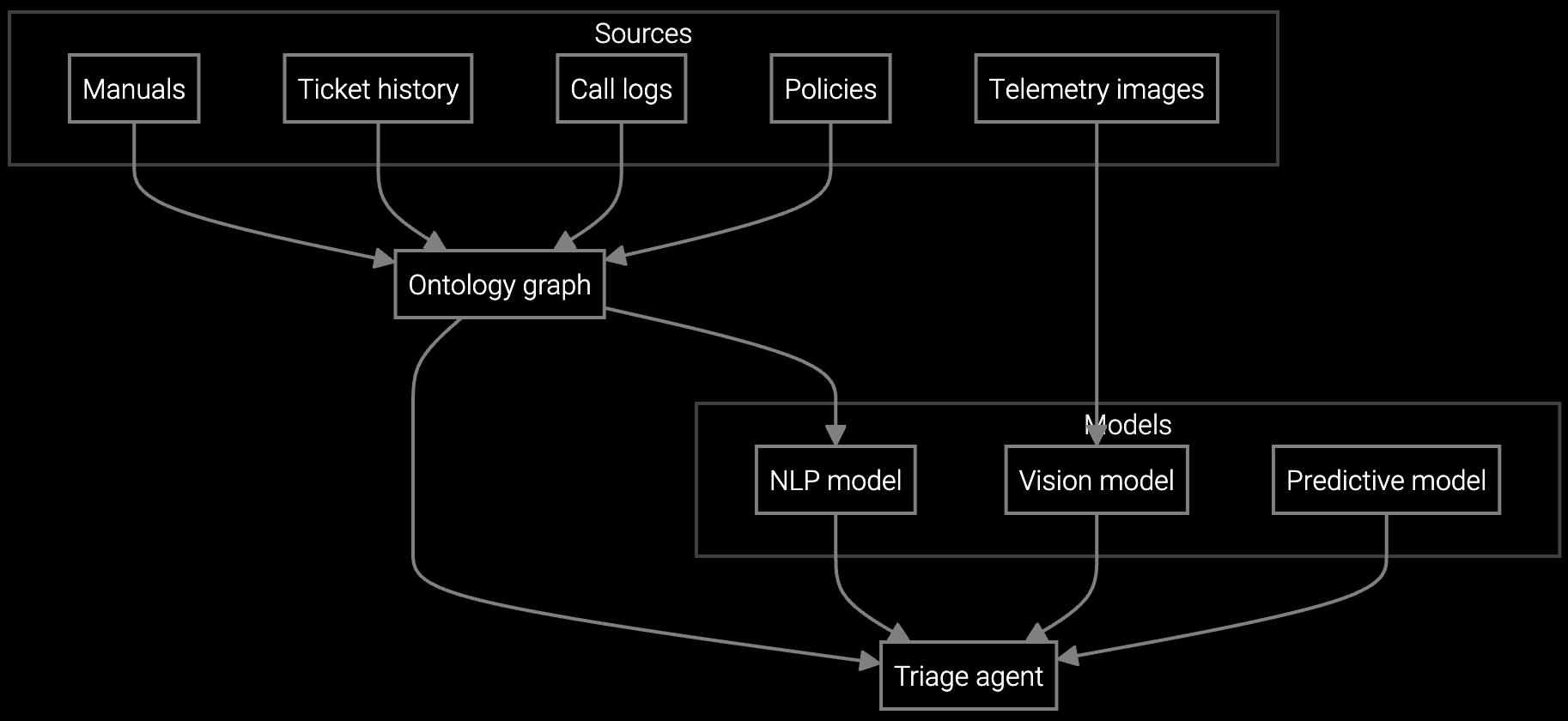
Classifies refrigerator cooling complaints by symptom pattern, correlates with warranty history, and routes to right service tier—eliminating manual case review for 70% of contacts.
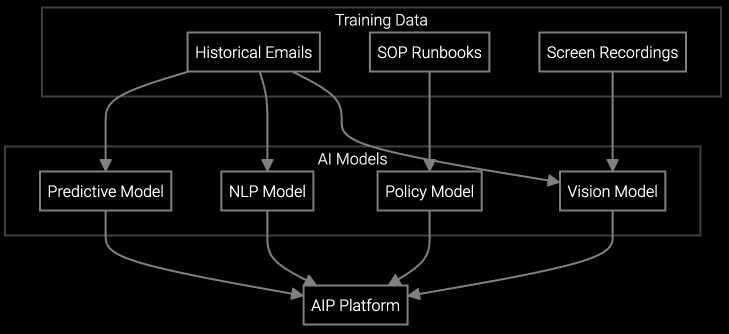
Automatically reads customer emails describing HVAC error codes, cross-references service bulletins and parts inventory, and drafts responses with troubleshooting steps—cutting email backlog by 60%.
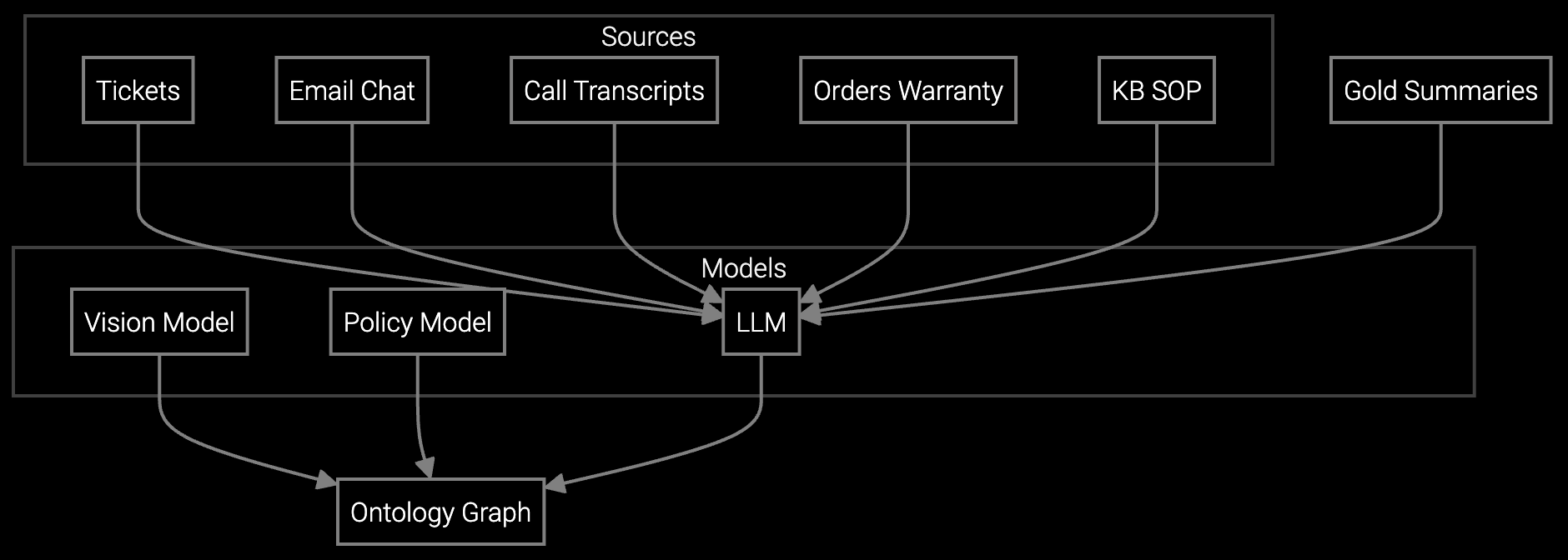
Generates instant summaries from multi-channel contact history—phone transcripts, chat logs, email threads—so agents understand dishwasher repair history without reading 15 prior interactions.
Appliance manufacturers face seasonal demand spikes—HVAC during summer heat waves, refrigeration during holidays—that strain contact centers. Implementation timing matters. Deploy AI triage and self-service tools 90 days before peak season to allow agent training and model tuning under normal call volumes. This prevents learning-under-fire scenarios where agents revert to manual processes when call queues surge.
Connected appliance telemetry—when available—feeds the AI proactive alerts about refrigerator compressor anomalies or HVAC filter clogs. This shifts customer interactions from reactive ("my fridge stopped working") to proactive ("replace this part before failure"). For non-connected products, the platform analyzes symptom descriptions and model-specific failure patterns from warranty claims to guide troubleshooting. Start with top-selling models where historical case volume provides rich training data.
Capture 90 days of pre-implementation data for Average Handle Time by product category, First Contact Resolution rate, self-service completion rate, and cost per contact. These four metrics provide clean ROI measurement post-deployment. Segment by product line (refrigeration, HVAC, laundry) to identify which categories deliver fastest payback.
The platform provides pre-built API connectors for major CRM systems (Salesforce, ServiceNow, Oracle) and warranty platforms. For legacy systems without modern APIs, batch data sync via SFTP or CSV import establishes initial connectivity. Real-time integration follows once pilot phase validates business case. This phased approach avoids upfront custom development while delivering early value.
Phase 1 (pilot deployment for one product line) takes 60-90 days including data integration, model training, and agent onboarding. AHT reduction becomes measurable 30 days after pilot launch. Phase 2 (full product catalog expansion) adds 60 days. Most appliance manufacturers see positive ROI within 120 days of deployment, versus 12-18 months for traditional contact center automation projects.
Involve agents in pilot design—let them identify which knowledge gaps slow them down most. Deploy AI as a copilot assistant, not a replacement. Show real-time AHT improvements for agents using the system versus those who don't. Gamification and peer comparison drive adoption faster than mandates. Agents embrace tools that make them look good on performance dashboards.
Deploy self-service troubleshooting first for high-volume product lines. This establishes deflection metrics without requiring agent behavior change. Once self-service patterns prove accuracy, roll out agent copilot features that leverage the same AI models. This sequence builds trust—agents see the AI handling simple cases correctly before relying on it for complex customer interactions.

Transforming appliance support with AI-powered resolution.

Understanding and optimizing the issue resolution curve.
Software stocks lost nearly $1 trillion in value despite strong quarters. AI represents a paradigm shift, not an incremental software improvement.
See how Bruviti reduces implementation risk with phased rollout and pre-built integrations for appliance manufacturers.
Schedule Implementation Review