
Every repeat visit erodes margin and customer trust—seasonal HVAC spikes and aging product lines make expertise gaps critical now.
Low first-time fix rates climb from 75 to 80% up to 88% when AI predicts the fault and parts before dispatch, per Bruviti deployment data. The root cause of repeat visits is wrong-part diagnosis, so Bruviti scores likely causes against installed-base history and pushes the right picklist to the technician's van.
Technicians arrive without the right parts because symptom descriptions are vague and parts catalogs span decades of models. This forces a second visit, doubling truck roll costs and delaying resolution for homeowners facing disrupted kitchens or HVAC outages.
Senior technicians who know refrigerant leak patterns or motor failure sounds are retiring faster than new hires can learn. Institutional knowledge walks out the door, leaving junior technicians with manuals that don't capture the nuance of real-world failures.
Technicians receive work orders with customer-reported symptoms but no error code history, no prior service records, and no connected device telemetry. They arrive blind and spend billable time on-site gathering information they should have had in the truck.
Bruviti's platform integrates with FSM systems via REST APIs to enrich work orders before dispatch. The platform analyzes customer symptom descriptions, model/serial numbers, warranty history, and connected device telemetry to predict failure modes and required parts. Technicians receive pre-populated mobile screens with historical failure patterns for that appliance model, recommended diagnostic steps, and parts manifest—all before they leave the depot.
For builders, the platform offers Python SDKs and headless architecture. You can train custom failure prediction models using your proprietary service history, integrate with SAP or Oracle ERP for parts availability checks, and deploy the system without ripping out existing FSM tools. The APIs return structured JSON with confidence scores, alternative diagnoses, and repair procedure links—you control how it renders in your mobile app.
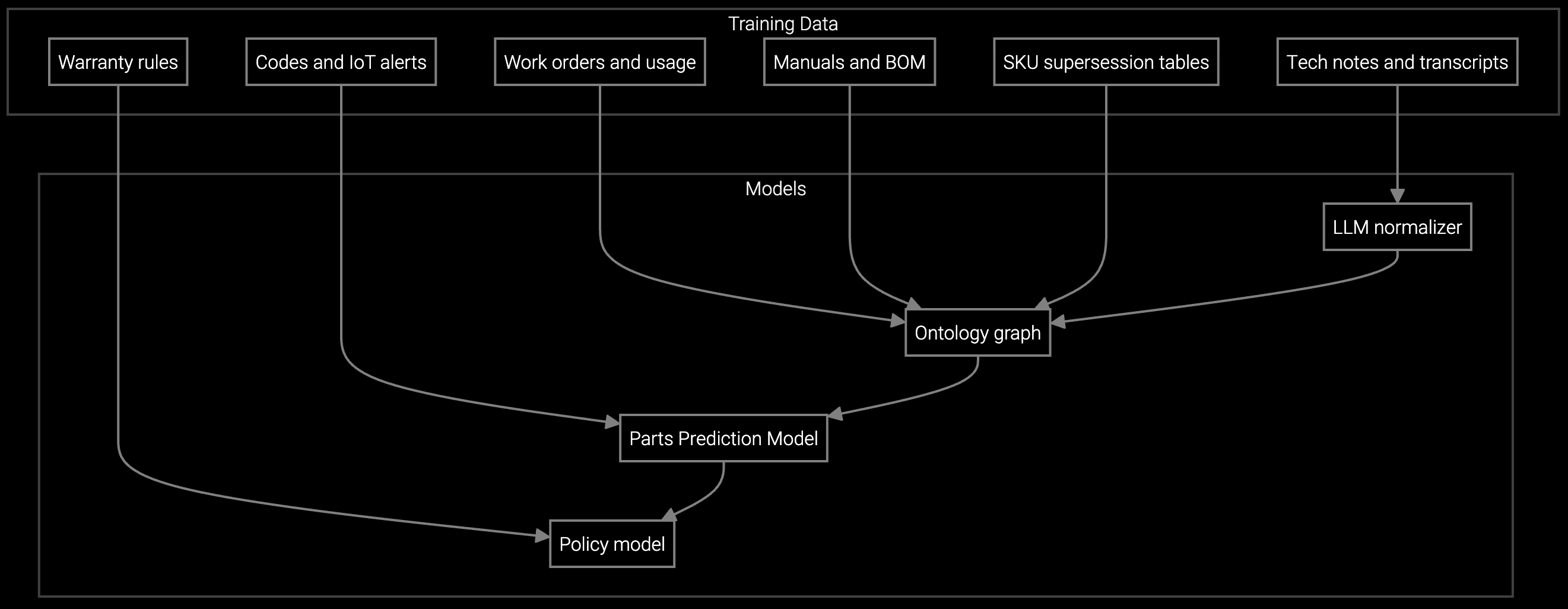
Predict which compressor, valve, or motor parts technicians need before they leave for a refrigerator or HVAC service call, using symptom analysis and failure history.
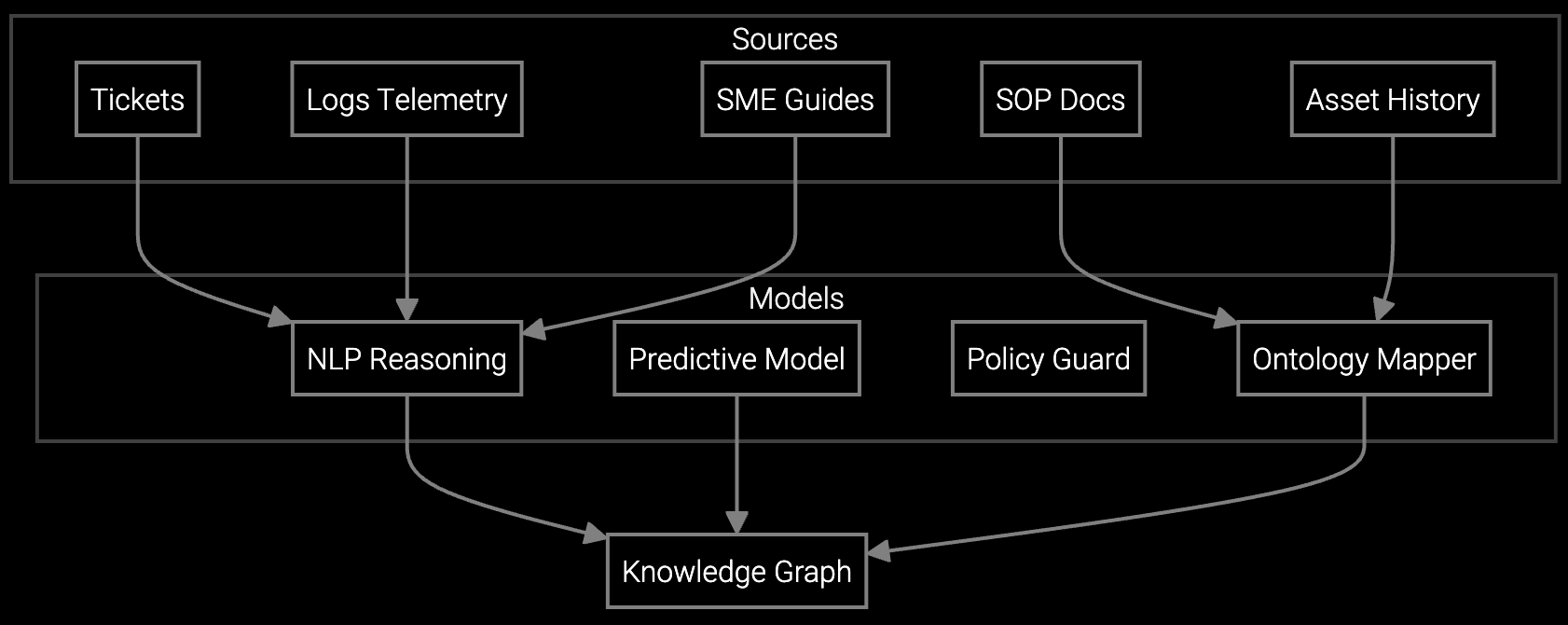
Correlate washing machine vibration symptoms with historical failure patterns to identify worn dampers or unbalanced loads, preserving retiring technician expertise.
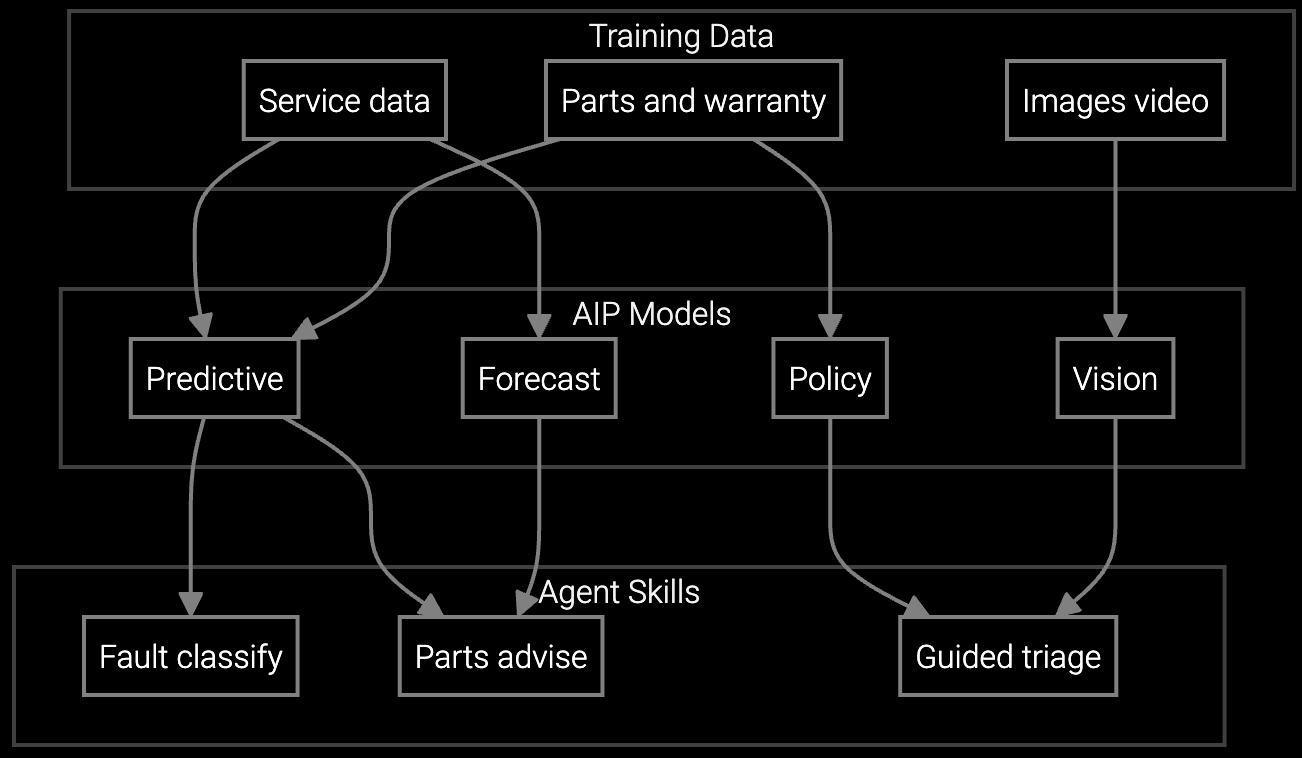
Mobile copilot delivers real-time repair procedures, wiring diagrams, and diagnostic recommendations on-site for dishwasher or ice machine repairs.
Appliance manufacturers face unique service constraints: seasonal HVAC demand spikes, decades-long product lifecycles requiring parts for discontinued models, and rising consumer expectations for same-day repair. Connected appliances add new failure modes—WiFi module faults, firmware bugs—that legacy FSM systems weren't designed to diagnose.
The platform ingests telemetry from IoT-enabled refrigerators, washing machines, and HVAC units to detect pre-failure signatures. For non-connected appliances, it correlates customer symptom descriptions with historical warranty claims and service records to predict the most likely failure mode. This arms technicians with context before they knock on the door, reducing diagnostic time and increasing the odds they brought the right compressor or control board.
The platform analyzes customer symptom descriptions, model/serial numbers, and historical service records to identify failure patterns. It correlates symptoms like "loud grinding noise" or "won't heat" with past repairs on that appliance model, then predicts which parts were most commonly needed. For connected appliances, it also ingests error codes and telemetry data to refine predictions.
Yes. Bruviti provides Python SDKs and API access to train models on your own warranty claim data, service call records, and technician notes. You control the training pipeline and can fine-tune the model with domain-specific knowledge about your product lines. The platform architecture is headless, so you own the deployment and can integrate with existing FSM systems without vendor lock-in.
The platform returns alternative diagnoses ranked by confidence score. Technicians can log the actual failure mode and parts used, which feeds back into the training data for future predictions. Over time, the model learns from edge cases and improves accuracy on rare failures.
Bruviti offers REST APIs that connect to SAP, Oracle, ServiceMax, and custom FSM platforms. You push work order data to the API before dispatch, and it returns enriched diagnostics, parts predictions, and repair procedures as structured JSON. You control how this data renders in your mobile app or technician portal. No need to replace existing tools—the platform augments what you already have.
Most appliance OEMs see 10-15% FTF improvement within 90 days of pilot deployment. The platform learns faster if you have rich historical service data and connected device telemetry. Start with a high-volume product line like HVAC units or refrigerators to accumulate training data quickly and prove ROI on truck roll reduction.
How AI bridges the knowledge gap as experienced technicians retire.
Generative AI solutions for preserving institutional knowledge.

AI-powered parts prediction for higher FTFR.
See how Bruviti's API-driven platform arms your technicians with the diagnostics and parts predictions they need before dispatch.
Schedule a Technical Demo